by James | Aug 24, 2014 | Remembrance
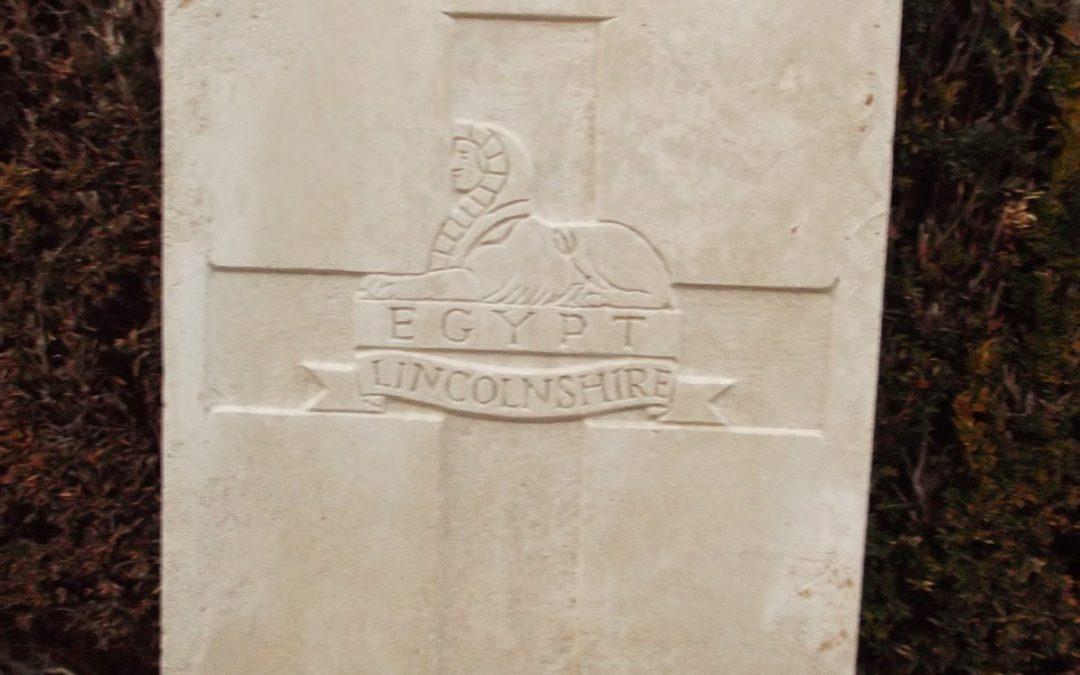
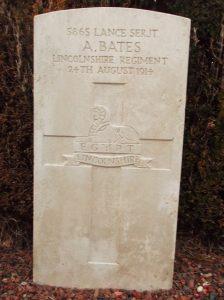
Today we remember Sgt Arthur Bates of the 1st Battalion Lincolnshire regiment. A regular soldier before the Great War, he had seen action in South Africa and more recently in India before returning home and placed in depot reserve at Lincoln.
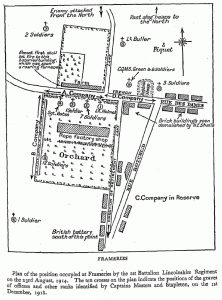
Rejoining his battalion when war was declared on the 4th August, Arthur and the 1st Battalion were mobilised to France and on the 24th August were involved in a rearguard action during the allied retreat.
Sgt Arthur Bates was killed in action whilst a brave few men of the Lincolnshire regiment held an orchard in Fromelles in front of the advancing German Army.
Arthur was the first Morton man to be killed in the Great War and as well as his grave in the communal cemetery in Fromelles, is remembered on both the Morton and Bourne war memorials.
by James | Jun 29, 2014 | Uncategorised
During our researches and whilst trying to create a book for each one of our local soldiers, we came across a bit of a brick wall;
According to the Commonwealth War Graves Commission Richard Christian was in the Durham Light Infantry when he died on the 18th November 1918.
” Private R Christian, 61814, Durham Light Infantry who died on 22 November 1918 Age 34
Son of Elizabeth Christian, of Kirkby Underwood, Lincs and the late Robert Christian; husband of the late Kate Christian”
Richard Christian is buried in Billingborough churchyard, but his date of death and regiment should have meant that he was still in Europe and not yet demobbed.
We tried to find out which battalion of the DLI he was in to see if there were any clues there… no his military records did not survive the blitz. So once again no answers.
Finding out that his wife died on the same date gave us the idea that he was at home when they both died but at the same time and what about baby Kate who was born and died in the same quarter of 1918. That’s unusual until you think of the Spanish Flu which was rife in Britain during this period, maybe that answers the question of why they died at the same time but no proof yet.
Our next clue came from the Kirkby Underwood war memorial;
“In thankfulness to God giver of peace and victory
and to the honoured memory of
Pte Bertie Evlyn Rudkin, Lincolnshire Regt
Pte Ernest Henry Rudkin, Royal Berkshire Regt
Pte John Thomas Wyer, Kings Own Royal Lancashire Regt
Pte Richard Christian, Labour Corps
of this parish who fell in the Great War, 1914-1919″
Now we have a discrepancy CWGC states Durham Light Infantry and the memorial states Labour Corps. A bit of further digging finds that he was transferred to the 409th company of the Labour Corps from the DLI. OK mystery solved but then why has the CWGC got it wrong?
Google came up with the Long Long Trail website which had the following to offer with regards to the Labour Corps;
“Formed in January 1917, the Corps grew to some 389,900 men (more than 10% of the total size of the Army) by the Armistice. Of this total, around 175,000 were working in the United Kingdom and the rest in the theatres of war. The Corps was manned by officers and other ranks who had been medically rated below the “A1″ condition needed for front line service. Many were returned wounded. Labour Corps units were often deployed for work within range of the enemy guns, sometimes for lengthy periods. In April 1917, a number of infantry battalions were transferred to the Corps. The Labour Corps absorbed the 28 ASC Labour Companies between February and June 1917. Labour Corps Area Employment Companies were formed in 1917 for salvage work, absorbing the Divisional Salvage Companies. In the crises of March and April 1918 on the Western Front, Labour Corps units were used as emergency infantry. The Corps always suffered from its treatment as something of a second class organisation: for example, the men who died are commemorated under their original regiment, with Labour Corps being secondary. Researching men of the Corps is made extra difficult by this, as is the fact that few records remain of the daily activities and locations of Corps units.”
So the Labour Corps is hard to trace, well that sound like a challenge for the future.
Another search finds that the 409th Labour Corps was the Kesteven and Lindsay company and was based in Lincoln and run through the Northern Command.
So now we have placed Richard Christian back in Lincolnshire, possibly after an illness or injury had him unfit for front line duty, transferred out of the Durham Light Infantry and assigned a new regimental number, 19310, in the 409th company Labour Corps.
How hard can that be to sort out without any official records?
Death certificates for Richard and Kate plus baby Kate now on order, so we can at least find out what sad outcome befell that young family.
More about Richard’s family can be found on our website
http://www.jamieandsue.co.uk/?page_id=815
by James | Dec 24, 2012 | Uncategorised
Well a three year quest to document the names on the Morton War Memorial is over. By over, we mean that all the soldiers now have their own pages on our web site.
The research that we have done so far gives each soldier, his family history and a potted military history. This information should be enough to allow relatives, the people of Morton, interested parties and my generation in general to understand the conditions, hardships and final sacrifice these men chose to make.
In places some of the research is limited due to lack of current records but this research will be ongoing and we are looking forward to other records, such as those now purchased by the Western Front Association to become available in the future.
The last name to be added to the website is that of James Wright, this is a work that has come full circle for us as James Wright was the first soldier we did basic research on in February 2010. He was also the first of the Morton men to be named in the Remembrance Sunday service at Morton church in November 2010. He also has family ties with our extended family, as with so many of those Morton men that come from the old families from the village.
To view the research please visit www.jamieandsue.co.uk/?page_id=241 to view the men of the Morton War Memorial.
We have been fortunate enough to visit the graves and memorials of all but one of these men and our photographs can be viewed on the following www.flickr.com/photos/suzey68/ to Sue’s Flickr site.
I suppose I had better find something else to be my main focus of Great War research, suggestions on a postcard please. 🙂
Jamie
by James | Dec 24, 2012 | Uncategorised
The following conundrum has been haunting us for many years and even though we had another go at solving this tonight, we are still no closer to a solution.
My family stories have always suggested that my Great Grandmother Martha Lawrance (Nee Mould) had two brothers that fought in The Great War. We always assumed that by fought they also meant died as we have never been able to trace them since this time.
The name Mould has been variously transcribed as Mould, Mold and Moulds a fact that has confused the story somewhat as both Mould and Moulds families (no relation as far as we know) both lived in Peterborough around the early 1900’s. We also have Martha’s Uncle James Mould and wife Ruth living in Peterborough at the same time as her parents John Thomas Mould and wife Martha.
Something that ties in with the story of the soldier brother’s of Martha, is the list of names on the Peterborough War Memorial. The following extract from their website www.pboro-memorial.com shows what is believed to our missing brothers, Jesse and Samuel William amongst other Mould and Moulds:-
|
MOULD, GEORGE WILLIAM,
153, Huntley Grove, 12985, Private, 6th Northamptonshire Regiment.
Killed in action 31.7.18 on the Somme, France. Buried in Heath Cemetery,
Harbonnieres, Grave VIII.B.19. near Bray-sur-Somme. 1914-15 Star.
|
|
MOULD, GEORGE (JESSE),
5, Russell Street, 18147, Private, 2nd Kings Own Scottish Borderers.
Killed in action 3.9.16 at Falfemont Farm, France. Commemorated on
Thiepval Memorial, Panels 4a/4d.
|
|
MOULD, SAMUEL WILLIAM,
5, Russell Street, 31812, Private, 5th London Regiment. Killed in
action 8.11.18. Buried in Cambrai East Military Cemetery, Grave II.B.14.
|
|
MOULDS, HORACE,
26, Duke Street, 12851, Private, 1st Northamptonshire Regiment. Killed
in action 23.7.16 on the Somme, France. Buried in Thiepval Cemetery,
Grave I.J.01.
|
|
MOULDS, JOHN WILLIAM,
26, Duke Street, 321314, Private, Army Service Corps. Died of sickness
4.11.18 in Royal Herbert Hospital, Woolwich. Buried in Peterborough
(Broadway) Cemetery, Grave 7.3.2374.
|
The last documented evidence we have of the brothers is on the 1911 census where they are both listed as prisoners in Lincoln Prison. Samuel William aged 30 a labourer in an Iron Works born in Langtoft and Jesse aged 26 a rope maker born in Helpstone, both single men.
In order to determine if we had the correct people, we had to look to see if there were any other Moulds with the same names. There is only one Samuel William Mould to be found in Peterborough but we have two people named Jesse Mould. The first born about 1882 was the son of James and Ruth Mould and born in Peterborough, the second born 1884 was the son of John Thomas and Martha Mould hence the brother of my Gt Grandmother Martha. John Thomas and James Mould were in fact cousins both being born of two brothers from Helpringham, Lincolnshire whose father originally came from langtoft.
Upon closer inspection the older Jesse Mould can be found on a passenger list heading for Canada, arriving on the 30th April 1906. Jesse’s Uncle Charles Mould was already living in Toronto Canada before this date and we can only assume that this is where Jesse headed for.
A Jesse Mould came back to the UK in 1947 as a first class passenger on the Cunard White Star ship Aquitania with wife Mary and daughter Joan, arriving in Southampton and listing their onward address as 23 Windmill Street Peterborough. We cannot find a return journey but there is also a death record for Jesse Mould in Toronto Canada.
Anyway this just about proves that any Jesse Mould we find in England from 1906 onwards is most likely to be our Jesse, Martha’s brother.
OK, so on with the mystery of the Peterborough War Memorial, lets start with Jesse.
Jesse Mould can be found on an attestation record, enlisting at Litchfield into the North Staffordshire Regiment on 12th August 1914. What is most interesting is that Jesse attested that he had previously served for 3 years and 326/365 in the Northamptonshire Regiment. If we work back the dates then we can see that around September 1911 he must have joined the army for the first time, possibly straight after coming out of prison.
The only thing on the paperwork that does not work out correctly is that the date of birth written in the margin was 2nd July 1886 and indeed on another page his age is shown as 28 years and 41 days. In reality we have found his birth registration in the september quarter 1884 and so something is not right with the listed year.
By 22nd October 1914 Jesse was discharged from the Army and his paperwork is marked with the comment “Not likely to become an efficient soldier”. This would then question why he had previously been a soldier for nearly 4 years and more so why he left the army.
This leaves us with another problem, who is George (Jesse) Mould and why is he on the Peterborough Memorial.
The Peterborough Memorial records gives us the following:-
MOULD, GEORGE (JESSE), 5, Russell Street, 18147, Private, 2nd Kings Own Scottish Borderers. Killed in action 3.9.16 at Falfemont Farm, France. Commemorated on Thiepval Memorial, Panels 4a/4d.
The address of Russell Street ties in with the right area of Peterborough as this is around the corner from Bright Street, a previous home of both the Mould and Lawrance families, but we only have the memorial listing with this address.
There is no Jesse Mould listed on the Commonwealth War Graves Commission registers but we do find George Mould with the right regimental number and regiment to tie in with the Peterborough Memorial information;
MOULD, GEORGE
Initials: G
Nationality: United Kingdom
Rank: Private
Regiment: King’s Own Scottish Borderers
Unit Text: 2nd Bn.
Date of Death: 03/09/1916
Service No: 18147
Casualty Type: Commonwealth War Dead
Grave/Memorial Reference: Pier and Face 4 A and 4 D.
Taken from Commonwealth war graves commission
The above information also ties in with the Medals Roll of the Great War in that;
Medal card of Mould, George
Corps: King’s Own Scottish Borderers
Regiment No: 18147
Rank: Private
The next official record we can look at is the Soldiers Died In The Great War, entry for George Mould;
Name: George Mould
Birth Place: Helpastone, Lincoln
Residence: Pontefract, Yorks
Death Date: 3 Sep 1914
Enlistment Location: Peterbourg, Yorks
Rank: Private
Regiment: King’s Own Scottish Borderers
Battalion: 2nd Battalion.
Number: 18147
Type of Casualty: Killed in action
Theatre of War: Aldershot
As you can see this final record has one or two facts that would indicate that this could be our Jesse but quite a few that don’t work especially the one about the death in 1914 when this should be 1916.
Samuel William Mould does not appear to have any attestation record available via normal sources. It could be that any record was destroyed in the blitz, what is known as the burnt records.
Unfortunately that only leaves us with three source records for Samuel William Mould.
The first record we have seen above is the listing for the Peterborough War memorial that would indicate that Samuel William was living at the same address as Jesse.
The listing would indicate that Samuel William Mould was a Private in the 5th London Regiment and killed in
action 8.11.18.
So if this is taken at face value then Samuel William and George (Jesse) should be brothers. Unfortunately the only listing for a Samuel William Mould on the Commonwealth War Graves Commission web site is as follows:-
MOULD,
SAMUEL WILLIAM; Lance Corporal 318122 08/11/1918 28 London Regiment
(London Rifle Brigade) United Kingdom II. B. 14. CAMBRAI EAST MILITARY
CEMETERY
If we look at extra information from the CWGC then the following statements throws an even darker shadow on the validity of the information from the Peterborough Memorial.
MOULD, SAMUEL WILLIAM
Initials: S W
Nationality: United Kingdom
Rank: Lance Corporal
Regiment: London Regiment (London Rifle Brigade)
Unit Text: 5th Bn.
Age: 28
Date of Death: 08/11/1918
Service No: 318122
Additional information: Son of William H. Mould; husband of Louisa Mould, of 14, Wade St., Poplar, London.
Casualty Type: Commonwealth War Dead
Grave/Memorial Reference: II. B. 14.
Cemetery: CAMBRAI EAST MILITARY CEMETERY
The Medals Roll tells a similar Story with Samuel William Mould of the 5th London regiment, the 21st London Regiment etc., with several regimental numbers ending up with the last entry as 318122.
I thought that Samuel William would have been easier to prove than Jesse and all was going well until the bombshell of a father and wife’s name has appeared on the CWGC site. A quick check tonight on Ancestry.co.uk cannot throw up a Samuel William being born to a William H Mould in London and so this is another line that will need to be investigated in order to prove or disprove the family history of Samuel William Mould of the London Regiment.
Well as you can see, there appears to have been some transcription errors plus some jumping to conclusions over the years and in reality very little in the way of concrete, documented, proof that the Peterborough War Memorial is correct.
I would like to say that in all probability the family story stand and that My two Gt Gt Uncles were both killed in the Great War, but are they really the ones listed on the Peterborough Memorial.
I guess we will probably be discussing this point for many years to come, who knows we may have to wait until the release of the 1921 census to really discover our missing relatives.
Jamie

Recent Comments