
6th Lincs in Lincolnshire Free Press August 1915

DARDANELLES HEAVY TOLL
Eight Bourne Soldiers in Recent Casualty List
PTE. BLOODWORTH THE ONLY ONE TO ESCAPE INJURY
SIX RURAL MEN KILLED OR WOUNDED
LETTERS TELL A TERRIBLE TALE
Several Bourne families have been in a state of great anxiety during the past week or so concerning their relatives who have experienced fierce fighting in the Dardanelles. It is a terrible ordeal, and it would seem that the 6th Lincolns were in the Suvla and the fight for Hill 70. Some of the casualties we have published in a previous issue, but during the past week we have been able to glean further particulars as to how the local men fell, and appended are letters giving vivid descriptions of the furious battle. The intensity of the fighting is evidenced by the casualty lists, and in a few days the following Bourne men were put out of action, viz.:—
Bourne Casualty List
Name, Rank, Regiment, Status
A. A. Kingsford Sergeant Welsh Regiment Killed in Action
P. Cleary Signaller 6th Lincolnshire Regiment Killed in Action
Harry Darner Private 6th Lincolnshire Regiment Wounded
Jack Baldock Private 6th Lincolnshire Regiment Wounded
E. Robinson Private 6th Lincolnshire Regiment Wounded
Vickers Lance-Corporal 6th Lincolnshire Regiment Wounded
Fred Savage Private 6th Lincolnshire Regiment Wounded
Frank Baldock Private 6th Lincolnshire Regiment Wounded
With the exception of Sergt. Kingsford, all the above-named joined Kitchener’s Army at the beginning of the war; they went to Belton Park, to hospital at Alexandria; the Baldocks are brothers (sons of Mr. Baldock, South-street, Bourne), and Pte. Robinson was in hospital, but at the time of writing it was not known where Frank was; and Vickers is also shown to be in hospital. Corporal H. Bloodworth (a son of the Bourne Gasworks manager) was the only Bourne man to escape, and by letters from him the unfortunate news was imparted.
We have also heard during the week of several soldiers belonging to villages near Bourne, having been in the thick of the fight in the Dardanelles, with the following result:—
Rural Villages Casualty List
Tom Hutchins, Private 6th Lincolnshire Regiment, Haconby, Killed in Action
S. Turner, Private 6th Lincolnshire Regiment, Baston, Killed in Action
Walter Archer, Private, 6th Lincolnshire Regiment, Toft, Wounded
C. Walpole,Private 6th Lincolnshire Regiment, Elsthorpe, Wounded
Warner, Driver, Royal Field Artillery (R.F.A.), Witham-on-the-Hill, Wounded
Alf. Chessum, Private 6th Lincolnshire Regiment, Pointon, Wounded
Practically all the above-named belonged to the Lincoln Regt. Before enlistment Pte. Chessum was in the service of Mr. Birch-Reynardson, J.P., of Holywell Hall, and while in training at Belton Park acted as servant to one of the officers. Mr. and Mrs. Chessum, of Pointon, have two other sons in the Army. Pte. Turner, the Baston hero, of only 20 summers, had, it is stated, only been in the firing line about a day.
MEMORIAL SERVICE AT HACONBY
By the death of Pte. Hutchins, Haconby mourns the loss of the first of her sons who have fallen in battle. Hutchins was a chorister in Haconby Church, and a memorial service was held on Sunday afternoon week, impressively conducted by the Vicar (Rev. J. H. Boldero). The service consisted of the Litany and the Burial Service. The beautiful little church—one of the sentinels of the Fens—was filled to its utmost seating capacity, the people assembling to pay tribute to one who had died for them. Mr. J. W. Palmer, the organist, in an able manner played appropriate music, including “O Rest in the Lord.”
A number of Bourne soldiers have recently been drafted to the Dardanelles, including—Pte. W. Hobbs (who has been twice wounded, and seen active service in France), Pte. F. Hinson, and Pte. F. Fisher.
TURKS BAYONET OUR WOUNDED.—HOW SIGNALLER CLEARY DIED.
Corpl. Bloodworth, writing to his parents, says:—
“Just a line to let you know that I am alive and well (dated August 16th), but we have been through it lately. Poor Vic, Jack and Signaller (or Bluey) Jack was bayonetted at the point of the bayonet, after advancing under a hail of lead for 3/4 miles. We lost over 250 men, but they was not as bad as when we attacked a hill previously. Our Bourne boys were in the firing line at the time, and it was terrible. How I escaped, god knows, but I did, only getting a bullet through my haversack. Cleary got killed, the Turks bayonetted him after he was wounded—the swines! Jack Baldock, Frank Baldock, Fred Savage, and Harry Darner were all wounded, but I have heard nothing at all of Robinson. Our battalion was awfully smashed up. All my section but one are gone.”
Wounded Burnt in a Wood
The letter proceeded:— “To make matters worse the whole village took fire, and burnt a lot of our wounded, despite the fact that we did all we could to rescue them. We also lost our good old Captain Brown, also one young lieutenant, nearly all our seargents, and there was only myself, three corporals, and three men left in our Company, so you can guess what sort of hell on earth we were in. Every man acted like a hero, or is killed or wounded, so I think I must have been born under a lucky star. The poor old Lincolns suffered much, but they fought bravely and well.”
Killed a Turk
“I saw a Turk running over a field, but I had something that stopped him, catching him the first shot. I don’t want you to worry about me, as I feel sure that we shall come back a bit like that again, and I feel sure that my luck is in. Just now we are at a little place by the cliffs of the sea, and quite safe from the bullets, so I am enjoying it watching our Navy bombarding the Turks’ positions. I wish they would send some more Lincolns here, but the Navy doesn’t do amiss.”
Corpl. Bloodworth concludes that he has to go the next day.
Writing on August 20th, Corpl. Bloodworth says:—
“I am still in the land of the living, and am A1. We are in the trenches again, but not in the firing line. It is quite all right and safe, but for a few shells, but we do get time short, and is all there when used to it. I do not know anything more about our wounded boys. I get a bit of training, and is very nice. I think we have got another stripe now, so am a full corporal, and am graduated, but not officially. The Turks have just shown the white flag. I don’t know what they are after, so they have done this sort of thing before.”
A Bourne Soldier Recommended for the D.C.M.
The last letter received from Corpl. Bloodworth was dated August 20th, and contained the following notes of interest:—
“I am still A1, and now writing in the trenches. We are having some busy days in the reserve. We got it pretty hot while we were in the firing line from snipers. If we give them half a chance, it means instant death. They always aim for the head, and they are dead shots. When we were in support, we were out at night trench digging, very often under fire, but we came through all right. I have had a few close shaves from shrapnel and snipers, but they haven’t got me yet, and I shall take care they don’t if I can help it. The boys from Bourne are all out here, and are quite well. I expect you will hear from some of them before long. The weather out here is very hot, and when we are marching to and from the trenches, it makes the sweat run, not half. I expect things at Bourne are a bit quiet now, most of the young men have enlisted. But wait while we come home! Tell the people in Bourne to ‘keep the pot boiling’ and keep smiling.”
The above-named soldier has since been wounded, also the Bourne “boys” out there, as recorded above.
Blog Update

16th January 1919

blog post added – Alfred Dimbleby, Baston,  Army Service Corps


3rd January 1918

blog post added – Joseph Stennet, Horbling, Royal Navy

Remembrance – Gunner Robert William Day

Today we remember Robert William Day of Thurlby who died of wounds on the 11th May 1918 whilst serving with the 149th Brigade Royal Field Artillery.

Robert was born late in 1884 in Bainton Lincolnshire to Robert William Day, a Farm Labourer born in Godmanchester and his wife Elizabeth Holiday born in 1861 in Thurlby near Bourne.

The couple were married in 1882 in the Peterborough District and only had the one child, Robert.
In 1891 the Couple were living in Uffington, Lincolnshire where Robert was working as a miller’s labourer.
We next find Robert with his parents on the 1901 census in Battersea, London. Father Robert is working as a general labourer and young Robert is now 15 and working as a Warehouse Porter.
Another 10 years on and Robert Snr and Elizabeth are living in her home village of Thurlby, Robert working as a Farm labourer. Robert Jnr is no longer at home.

Robert William Day Jnr., in the meantime is found getting Married in Newcastle upon Tyne in 1909. He married Elizabeth Mary Rochester in the summer and their Daughter Elizabeth Ann Rochester Day was born on 23rd November 1909.
The 1911 census is very interesting as we can find Elizabeth Day in Belford, Northumberland, working as a general domestic servant. She has entered herself on the census as single with no children and we know at the same time Daughter Elizabeth Ann is living with her Grandparents John and Elizabeth Rochester.
Robert Day cannot be found on any 1911 census return and we suspect has most likely joined the Army.

Robert first served abroad in September 1914, usually this means that he was either already serving at the outbreak of war or on Army reserve and immediately re-joined.

Unfortunately no records appear to still exist and like 60% of all WW1 full service records, probably destroyed in a warehouse fire in the Blitz. All we can say is that he initially served with the 12th Brigade RFA, possibly his old Brigade and first war posting. He also know that he was serving with the 149th Brigade when he was wounded in the field and later died of wounds.

The 12th Brigade formed part of Britain’s pre war regular army and comprised the 43rd, 86th and 87th Howitzer Batteries.

On august 5th the Brigade was mobilised and moved to Queenstown (Cork, Ireland). They embarked on the Cymric on the 15th August and proceeded to Liverpool. The 6th Division concentrated around Cambridge between the 19th and the 31st August. On the 7th September the 12th Brigade proceeded to Southampton and on the 8th embarked on ship with the rest of the division.

After arriving in St Nazaire on the 10th they disembarked and stayed in camp there until the 12th.
Over the next week they were moved around by train and eventually on the 16th arrived at Serches (S.E. of Soissons). Coming under orders of the 5th division , after dark they came into action near Le Pavillon Farm. The 43rd and 86th Batteries set up north of the farm and 87th in the rear of Les Carrierres. The guns were entrenched in the night.
On the 17th September they were ordered to shell Chivres village (N.E of Soissons) and the vicinity, setting the village on fire. On the 19th they registered the enemy’s trenches near Y of Vregny. At the time it would look they were using the names on the maps to pinpoint their position. The Brigade diary notes that this registering of trenches was done with the help of Aircraft.
The actions above would have been Robert’s first actions of the war.

After the 18th May 1915, the 86th Battery was transferred and a year later on the 12th May 1916 the Brigade was broken up.

The 149th was a new army Brigade and joined the 30th Division on the 13th August 1915 at Grantham. This was made up of 4 batteries and over time these Batteries moved around and so it is impossible with the information we have about Robert to even try and work out when and where he joined the 149th. If there is anyone who has researched batteries that could have moved from the 12th to the 149th please do get in touch.

We can say for certain that he was with the 149th when he was wounded and so we look to the Brigade Diary around that time to tell Robert’s story. By now a Brigade was made up of 4 batteries A,B,C,D. and at the end of April the 149th had been in the Ypres Salient.

28th April 1918- H21.b.2.3
Quieter day – enemy shelled A battery position, causing a few casualties, during the night 28/29 a prisoner captured near Voormezeele warned us that the Bosch intended to make further attack on Ypres on the following day – every precaution was taken but no attack developed.
Orders received to take over the line from 51st Brigade RFA on the night – but these were afterwards cancelled.

29th April 1918
Enemy further attempted to force positions on our right but were unsuccessful. A concentration of the enemy round Voormezeele was spotted by 1 F.O.O. and completely dispersed by our guns. Harassing fire carried out during the night.

30th Aril 1918
Quiet day – very little shelling by the enemy he was reported to be moving up his guns. Two or three very successful shots on enemy movement under direct observation were carried out. To trench mortar batteries were effectively silenced by our howitzer battery.

May 1918
In action south of Ypres Cover in front from south of the Zillebeke lake to Lock 8 on Canal.

5th may 1918
Moved to cover Ridge Wood to the Voormezeele front, changing positions with 245 brigade RFA (49 DA).

8th May 1918
French operation in neighbourhood of Locre 4am. Bangs put down to assist.
Enemy attack, bombardment beginning 3 am gas shell and all calibres. Battery positions heavily gas shelled 3 am to 2 pm afternoon. Enemy advance on La Clytte to Voormezeele front but situation ?? Late.
Brigade relieved by 156 Brigade RFA after delay through attack.
Marched to Staple area same evening (20 mile)

9th May 1918
In action again relieving 64th Brigade RFA on front Meteren and W adjoining French

10th May 1918
All Quiet

11th May 1918
Batteries shelled in the morning. Some casualties.

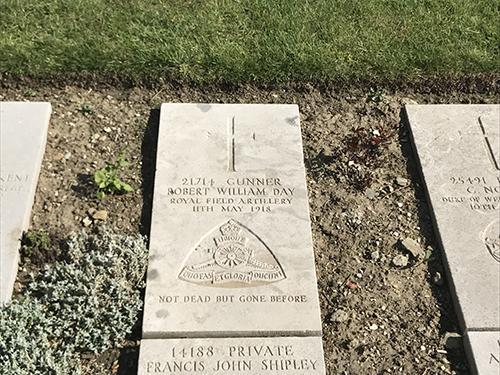
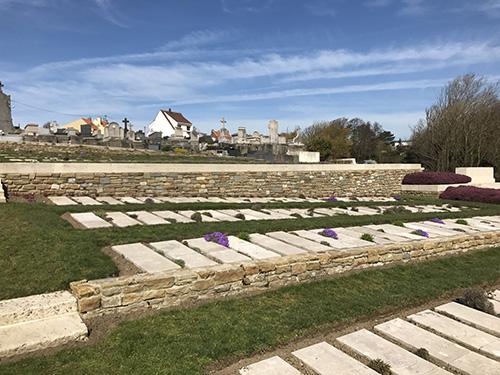
It was on the 11th May 1918 that Gunner Robert William Day died of wounds. He is buried in Boulogne Eastern Cemetery. At the time Boulogne would have been one of the ports used to evacuate the badly wounded back to England.
Normally after getting injured a man would be cleared through a casualty clearing station or field hospital and placed on an ambulance train taking them back to hospitals away from the line, such as Boulogne, Etaples, Le treport. Here they would continue to be treated until they could be evacuated back to England and further hospitalisation and hopefully convalescence.
The train would take several hours maybe even half a day and so it is unlikely that Robert was one of the casualties of the shelling on the 11th, but more likely was one of the casualties 8th from the bombardment and gas shelling, those wounds being fatal and then passing away at hospital or I transit through the Boulogne hospital system.

Commonwealth War Graves Commission:
In memory of Gunner Robert William Day, 21714, 149th Bde., Royal Field Artillery who died on 11 May 1918 Age 32. Son of Robert William and Elizabeth Day, of Thurlby, Bourne, Lincs.
Remembered with honour, Boulogne Eastern Cemetery.

Robert is also remembered on the Roll of Honour in St Firmin’s Church, Thurlby.

Robert’s effects were left jointly to his Mother and Father, Elizabeth and Robert W Day. This was the same with the War Gratuity. The Gratuity paid was £22/-/- which confirms that Robert most likely re-joined the Army on the outbreak of war but does not allow us to calculate an exact date.

Unusually his wife Elizabeth did not receive anything although she was the recipient of his pension. Robert’s pension card is very interesting as it tells us that Elizabeth Mary Day, his wife, was serving with the Queen Mary’s Army Auxiliary Corps, W.A.A.C., initially at the MTC Depot Army Service Corps in Plumstead, then 36 Camp, Ripon.
From other records we can see that she also served in Gateshead and finally at the Officers Command Depot in Scarborough, each time as a waitress. She served between September 1917 eventually leaving on compassionate grounds on 22nd November 1918.
On none of her records is Robert mentioned, although he would be away serving when the WAAC started and she can only be found on his pension records.
What the relationship was between Robert and Elizabeth was we will probably never know. On the day that he died she was in hospital and then spent the next 12 days on sick leave. The reason for the compassionate leave in November is also unknown.

The Commonwealth War Graves report into headstones for Boulogne Eastern Cemetery shows that his father, R.W.Day Esq., Thurlby, Lincolnshire, had the extra inscription added on the engraving of the stone, “Not dead but gone before”.

We will remember them.

The find about Robert’s wife is a piece of research carried out today and goes to prove that it dos not matter how much time you spend researching someone, something new will eventually come along and so our men’s stories will never be completely told.

https://www.southlincolnshirewarmemorials.org.uk/…/robert-…/