by James | Jan 2, 2015 | Biography
http://www.jamieandsue.co.uk/?page_id=268
Birth
The birth of Arthur Ashton was registered in the March Quarter in Bourne 1896. Research into his army records shows his age as 19 years and 7 months on the 4th September 1914 indicating a birth in either January or early February 1895. Here we have a discrepancy of one year but as the Birth Registration should take place within three months then we have to assume that he was born in 1896.
Family History
Arthur Ashton was born in Dunsby, Lincolnshire, England to Cornelius Ashton, a cattleman on a farm and his wife Alice Boyfield. Cornelius was born in Morton and after his marriage to Alice Boyfield in 1891 lived there before moving to Dunsby.
The children of Cornelius and Alice were:-
Hilda b c1894, Cornelius b c1895, Arthur b 1896, Frederick Victor (aka Victor) b c1897, Evelyn Mary (aka Eva) b c1899 and Alice b 1901.
Cornelius Ashton died in 1901 and it is thought that his wife Alice died in 1905.
In 1911 Arthur is listed on the census for Morton as living with his Uncle Arthur Ashton, Aunt Kate and their children Bernard and Myra.
In September 1914 Arthur had listed his address as “Care Of Mrs Pace, Belper, Derbyshire”.
In May 1919 the army wrote to an Arthur and Kate Ashton of Tower House Morton, Bourne to ascertain kinship of the close relatives of Arthur. This Arthur was an Uncle who filled out a form which shows none for the father and mother and lists Arthur’s brothers and sisters as listed above. Alice Ashton was living with her Aunt and Uncle in May 1919.
Cornelius, Arthur’s Brother also served in the Great War with the 7th Durham.
Arthur’s Cousin John Thomas Ashton is also remembered on the Morton Memorial having been killed in action in April 1917
Military History
In August 1914 the 1/5th Battalion Sherwood Foresters were formed in Derby as part of Notts. & Derby Brigade and in the North Midland Division.
The Commonwealth war Graves Commission has some basic information and shows the enlistment location for Arthur Ashton as Morton. I am not sure if this is correct as his attestation records list an address in Derbyshire which would be consistent with his enlistment into the Nottinghamshire and Derbyshire Regiment, The Sherwood foresters.
On the 4th September 1914 Arthur enlisted for the Territorial Force at Derby at the age of 19 years and 7 months. This was only six weeks after war had been declared and his attestation papers show that he had no previous military service.
Arthur passed his medical examination and was described as “fit” his description shows that he was 5 feet 9 ½ inches and had a chest of 36 inches. At this point he was assigned to the 5th battalion Notts and Derby Regiment.
Upon mobilisation the 5th Battalion was moved to Harpenden and in November 1914 went on to Braintree for training.
By February 1915 the battalion was ready for action and moved to Southampton to be shipped to France, where they landed at Harve on the 25th February. The Battalion was part of the first complete territorial force to link up with the British Expeditionary Force.
On the12th of May 1915 the formation of the 5th, 6th, 7th and 8th Battalions became known as the 139th(forester) Brigade in the 46th (North Midland) Division.
On the 15th August 1915 Arthur Ashton was wounded in his right thigh and records show he was admitted at Abeele.
The place mentioned in the report, Abeele, is a small village bisected by the border between France and Belgium. This was the site of a WW1 military airfield and we can only assume that this would be a location of Billets and possibly a military hospital. There is another entry on Arthur’s military records showing that on the 4th September 1915 he was mentioned in a report from a different source but again this mentions that he was admitted at Abeele on the 16th August 1915.
By 22nd October 1915 Arthur was passed as fit for service and was sent back to duty in the field.
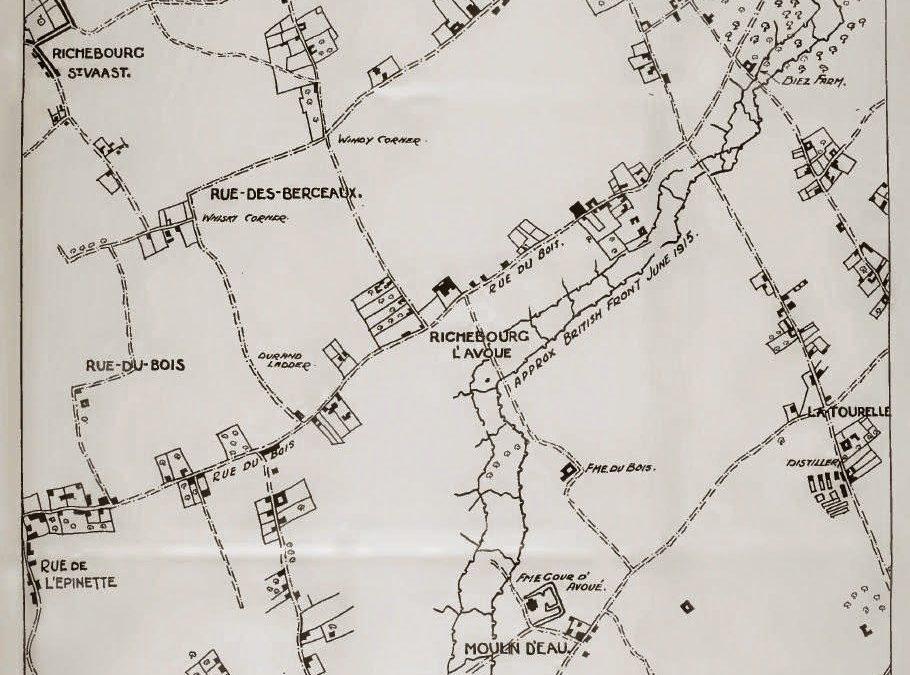
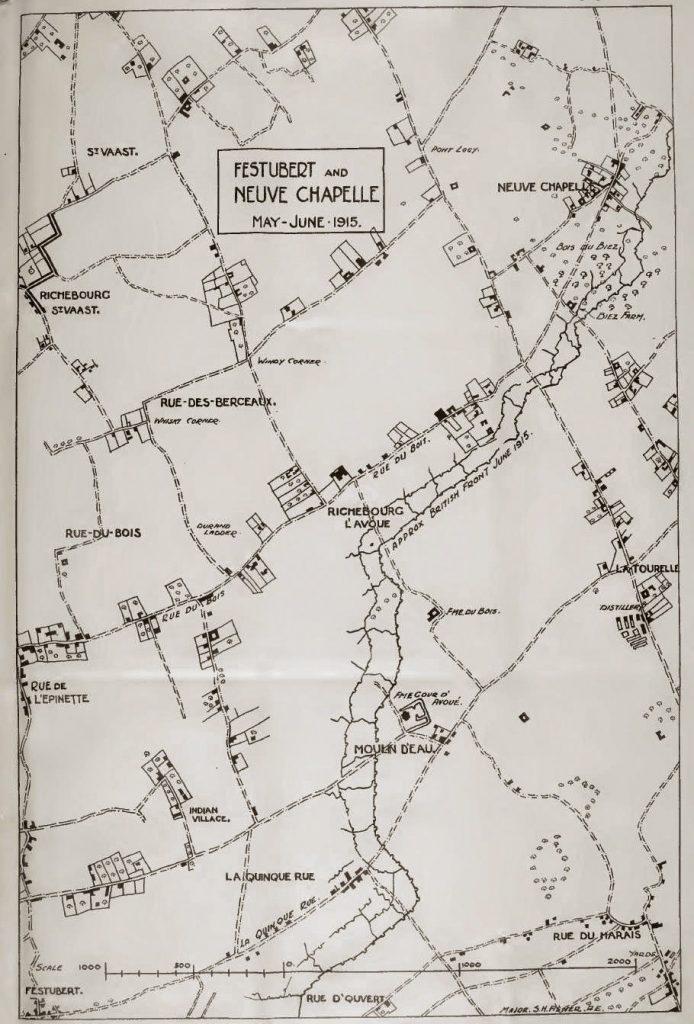
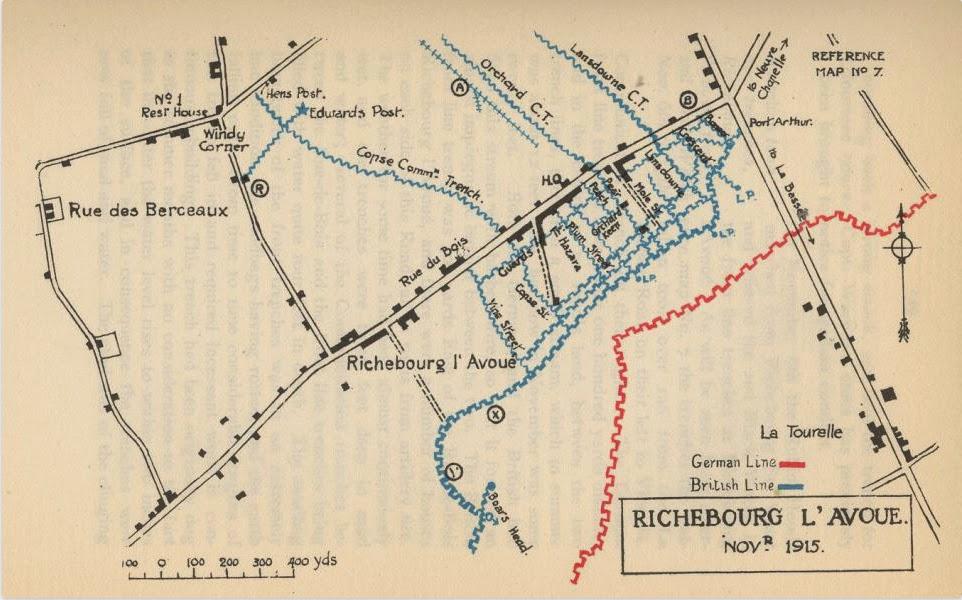
The maps above show the movements of the Sherwood Foresters during the tour of the front line when Arthur Ashton died. On the 6th November 1915, the 5th Battalion Sherwood Foresters started a tour and took to the trenches on the right sub-sector of the front line, south of Richbourg-L’Avoue, setting up headquarters in Albert Road. Two companies were placed in the front line, one in support and one in reserve, a position they were to hold until being relieved on the 10th November.
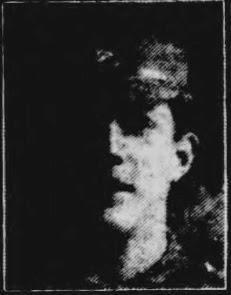
Arthur saw his final action on the 7th of November 1915 when he was killed by a sniper aged 19. His brother Neal (Cornelius is reported to have written home saying that he believed that Arthur of the same battalion had been shot).
Private Arthur Ashton 2402, 1/5th Battalion Sherwood Foresters (Notts and Derby Regiment) was eligible for the following medals:-
Victory Medal
The British Medal
The 1915 Star.
Newspaper Articles
Grantham Journal 31st October 1914
Off to the front – On Sunday afternoon, the people of Morton gave Arthur Ashton a good “Send-off” on his way to Essendine Station, en route to the headquarters of his regiment preparatory to joining the Expeditionary Force in France. Arthur, who joined the Regulars (the 5th Notts and Derby Regiment) only two months ago, is quite elated at being able to serve his country soon. His brother Cornelius, also a Morton man, joined the 6th Notts and Derbys. Arthur Ashton is an old chorister of Morton Church, and on Sunday his colleagues met to wish him “God speed and a safe return”. A collection was made among the members of the choir and friends gathered round at the cross-roads at the time fixed for Arthur’s departure, and a large box of cigarettes and a new purse containing a sovereign were hastily collected and given to him.
Grantham Journal November 27th 1915
For King and Country – We regret to state that Arthur Ashton, a Morton Soldier, has been shot by a sniper. His Brother Neal Ashton, in the same Battalion, sent the sad news. Whether the shot was fatal or otherwise, his numerous friends in Morton are very anxious to learn. We understand that no official notification of his death has been received. Another name has been added to the Roll of Honour, Edwin Handford having joined the Lincolnshire Regiment.
Grantham Journal 11th December 1915
Sad news has been received at Morton within the past few days that two of her gallant youths have laid down their lives for their country. In a previous issue, we reported that a letter had been received from Pte C Ashton, who is in France, to the effect that he was afraid that his brother Arthur had been shot by a German sniper. Upon inquiry at the War Office, the news has been officially proved to be only too true. The Parents of Thomas Fowler received a communication last week stating that their son was killed by a gunshot wound in the shoulder. He was drafted with a Mediterranean Force and death took place at Sulva on the Gallipoli Peninsula. Real heart-felt sympathy is felt for the bereaved families. Our toll of the war is now seven and we share the unenviable distinction of figuring most conspicuously in the casualty lists which concern the villages in the Bourne district. On Sunday evening last, the Parish Church was packed with parishioners who came to pay their last tributes to the three brave lads – Arthur Ashton, Thomas Fowler, Joseph Taylor (who was recently killed by a trench mortar in France). The Vicar, the Rev J.H. Boldero, read the burial service only omitting the committal portion. The lesson for the day was singularly appropriate vis., St John xiv. “Let not your heart be troubled, ”which was read by the schoolmaster, Mr. J.W. Palmer. In the course of the sermon, the vicar made a touching reference to the three lads, mentioning that they were all members of the church, and had all been in the church choir, and how, when far away, their last thoughts had been of home and the old church. The rev. gentleman spoke words of great comfort to the bereaved. The sadness was on all; the congregation mourned with the parents of the dead soldiers. At the close of the service, the National Anthem was sung, and the “Dead March” in “Saul” was played by the organist (Miss Betson). It was a beautiful service, and one that will long be remembered and the vicar’s words were most uplifting.
Memorial
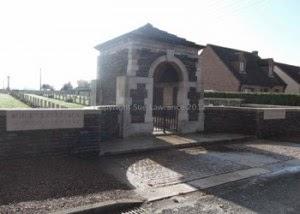
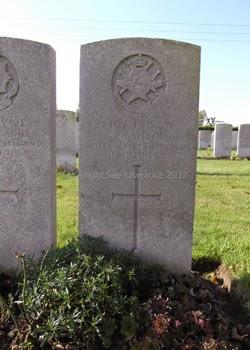
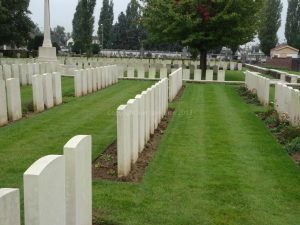
Private Arthur Ashton 2402 is remembered with honour at the Rue-Des-Berceaux Military Cemetery at Richebourg-L’Avoue near Bethune in the Nord-Pas-De-Calais region of France. Reference II. F. 1.
by James | Dec 31, 2014 | Biography
William’s military records cannot be found but the medal roll would indicate that there was a William Sisson Hyde originally in the Sherwood Foresters (Notts and Derby regiment), although the record is incomplete.
When a soldier was wounded and moved to a hospital back home, they could be attached to a different regiment when recovered and sent back into active service which could explain why most records show that William was in the 5th Battalion Lincolnshire regiment.
The army list for August 1918 shows that William was awarded the rank of 2nd Lieutenant on 28th May 1918 and was serving in the 5th Battalion Lincolnshire Regiment.
The next time we find William he is mentioned in the diary for the 8th Battalion Lincolnshire Regiment shows that on the 19th October 1918 they received reinforcements, including 2nd Lieutenant W S Hyde.
For the rest of October and November the Battalion was involved in front line trenches north east of Caudry. Whilst in action on the 4th November William was wounded.
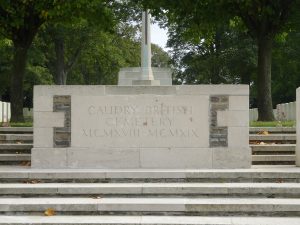
2nd Lieutenant William Sissons Hyde died of wounds on the 7th November and is remembered with honour at Caudry British cemetery.
Battalion Diary – 8th Battalion Lincolnshire Regiment
(Transcriptions to follow)
by Suzey | Oct 25, 2014 | Remembrance, Uncategorised
On the 24th of October we remember Walter Sandall of Rippingale.
Born in 1893, Walter was one of nine children born to Edward John Sandall and his wife Mary Pridmore.
In 1911 Walter was working as a horseman on a farm in Scredington and was living with The Whotton family.
Before the war Walter had served with the 1st Battalion Lincolnshire Regiment and had bought himself out of service.
He was living back in Rippingale when in October 1914 he re-joined the Army, this time with the Lincolnshire Yeomanry.
The Yeomanry were a cavalry unit who were based at the barracks at Lincoln and were essentially a forerunner of the Territorial Force before the war. The four squadrons of the Yeomanry were based in the Grimsby, Brigg, Lincoln and Stamford/Bourne and Men were recruited locally, In the Bourne Area their patron was the Earl of Ancestor.
Several other local farmers joined the Lincolnshire Yeomanry including Leonard Miller, Everitt Cook, Edward Franks and George Jessop. In most cases the soldiers took their own horse from civilian life into service with them.
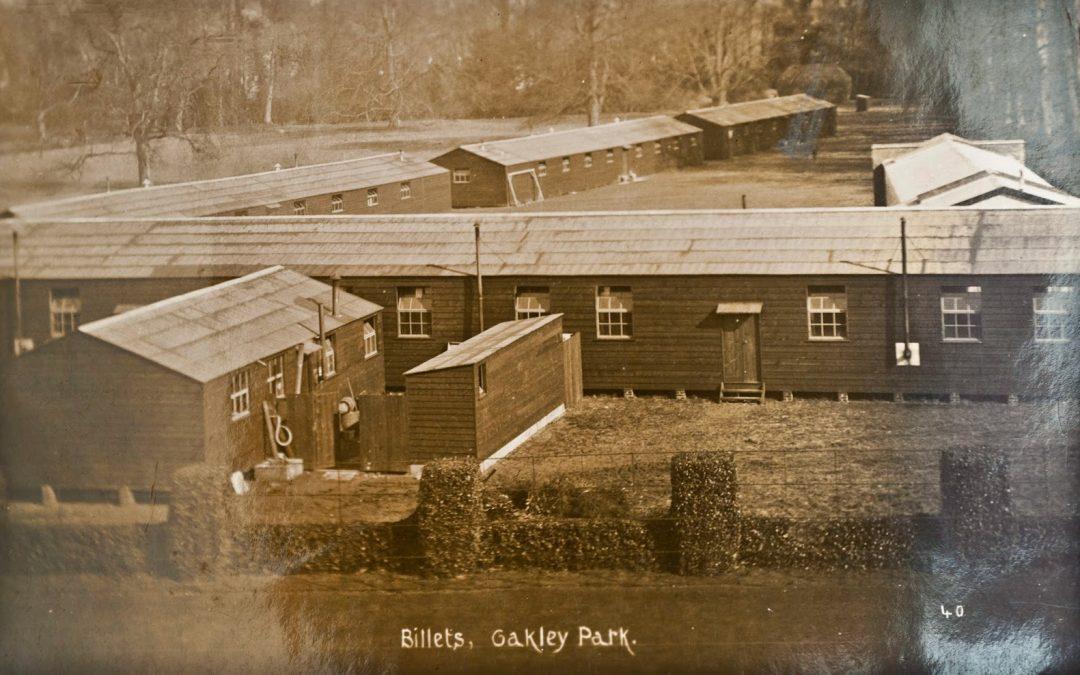
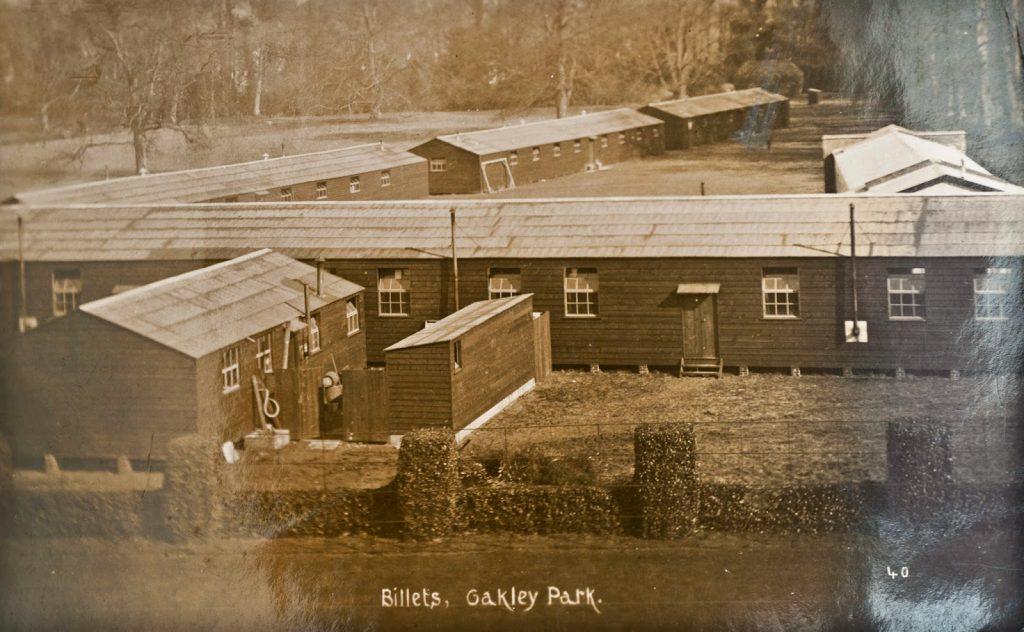
Walter carried out his training and home service, first at Oakley Barracks and then at Lowestoft and Sprowston. His training was not without incidents which had landed him in trouble with his seniors.
The 1st Lincolnshire Yeomanry Embarked in Southampton on 27th October 1915 for Salonika and war in the Dardanelles. During the voyage the destination was changed due to a threat by the Turks on the Suez Canal. After leaving Gibraltar the Mercian was attacked by U38 who out of torpedoes attacked with its guns. In the ensuing battle the Mercian returned fire with what little it had and U38 dived. Following putting into port at Oran, Algeria, to bury the dead and transfer the wounded to a military hospital, the Mercian went to Malta where it was fitted with a 3″ quick firing gun. From Malta the Mercian and the Yeomanry eventually disembarked in Alexandria on 21st November 1915
The Lincolnshire Yeomanry saw action across the middle east for the whole of the war, including Egypt, Palestine and also the battle of Gaza.
In February 1917 the Yeomanry was disbanded with most of the men becoming part of the Machine Gun Corps and Walter was transferred to the 18th Squadron of the Corps on 27th February 1917.
Walter Died on Pneumonia on 24th October 1918 and is buried in Beirut Military Cemetery.
In Memory of Private Walter Sandall, 95973, 18th Squadron Machine Gun Corps (Cavalry) who died on 24 October 1918.
Remembered with Honour Beirut War Cemetery
Grave Ref: Bay 3 and 4
Walter was one of seven cousins from our villages who did not return home at the end of the war, a generation missing for their family.
Walter is also remembered on the Rippingale war memorial.
http://www.jamieandsue.co.uk/?page_id=828
by James | Sep 14, 2014 | Remembrance
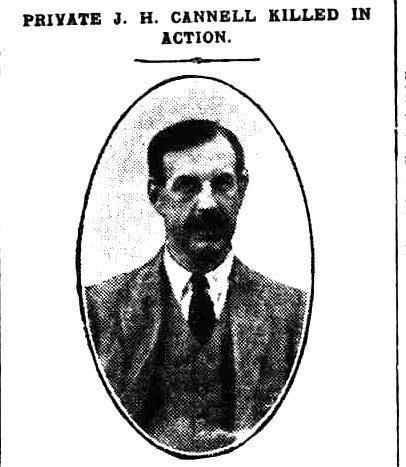
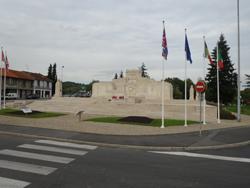
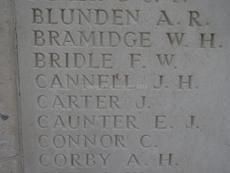
Our second remembrance today is for John Henry Cannell who was killed on this day 100 years ago on the 14th September 1914.
John Cannell was born in Norfolk and after earlier military service returned to civilian life although remained an Army Reservist. He was called back to his regiment, The Duke of Cornwall’s Light Infantry at the outbreak of the war.
John had been working as a chauffeur for Alderman Dean of Dowsby Hall when he was recalled for service.
He was killed in action trying to stop the invading enemy forces from reaching Paris, an action which helped to hold then at the Marne river thus starting the trench warfare phase of the war.
Grantham Journal :
Our Dowsby correspondant writes :- Ours is the sorrowful duty this week to chronicle the death of one of our most esteemed and loyal inhabitants. We refer to Private J H Cannell, who was killed in action at the front on the 14th September; the exact place is at present unknown. He belonged to the Duke of Cornwall’s Light infantry, his number was 7583. The notification of his decease was only received here on Friday evening week, when it came from headquarters, and when the news became known it caused quite a gloom to be spread, not only in this village, but in all who knew him, for he possessed a most amiable disposition, and had a kind word for everyone.
Steady, upright and fearless in dealing with mankind, he will be much missed by all his acquaintances. He was among the foremost to leave this district in the early stages of the present war, and now his name is numbered with other heroes in the roll of honour who have sacrificed all for their country and the freedom of Europe. Who could wish for a better epitaph?
It is hard for us to realize that we have lost him, but it is not for us to murmur, we shall remember him as a patriotic Britisher, and one who set an example which ought to shame all able-bodied single young men, for he was willing at the call of duty to leave his wife and child, a happy home, and all who loved him dearly, to find his rest in a grave of honour within a foreign land. A fine type of soldier he was, always ready to fulfill his duties faithfully, and when he received the “call to advance” to a far more glorious life, we fell he sure he did not falter. His age was 31 years, and he leaves a young widow and a daughter just over a year old to mourn their loss, and all hearts will extend them their sympathy in the hour of their deep sorrow. The poignancy of it all is that in a few months his time would have expired in the Army, for he joined twelve years ago. He had been in the employ of Alderman A.W. Dean J.P., of Dowsby Hall, as chauffeur, and his services in that capacity were valued, his parents reside at Careby, near Stamford. He was an attendant at our Parish Church and on Sunday, at both services the Rev. Gordon MacMorran, Rector, made feeling references to the deceased. In the morning, he preached from the text, St. Luke xii, 34, “For where your treasure is there will your heart be also,” and at evensong he delivered a most eloquent sermon from St. John xi, part of the 28th verse, “The master is come, and calleth for thee.”
There was scarcely a dry eye in the congregation. Special hymns were sung, and the services throughout were of the most impressive and reverent character.
John Cannell is remembered on the Dowsby Memorial and on the memorial at Le Ferte-Sous-Jouarre, France.
by James | Aug 24, 2014 | Remembrance, Uncategorised
In our preparations for the recent Morton Exhibition for the 100th anniversary of WW1 we compiled a book for each soldier that died from the 5 surrounding parishes.
The interesting thing about the Wyer Family is that so many cousins fought and died.
Sandall
and Wyer Cousins who served in the Great War
Loosing a child or a Grandchild in today’s world is devastating and so
we can only imagine the grief that local brothers felt when they lost 7
Children between them in the Great War.
The newspaper cuttings tell us that villages are proud that their sons
have enlisted, but secretly we can assume that parents and relatives are
fearful for their loved ones, some of whom are still quite young.
Brothers William Wyer, Thomas Wyer, George Sandall and Edward Sandall
waved off their offspring not knowing when they would see them again.
Of the 9 cousins that enlisted from Kirkby Underwood, Hacconby and
Rippingale, only 2 would return and one of them quite badly injured.
Frederick Stanley Wyer would spend the rest of the war wearing his
Silver Badge showing that he had fought, done his bit but was now disabled and
unfit for war due to wounds he received.
He lost one brother (John Thomas Wyer) and six cousins in the fighting during
the “War to End All Wars”
Robert Wilson Wyer Died
on the Somme 3rd July 1916
William Wyer Died on the Somme 14th
July 1916
Edmund Wyer Died on the Ypres Salient 4th
October 1917
Harry Sandall Died
near Arras 14th May 1917
John William Sandall Died
near Arras 22nd March 1918
Walter Sandall Died near Beiruit 24th October 1918
John Thomas Wyer Died
near Ploegsteert 13th April 1918
by James | Aug 24, 2014 | Remembrance
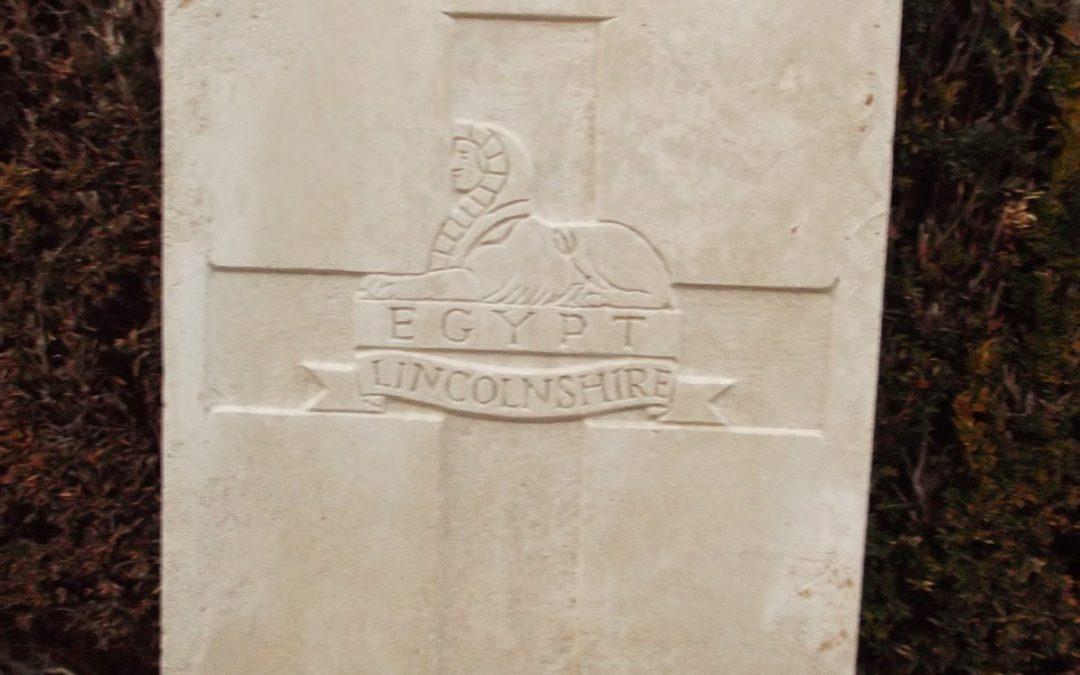
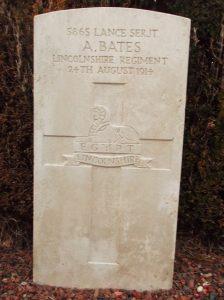
Today we remember Sgt Arthur Bates of the 1st Battalion Lincolnshire regiment. A regular soldier before the Great War, he had seen action in South Africa and more recently in India before returning home and placed in depot reserve at Lincoln.
Rejoining his battalion when war was declared on the 4th August, Arthur and the 1st Battalion were mobilised to France and on the 24th August were involved in a rearguard action during the allied retreat.
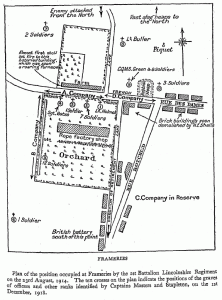
Sgt Arthur Bates was killed in action whilst a brave few men of the Lincolnshire regiment held an orchard in Fromelles in front of the advancing German Army.
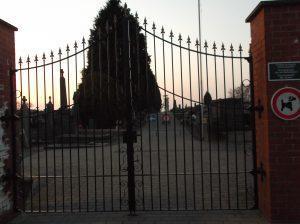
Arthur was the first Morton man to be killed in the Great War and as well as his grave in the communal cemetery in Fromelles, is remembered on both the Morton and Bourne war memorials.
by James | Jun 29, 2014 | Uncategorised
During our researches and whilst trying to create a book for each one of our local soldiers, we came across a bit of a brick wall;
According to the Commonwealth War Graves Commission Richard Christian was in the Durham Light Infantry when he died on the 18th November 1918.
” Private R Christian, 61814, Durham Light Infantry who died on 22 November 1918 Age 34
Son of Elizabeth Christian, of Kirkby Underwood, Lincs and the late Robert Christian; husband of the late Kate Christian”
Richard Christian is buried in Billingborough churchyard, but his date of death and regiment should have meant that he was still in Europe and not yet demobbed.
We tried to find out which battalion of the DLI he was in to see if there were any clues there… no his military records did not survive the blitz. So once again no answers.
Finding out that his wife died on the same date gave us the idea that he was at home when they both died but at the same time and what about baby Kate who was born and died in the same quarter of 1918. That’s unusual until you think of the Spanish Flu which was rife in Britain during this period, maybe that answers the question of why they died at the same time but no proof yet.
Our next clue came from the Kirkby Underwood war memorial;
“In thankfulness to God giver of peace and victory
and to the honoured memory of
Pte Bertie Evlyn Rudkin, Lincolnshire Regt
Pte Ernest Henry Rudkin, Royal Berkshire Regt
Pte John Thomas Wyer, Kings Own Royal Lancashire Regt
Pte Richard Christian, Labour Corps
of this parish who fell in the Great War, 1914-1919″
Now we have a discrepancy CWGC states Durham Light Infantry and the memorial states Labour Corps. A bit of further digging finds that he was transferred to the 409th company of the Labour Corps from the DLI. OK mystery solved but then why has the CWGC got it wrong?
Google came up with the Long Long Trail website which had the following to offer with regards to the Labour Corps;
“Formed in January 1917, the Corps grew to some 389,900 men (more than 10% of the total size of the Army) by the Armistice. Of this total, around 175,000 were working in the United Kingdom and the rest in the theatres of war. The Corps was manned by officers and other ranks who had been medically rated below the “A1″ condition needed for front line service. Many were returned wounded. Labour Corps units were often deployed for work within range of the enemy guns, sometimes for lengthy periods. In April 1917, a number of infantry battalions were transferred to the Corps. The Labour Corps absorbed the 28 ASC Labour Companies between February and June 1917. Labour Corps Area Employment Companies were formed in 1917 for salvage work, absorbing the Divisional Salvage Companies. In the crises of March and April 1918 on the Western Front, Labour Corps units were used as emergency infantry. The Corps always suffered from its treatment as something of a second class organisation: for example, the men who died are commemorated under their original regiment, with Labour Corps being secondary. Researching men of the Corps is made extra difficult by this, as is the fact that few records remain of the daily activities and locations of Corps units.”
So the Labour Corps is hard to trace, well that sound like a challenge for the future.
Another search finds that the 409th Labour Corps was the Kesteven and Lindsay company and was based in Lincoln and run through the Northern Command.
So now we have placed Richard Christian back in Lincolnshire, possibly after an illness or injury had him unfit for front line duty, transferred out of the Durham Light Infantry and assigned a new regimental number, 19310, in the 409th company Labour Corps.
How hard can that be to sort out without any official records?
Death certificates for Richard and Kate plus baby Kate now on order, so we can at least find out what sad outcome befell that young family.
More about Richard’s family can be found on our website
http://www.jamieandsue.co.uk/?page_id=815
by Suzey | Jun 26, 2013 | Uncategorised
Ovington Court.
On the 31st January 2008 I received an email saying:
My name is Jonathan Oberholster. I am a freelance sub-editor for Independent Newspapers and I live in South Beach, Durban.
My hobby is scuba diving and I am researching a local shipwreck lying offshore near my flat. The ship’s name is the Ovington Court and searching the net is how I came across your Cyril Crawford page.
In his Durban notes Cyril refers to South Beach and Ovington Court.
Looking at the date on which he left England (November 15 1940) and the date he arrived in Egypt (January 1 1941), I noticed something interesting – the Ovington Court ran aground on November 26 1940, only eleven days after he left England.
I guess he must have arrived in Durban just about when or shortly after it ran aground. It was a Durban landmark for many years before disintegrating to the extent that the wreck is now underwater 99% of the time. Only during spring low does a piece of it still stick out above the surface.
I thought you might be interested and decided to e-mail you. There is a pretty good site with all the details of what happened to the Ovington Court
http://www.fad.co.za/Resources/ovi/ovington.htm
After many emails going back and forth with photos attached of postcards, Grandad and general information about him and the family, my Grandad finally ended up in the
Independent on Saturday on 16th February 2008. A copy of the article was sent to me by Jonathan showing me exactly what went into the paper. I am very pleased that some chance comments on Grandad’s postcard has created news nearly 70 years later.
On the 19th September 2011 another email came from Jonathan with an article attached dated 17th September 2011. This time we have Grandad appearing in the same paper but with a headline stating that this was the best of 2008.
As I never knew what the Ovington Court was this has really touched my heart and I am longing to visit Durban and hopefully see the wreck of the ship myself one day.
Please take time to read the articles which you will find below.
by James | Jan 3, 2013 | Uncategorised
In our last post we mentioned that after quite some time we have finally managed to get some information on line for each of the men named on the Morton War memorial. This left us with a little gap in our time and bitten by the research bug we started to look for another project to start. Low and behold it came our way by chance on new year’s eve when a conversation turned to the nearby village of Dowsby.
by James | Dec 24, 2012 | Uncategorised
Well a three year quest to document the names on the Morton War Memorial is over. By over, we mean that all the soldiers now have their own pages on our web site.
The research that we have done so far gives each soldier, his family history and a potted military history. This information should be enough to allow relatives, the people of Morton, interested parties and my generation in general to understand the conditions, hardships and final sacrifice these men chose to make.
In places some of the research is limited due to lack of current records but this research will be ongoing and we are looking forward to other records, such as those now purchased by the Western Front Association to become available in the future.
The last name to be added to the website is that of James Wright, this is a work that has come full circle for us as James Wright was the first soldier we did basic research on in February 2010. He was also the first of the Morton men to be named in the Remembrance Sunday service at Morton church in November 2010. He also has family ties with our extended family, as with so many of those Morton men that come from the old families from the village.
To view the research please visit www.jamieandsue.co.uk/?page_id=241 to view the men of the Morton War Memorial.
We have been fortunate enough to visit the graves and memorials of all but one of these men and our photographs can be viewed on the following www.flickr.com/photos/suzey68/ to Sue’s Flickr site.
I suppose I had better find something else to be my main focus of Great War research, suggestions on a postcard please. 🙂
Jamie


Recent Comments