by James | Jul 30, 2017 | Remembrance
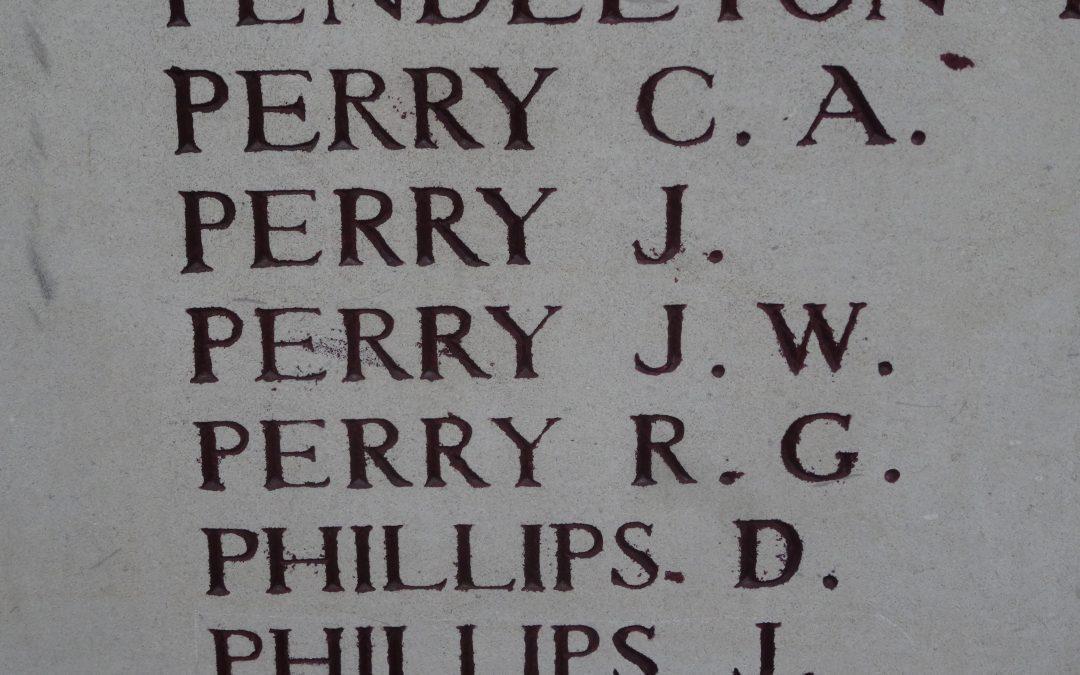
Today we commemorate the 100th anniversary of the death of John William (Jack) Perry of Bourne and the 17th battalion, Sherwood Foresters.
Jack was born in Bourne late in 1898 to William Thomas Perry, an Insurance Agent born in Hilgay Northamptonshire and his wife Edith Amy Creasey born in Swineshead.
They were married in 1896 in the Boston area and had two children, Violet Amy born in Bourne in 1897 and Jack.
On census night 1901 Jack and his sister Violet are living with their maternal grandparents in Bicker, his mother having died earlier this year and his father boarding in Peterborough.
By 1911 Jack and Violet are living with their uncle, Christopher Creasey in Bicker.
At some point Jack was adopted by his mother’s widowed sister Harriet Bannister nee Creasey.
On the 11th November 1915 Jack enlisted into the 3/4th Battalion of the Lincolnshire Regiment and following training eventually posted to France in June 1916.
Whilst serving with his Battalion in October, Jack was gassed and hospitalised. Following his return to fitness he was posted to the 17th Service Battalion of the Sherwood Foresters (Welbeck Rangers) and served with “D” Company.
By June 1917 Jack’s new Battalion were serving in the Ypres Salient in the area around the Ypres-Yser Canal Bank and Irish Farm working every nightime hour possible. On the 1st of July moved to Moulle in Northern France via Poperinge.
They stayed in the Tilques area undertaking training in advance of planned operations until the 22nd of July when they were bussed back to the Ypres area.
On the 29th July they were moved up to the Canal Bank area and on the 30th “Y” day they were resting prior to the attack. At 10:30pm the Battalion moved up to the place of assembly in the Hill Top Trenches.
Assembly was complete by 1:15am on “Z” day 31st July and the Battalion Diary reports that no casualties occurred whilst the Battalion was in assembly.
Zero Hour was at 3:50am on the 31st when the 3rd Battle of Ypres (Battle of Passchendaele) started. The 6th Army Corps in which the 39th Division and hence the 17th Sherwood Foresters were posted were to attack on a one and a half to two mile front.
The Battalion Diary offers the following report of actions on the 31st July;
“Yesterday we carried all before us, it was one of the Battalion’s greatest days lines etc, formation. we penetrated the enemy defences, which he had held for over 2 years, to a depth of 2 miles. It was a glorious feat and worthy of the Sherwood Foresters’ record. The day is very bad and the ground full of water and mud. We have secured the crossings of the Steenbeek and have dug in, the enemy is expected to counter attack. The Battalion is quite prepared to resist to the end.
In total the men and officers of the Battalion were recommended for the following gallantry awards for actions on the 31st July 1917, the first day of the battle of Passchendaele.
26 x Military Medals
1 x Military Medal Bar
1 x Distinguished Service Order
9 x Military Cross
1 x Distinquished Conduct Medals
The Battalion held firm against counter attacks, shelling etc until they were relieved on the 5th August.
Private John William “Jack” Perry was killed in action during the first day of the battle of Passchendaele.
All official records state that he fell on the 30th July however one newspaper record states that it was the 31st, which if you take the information from the battalion diaries makes more sense.
Commonwealth War Graves Commission:
In memory of Private John William Perry, 70021, 17th Battalion, Sherwood Foresters (Notts and Derby Regiment) who died on 30 July 1917 Age 18. Adopted son of Mrs H. J. Bannister of 3 Victoria Place, Bourne, lincs. Remembered with honour, Ypres (Menin Gate) Memorial.
Rest in Peace
by James | Jul 28, 2017 | Remembrance
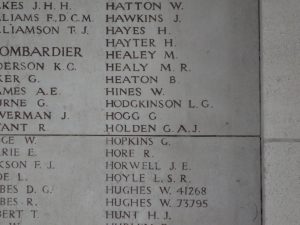
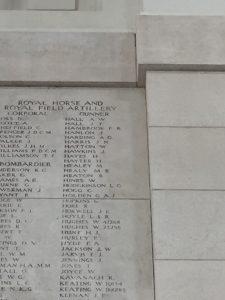
Today we commemorate the 100th Anniversary of the death of Billingborough man Leslie Grosvenor Hodgkinson, killed in action 28th July 1917.
Leslie was born in early 1894 in Billingborough the eldest of three sons born to Charles Grosvenor Hodgkinson, a Journalist born in Grantham and his wife Mary Ann Burrows of Swinsted.
His two brothers Charles Norman, 1895 and Thomas Basil, 1897 were also born in Billingborough. Their parents had married in the Nottingham area in 1893.
The young family made their home on the High Street in Billingborough as can be seen in the 1901 census although by 1911 Leslie was working as an insurance clerk and living at 14 Mansfield Grove, Nottingham and lodging with Fanny Nelson.
The young men of Billingborough were quick to answer their call and the Grantham Journal carried an article on the 12th September 1914 naming the “Local Patriots”
“Several Billingborough and Horbling young men have rallied most patriotically to the nation’s call. Their names and the regiments in which they have enlisted are as follows:-H.J. Tebb, Royal Horse Artillery, R,W Tebb, Royal Horse Artillery and Herbert Tebb, 11th Hussars, sons of Mr. H. Tebb (Horbling); Leslie G Hodgkinson, Royal Field Artillery and C Norman Hodgkingson, Royal Engineers, sons of Mr. C.G. Hodgkinson; Ernest Smith, Royal Field Artillery and Albert Smith, Oxford and Bucks Light Infantry, sons of Mr. William Smith, Bootmaker. Mr Smith has also another son in the regular service, viz., Bandman Archie Smith, 3rd King’s Royal Rifles. The following have enlisted in Lord Kitchener’s New Army: – Fred Harrison, son of Mr. H.C. Harrison; Walter Nicholson, W. Carpenter (Horbling), Frank Corn, W. Watson (Horbling), Harris Ellingworth (Horbling), W. Swin (Horbling), H. Kemp (G.N. railway clerk, Billingborough), W. Birch and W.H. and J.F. Pattinson (Stow). Mr. John Marshall, hairdresser, who saw active service in the South African war, has also been accepted. The Yeomanry ranks include Eric Barber, son of All. J.S. Barber, of Rookfield. There are several others serving in the Regular Army. The recruits mentioned are in addition to the lads – mostly farm hands – who enlisted on Monday night.”
A further article on the 24th of December 1914 mentioned Leslie Hodgkinson as one of the lads that had recently been home for short leave.
Leslie was posted to “B” Battery of the 58th Brigade Royal Field Artillery and sailed with them and on the 9th August they landed at Anzac Cove in Galipoli. A week later it was moved to the Left Flank Artillery in the Suvla Bay area and came under temporary command of the 10th (Irish) Division.
Leslie wrote a letter home that was edited into an article by the Grantham Journal on the 21st August under the headline “Sunshine and Flies”
Writing from “Somewhere with the British Mediterranean Expeditionary Force” Bombardier Leslie G Hodgkinson, of the R.F.A. gives some interesting particulars of the difficulties encountered by the troops. He says their greatest troubles are the intense heat and the pestering habit of the flies. There is one continuous blaze of sunshine from the rising to the setting of the orb, and the hottest days in England are not in it with the heat out there. there are myriads of flies, covering their food every time it is served, and pestering them at all times, more especially when they want to snatch a few hours’ sleep. The sand blows about in blinding clouds, covering everything and they must have eaten quite a lot with their food. Although we, in England, have been having record rains this summer, they have not seen a spot since they left England at the beginning of July. In spite of the discomforts, the general health of the troops is good, and a fine spirit of courage and determination pervades the lot of them.
The Brigade remained in Galipoli until the 18th December 1915 and sailed for Alexandria, Egypt, arriving there on the 2nd January 1916. They stayed in Egypt for 6 months, a regular story for many of the ex Galipoli brigades, before being posted to France in preparation for the Somme offensive.
Leslie is next mentioned in another Grantham Journal article on the 23rd June 1917.
“ON LEAVE- Mr. C. G. Hodgkinson’s eldest son, Leslie who is in the R.F.A. has returned home this week for his first leave, after being abroad for two years. After going through the Gallipoli campaign, he was sent to Egypt for six months, prior to being transferred to France, where he has been fighting since June 1916. His battery was engaged in all the big battles on the Somme and although he saw severe fighting at Arras, La Boisselle, Pozieres, Thiepval, Courcellette, Le Says, Bapaume and Bullecourt, his worst experiences were in the Ypres Sector. With his Artillery officer, he went over the top with the infantry and tells some thrilling accounts of what he saw after the explosion of the mines. In spite of the long and arduous work he had had to perform and the privations and hardships suffered on the Gallipoli Peninsula , he looks very little the worse for his experiences.”
Leslie rejoined his battery in the Ypres Salient immediately after his leave, although his return was short lived as less than a month later he would be killed in action just days before the battle of Passchendaele (3rd Battle of Ypres) commenced.
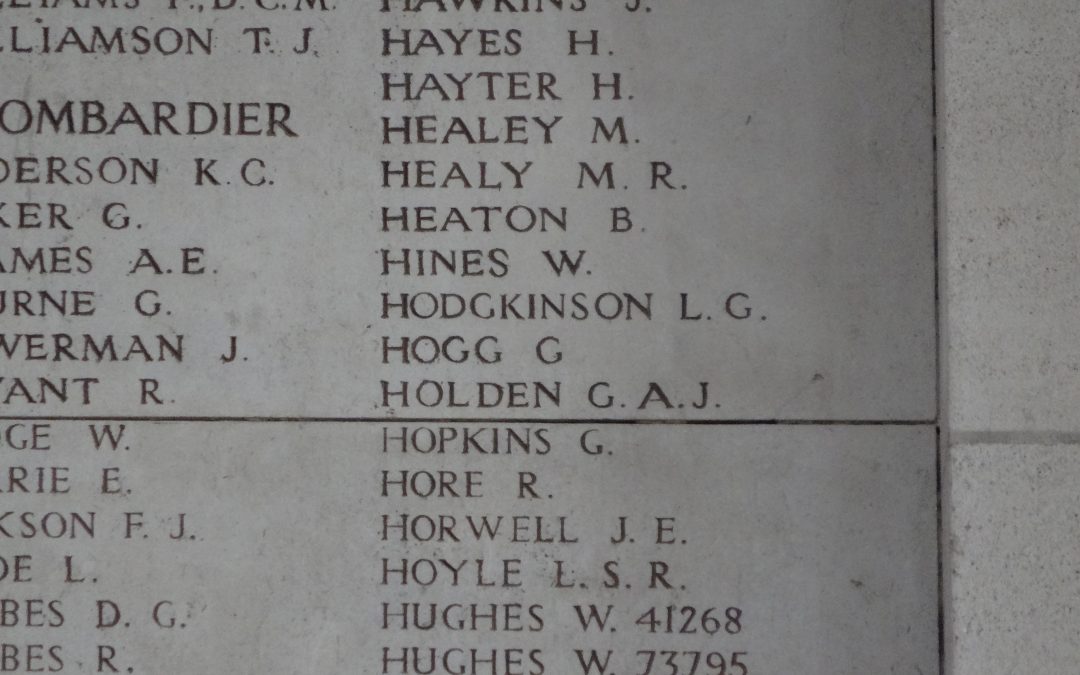
In memory of Gunner Leslie Grosvenor Hodgkinson (20981)
“B” Bty, 58th Bde, Royal Field Artillery who died on 28 July 1917 Age 23
Son of Charles Grosvenor Hodgkinson and Mary A Hodgkinson, of Billingborough, Lincs
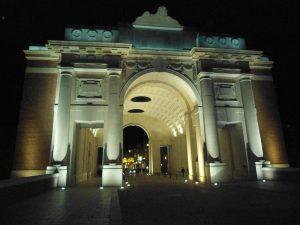
Remembered with honour, Ypres (Menin Gate) Memorial.
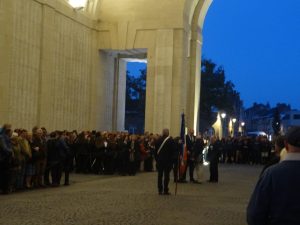
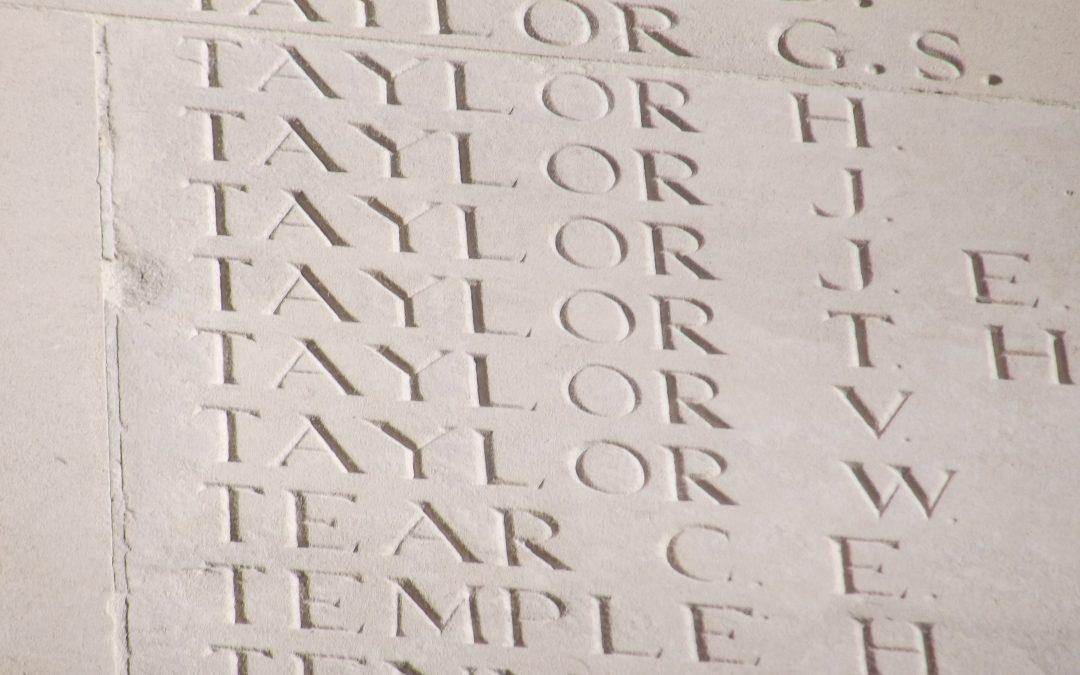
We were very honoured to be in Ypres on the 100th anniversary of Leslie’s death and were pleased that we could pay our respects on this sad anniversary.
by James | Oct 23, 2016 | Remembrance
Today we remember Morton man John Taylor. Killed this day, 23rd October 100 years ago in 1916.
John was born in 1896 and was the second of 8 children born to Joseph Parker Taylor and his wife Emma Downs.
By 1911 Emma had passed away leaving Joseph to bring up the children.
By 1915 brother Joseph had joined the army and was killed in September 1915 fighting with the 7th Battalion Lincolnshire Regiment.
John also joined the army although records would suggest that he did not see overseas service until 1916 which could indicted that he joined after the death of his brother.
In 1916 John saw action with the 2nd Battalion Lincolnshire regiment on the first day of the battle of the Somme. This day saw such divisional losses that they Battalion was withdrawn from the line and John spent the rest of the summer with his Battalion around the Loos area.
By mid October the Battalion had engrained for the Somme again arriving to a very wet, muddy and winter trench system. They entered the front line on the 19th October in advance of a planned attack on the 23rd October.
This attack would see the first wave of the Battalion being mown down, almost to a man, by rapid rifle and machine gun fire. Part of the brigade did succeed in taking 200 yards of enemy trench whilst under very intense raffle and machine gun fire. The main part of the were withdrawn after only a few hours but some part that had made the trench were still there some time later.
John Taylor was lost during this action that cost the Battalion 13 officers (out of 16) and 272 men out of 470.
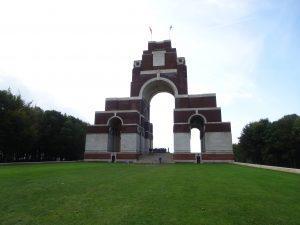
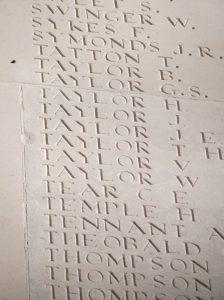
Private John Taylor, 1943, Lincolnshire Regiment who died on 23rd October 1916 is remembered with honour on the Thiepval Memorial on Pier 1 face C.
John and his brother Joseph are both honoured on the Morton Memorial.
by James | Sep 27, 2016 | Remembrance
Today we remember Kirkby underwood man, Bertie Rudkin who gave his life in the Great War 100 years ago in 1916.
Bertie Rudkin was born in Morton in 1893 to Henry James Rudkin, a wagoner and his wife Mary Ann Wrighton.
Bertie was one of 7 children and the family moved from Morton to Witham on the Hill, Corby Glen and then on to Swinsted. Later the family settled at Kirkby Underwood.
Bertie can be found on the 1911 census was living with the Cook family in Swinsted and working as a wagoner on a farm.
He enlisted, along with his brother, Ernest, and joined the 1st Lincolnshire regiment.
During the week of the 23rd September, the battalion had been encamped near Fricourt and were called into action on the 25th September to be part of an attack. That day the battalion lost 21 men with 127 wounded and 16 missing in action.
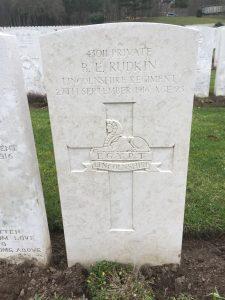
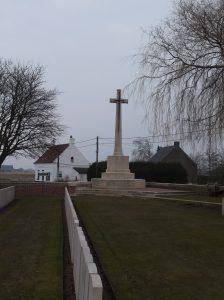
On the 27th September Bertie Rudkin died of wounds and is buried at Etaples Military cemetery.
Etaples was the site of the final military hospital before being shipped back to England, it can be assumed that he died of wounds attained in the earlier fighting with his battalion but never made it back as far as being evacuated back to England.
Bertie is commemorated on the stained glass window at Kirkby Underwood Parish Church as well as the memorial plaque in the church.
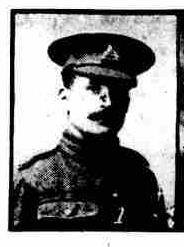
Photograph courtesy of Lincolnshire Free Press

Recent Comments