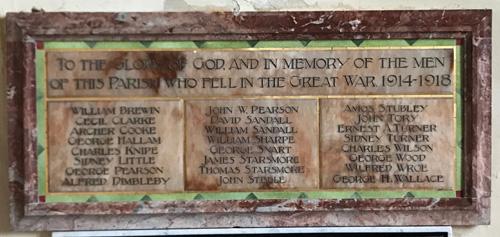
Remembering Walter Sandall and the Lincolnshire Yeomanry.

Remembering Walter Sandall and the Lincolnshire Yeomanry.

On the 24th of October we remember Walter Sandall of Rippingale.
Born in 1893, Walter was one of nine children born to Edward John Sandall and his wife Mary Pridmore.


In 1911 Walter was working as a horseman on a farm in Scredington and was living with The Whotton family.

Before the war Walter had served with the 1st Battalion Lincolnshire Regiment and had bought himself out of service.

He was living back in Rippingale when in October 1914 he re-joined the Army, this time with the Lincolnshire Yeomanry.

The Yeomanry were a cavalry unit who were based at the barracks at Lincoln and were essentially a forerunner of the Territorial Force before the war. The four squadrons of the Yeomanry were based in the Grimsby, Brigg, Lincoln and Stamford/Bourne and Men were recruited locally, In the Bourne Area their patron was the Earl of Ancestor.
Several other local farmers joined the Lincolnshire Yeomanry including Leonard Miller, Everitt Cook, Edward Franks and George Jessop. In most cases the soldiers took their own horse from civilian life into service with them.

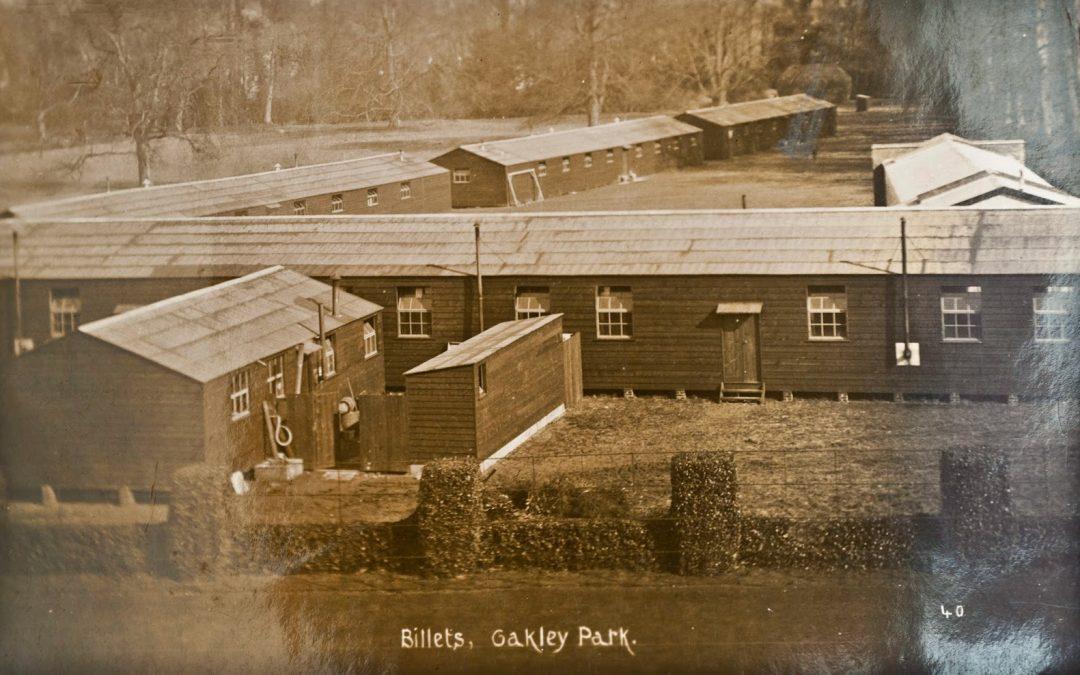
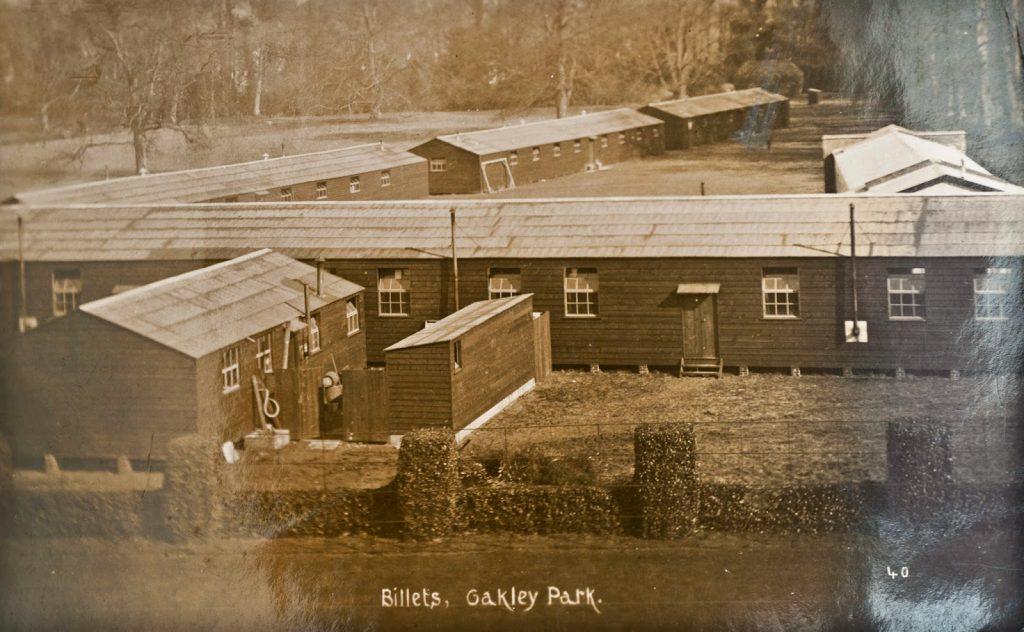
Walter carried out his training and home service, first at Oakley Barracks and then at Lowestoft and Sprowston. His training was not without incidents which had landed him in trouble with his seniors.

The 1st Lincolnshire Yeomanry Embarked in Southampton on 27th October 1915 for Salonika and war in the Dardanelles. During the voyage the destination was changed due to a threat by the Turks on the Suez Canal. After leaving Gibraltar the Mercian was attacked by U38 who out of torpedoes attacked with its guns. In the ensuing battle the Mercian returned fire with what little it had and U38 dived. Following putting into port at Oran, Algeria, to bury the dead and transfer the wounded to a military hospital, the Mercian went to Malta where it was fitted with a 3″ quick firing gun. From Malta the Mercian and the Yeomanry eventually disembarked in Alexandria on 21st November 1915

The Lincolnshire Yeomanry saw action across the middle east for the whole of the war, including Egypt, Palestine and also the battle of Gaza.

In February 1917 the Yeomanry was disbanded with most of the men becoming part of the Machine Gun Corps and Walter was transferred to the 18th Squadron of the Corps on 27th February 1917.

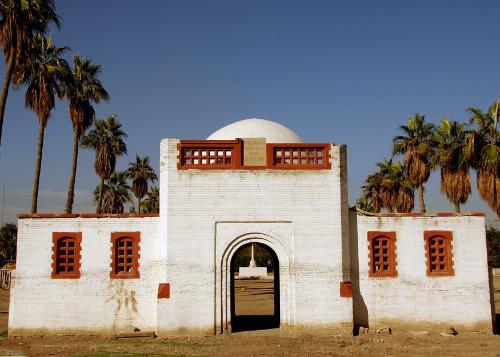
Walter Died on Pneumonia on 24th October 1918 and is buried in Beirut Military Cemetery.

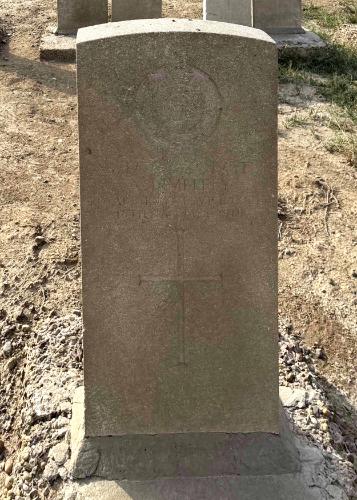
In Memory of Private Walter Sandall, 95973, 18th Squadron Machine Gun Corps (Cavalry) who died on 24 October 1918.
Remembered with Honour Beirut War Cemetery
Grave Ref: Bay 3 and 4

Walter was one of seven cousins from our villages who did not return home at the end of the war, a generation missing for their family.

Walter is also remembered on the Rippingale war memorial.

http://www.jamieandsue.co.uk/?page_id=828

Remembrance – John Henry Cannel

Remembrance – John Henry Cannel

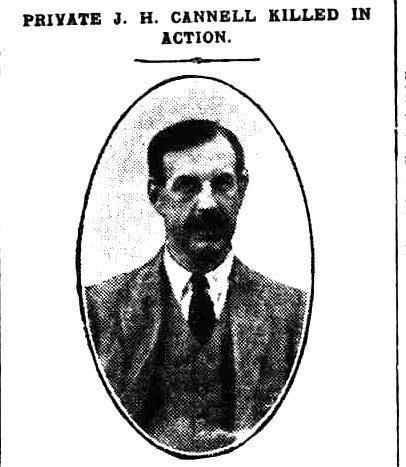
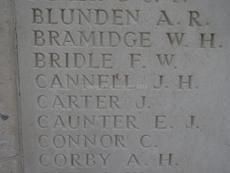
Our second remembrance today is for John Henry Cannell who was killed on this day 100 years ago on the 14th September 1914.

John Cannell was born in Norfolk and after earlier military service returned to civilian life although remained an Army Reservist. He was called back to his regiment, The Duke of Cornwall’s Light Infantry at the outbreak of the war.

John had been working as a chauffeur for Alderman Dean of Dowsby Hall when he was recalled for service.

He was killed in action trying to stop the invading enemy forces from reaching Paris, an action which helped to hold then at the Marne river thus starting the trench warfare phase of the war.

Grantham Journal :
Our Dowsby correspondant writes :- Ours is the sorrowful duty this week to chronicle the death of one of our most esteemed and loyal inhabitants. We refer to Private J H Cannell, who was killed in action at the front on the 14th September; the exact place is at present unknown. He belonged to the Duke of Cornwall’s Light infantry, his number was 7583. The notification of his decease was only received here on Friday evening week, when it came from headquarters, and when the news became known it caused quite a gloom to be spread, not only in this village, but in all who knew him, for he possessed a most amiable disposition, and had a kind word for everyone.

Steady, upright and fearless in dealing with mankind, he will be much missed by all his acquaintances. He was among the foremost to leave this district in the early stages of the present war, and now his name is numbered with other heroes in the roll of honour who have sacrificed all for their country and the freedom of Europe. Who could wish for a better epitaph?
It is hard for us to realize that we have lost him, but it is not for us to murmur, we shall remember him as a patriotic Britisher, and one who set an example which ought to shame all able-bodied single young men, for he was willing at the call of duty to leave his wife and child, a happy home, and all who loved him dearly, to find his rest in a grave of honour within a foreign land. A fine type of soldier he was, always ready to fulfill his duties faithfully, and when he received the “call to advance” to a far more glorious life, we fell he sure he did not falter. His age was 31 years, and he leaves a young widow and a daughter just over a year old to mourn their loss, and all hearts will extend them their sympathy in the hour of their deep sorrow. The poignancy of it all is that in a few months his time would have expired in the Army, for he joined twelve years ago. He had been in the employ of Alderman A.W. Dean J.P., of Dowsby Hall, as chauffeur, and his services in that capacity were valued, his parents reside at Careby, near Stamford. He was an attendant at our Parish Church and on Sunday, at both services the Rev. Gordon MacMorran, Rector, made feeling references to the deceased. In the morning, he preached from the text, St. Luke xii, 34, “For where your treasure is there will your heart be also,” and at evensong he delivered a most eloquent sermon from St. John xi, part of the 28th verse, “The master is come, and calleth for thee.”
There was scarcely a dry eye in the congregation. Special hymns were sung, and the services throughout were of the most impressive and reverent character.

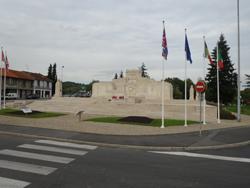
John Cannell is remembered on the Dowsby Memorial and on the memorial at Le Ferte-Sous-Jouarre, France.


John Thomas Wyer, Cousins at war

In our preparations for the recent Morton Exhibition for the 100th anniversary of WW1 we compiled a book for each soldier that died from the 5 surrounding parishes.

The interesting thing about the Wyer Family is that so many cousins fought and died.


Sandall
and Wyer Cousins who served in the Great War
Loosing a child or a Grandchild in today’s world is devastating and so
we can only imagine the grief that local brothers felt when they lost 7
Children between them in the Great War.
The newspaper cuttings tell us that villages are proud that their sons
have enlisted, but secretly we can assume that parents and relatives are
fearful for their loved ones, some of whom are still quite young.
Brothers William Wyer, Thomas Wyer, George Sandall and Edward Sandall
waved off their offspring not knowing when they would see them again.
Of the 9 cousins that enlisted from Kirkby Underwood, Hacconby and
Rippingale, only 2 would return and one of them quite badly injured.
Frederick Stanley Wyer would spend the rest of the war wearing his
Silver Badge showing that he had fought, done his bit but was now disabled and
unfit for war due to wounds he received.
He lost one brother (John Thomas Wyer) and six cousins in the fighting during
the “War to End All Wars”
Robert Wilson Wyer           Died
on the Somme                   3rd July 1916
William Wyer                      Died on the Somme                  14th
July 1916
Edmund Wyer                     Died on the Ypres Salient          4th
October 1917
Harry Sandall                      Died
near Arras                         14th May 1917
John William Sandall          Died
near Arras                         22nd March 1918
Walter Sandall                     Died near Beiruit                       24th October 1918
John Thomas Wyer             Died
near Ploegsteert                 13th April 1918

Remembrance – Arthur Bates

Remembrance – Arthur Bates

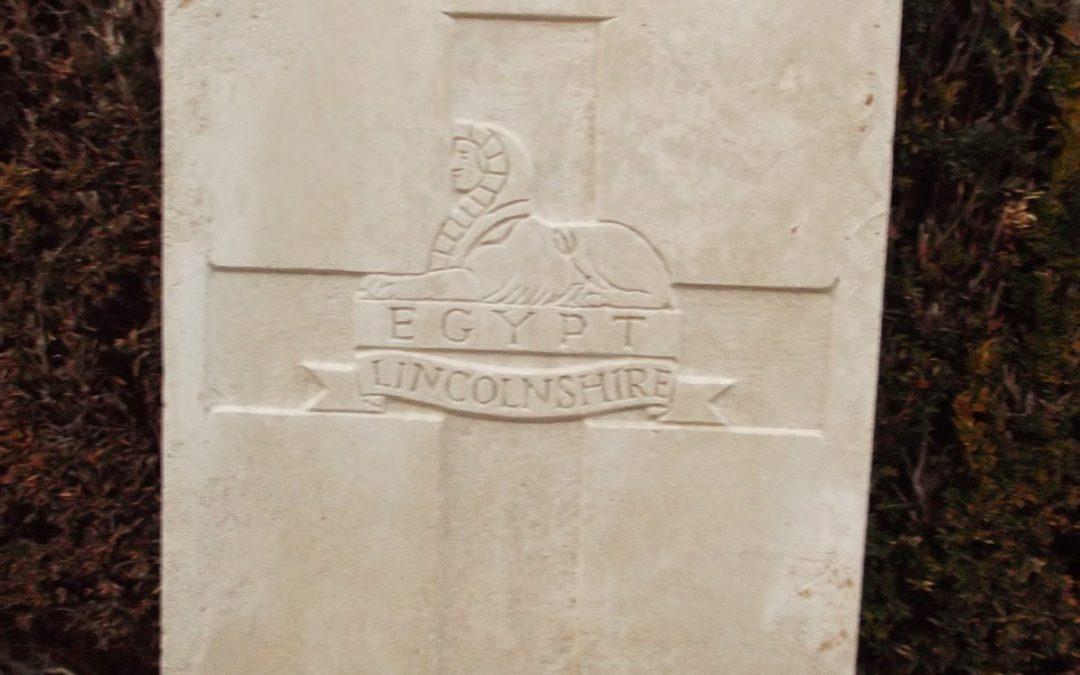
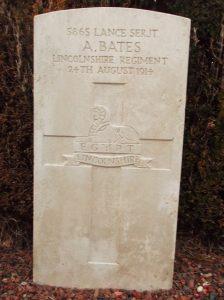
Today we remember Sgt Arthur Bates of the 1st Battalion Lincolnshire regiment. A regular soldier before the Great War, he had seen action in South Africa and more recently in India before returning home and placed in depot reserve at Lincoln.
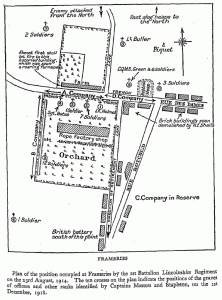
Rejoining his battalion when war was declared on the 4th August, Arthur and the 1st Battalion were mobilised to France and on the 24th August were involved in a rearguard action during the allied retreat.

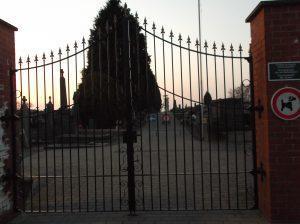
Sgt Arthur Bates was killed in action whilst a brave few men of the Lincolnshire regiment held an orchard in Fromelles in front of the advancing German Army.

Arthur was the first Morton man to be killed in the Great War and as well as his grave in the communal cemetery in Fromelles, is remembered on both the Morton and Bourne war memorials.


Remembrance – Alfred Dimbleby

16th January 1919

Alfred Dimbleby

Army Service Corps

Today we remember Baston man Alfred Dimbleby who died on this day, 16th January 1919, whilst serving with the Army Service Corps in Baghdad.

Alfred was born on 28th July 1882 in Butterwick, Lincolnshire, to Benjamin Dimbleby, a Bricklayer born in Glentham and his wife Eliza Dunn Clayton, born in Old Leake, Lincolnshire. The couple were married in 1872 in the Boston District. The couple settled in Butterwick where Alfred and his five siblings were all born.:-

• Ambrose Dimbleby, 1872, Butterwick

• Enos Dimbleby, 1875, Butterwick

• Herbert Dimbleby, 1877, Butterwick

• Maude Dimbleby, 1879, Butterwick

• David Dimbleby, 1881, Butterwick

• Alfred Dimbleby, 1882, Butterwick

In 1891 Alfred, now 8 years old, was living with his parents in Beningtion Road, Butterwick his father working as a bricklayer and eldest brother a Bricklayer’s apprentice.

Ten years later in 1901, now aged 18, Alfred is living in Thurlby in the household of Aquila Peasgood and his family. Mr Aquila Peasgood is a Baker and Grocer in the High Street and Alfred now lists his occupation as a Journeyman Baker and is a servant in the household thus looking very like he worked for Aquila Peasgood in his business.

The last Census for Alfred in 1911 now has him living in Baston at the age of 28 and working as a Baker’s assistant. He is living with the Morris Family, Betsy being the head of the house aged 80, a widow, her son Herbert was a wheelwright and carpenter. Another son James, a widower aged 42, was a baker and employed and we assume that Alfred worked with James.

The Military Service Act 1916 dictated that any unmarried men up to the age of 41 would be conscripted and Alfred was called up to carry out his duty, enlisting in Bourne on the 1st March 1916. On enlistment Alfred was to posted to the Army Reserve.

Alfred’s attestation listed his Father as Benjamin Dimbleby of Uppingham.

Alfred finally received his mobilisation papers on the 17th April 1916 and proceeded to Lincoln where on the 18th April his initial medical examination was carried out. This noted that he was aged 33 years and 216 days, was 5ft 3 and 1/4 inches tall and weighted 109 pounds. It was also noted that he was a qualified baker which would have swayed the decision as to where he would be most useful for his Army service and so on the 19th April 1916, Alfred was posted to the Army Service Corps. A note in his service record shows “K” as the Battalion or Depot.

On the 26th April 1916 the posting to the Army Service Corps was approved and he would have started his basic training.

Five months of training later on the 9th September 1916, Alfred’s Home Service ended and he embarked on a ship at Devonport and posted official records show his posting to the Indian Expeditionary Force on the 10th September 1916.

After a voyage of one month Alfred Disembarked in Basrah and arrived at ASC Base Deport in Makina (Basrah) on the 11th October 1916. Eventually he was assigned a unit and posted on 30th October 1916 Alfred to the 10th Field Bakery at Amara.

Each division of the British Army was allocated a Field Bakery that was part of the supply department of the Army Service Corps. These field units were usually more static and worked well behind the lines, usually at a base camp. Information regarding one such bakery unit in France would suggest that each Field Bakery consisted (originally in 1914) of one officer and 92 men and could produce enough bread for 20,000 men.

Alfred was present with his unit, as can be seen in some entries in his service records, these are listed under “in the field” during the next two years, other than one entry that has an unreadable location. He would have been in the field when Baghdad was captured on 11th March 1917 and when Turkey signed the Armistice on the 1st October 1918.

The next time he is mentioned specifically in records is on the 19th October 1918 when he was diagnosed with Dysentery. This diagnosis took place at the 16th Casualty Clearing Station and Alfred was shipped to Hospital at Abu Saida where he was to spend a long time and even see out that war as he would have been still in hospital on Armistice day. Things did not go well for Alfred and Army records office received a report that he was ‘Dangerously ill’ on the 11th January 1919.

Five days later on the 16th January 1919, Alfred died of Dysentery in Abu Saida, Mesopotamia.

Alfred is buried at North Gate Cemetery in Baghdad which contains the graves of men who fell in Baghdad as well as graves later brought on from Northern Iraq.

The CWGC completed work to repair and place 511 graves on new bases in 2012 however because of the location of the cemetery in a hostile area of Baghdad they have not been able to maintain the cemetery to this date.

Of the 38,842 British Military Deaths in the Mesopotamia Campaign, 26,814 were from sickness and other non-battle causes (including prisoners). The high ratio of non-battle casualties was largely put down to the geography of the operational area. It was unhygienic, extremely hot in summer, extremely cold in winter, composed primarily of either sandy deserts or marshes, and largely underdeveloped. This meaning men had to be transported long distances for medical attention.

On the 29th November 1920, Benjamin Dimbleby received the Memorial Scroll and a letter from the King, posted from the ASC administration depot at Woolwich Dockyard. His note on the receipt adds that he has received the letter and scroll with thanks.

Commonwealth war Graves Commission

In memory of Private Alfred Dimbleby, S4/173635, 10th Field Bakery, Royal Army Service Corps who died on 16 January 1919. Remembered with honour, Baghdad (North Gate) War Cemetery

More information about Alfred can be found on a page dedicated to his memory on our website.

https://www.southlincolnshirewarmemorials.org.uk/…/alf…/

The photographs of Baghdad North Gate War Cemetery are Courtesy of the War Graves Photographic Project. Not all of the graves in this cemetery are in great condition and thankfully Alfred’s has survived even though it is not in the best of condition.