by James | Feb 17, 2018 | Uncategorised
Today we remember Langtoft man, Abraham Warn who lost his life 101 years ago today.
Abraham was born in Langtoft in 1877, 6th child born to William Warn, a cottager with his 2nd wife Martha Coddington.
Abraham’s father passed away before 1901, where Abraham can be found living with his mother in Langtoft. He worked as a farm labourer in Langtoft before enlisting in the army with the Prince of Wales’ own West Yorkshire Regiment.
Abraham was serving with the 2nd/5th Battalion Yorkshire when the battalion was mobilised for war in January 1917.
Private Abraham Warn, 202055, 2nd/5th Bn, Yorkshire Regiment (Prince of Wales’s Own, who died on 17 February 1917.Age 37
Son of Martha Warn, of Gray’s Cottage, Langtoft, Peterborough, and the late William Warn. Remembered with honour, Thiepval Memorial.
Abraham is one of the 8 men commemorated on the Langtoft village memorial.
by James | Feb 8, 2018 | Uncategorised
Today we remember the 100th anniversary of the death of John Tom Haines, commemorated on the Bourne Memorial and also on the Thiepval Memorial to the missing of the Somme.
John Thomas Haines was born in Spalding in 1883.
The son of John William Haines and possibly the step son of Suzannah Jane Blood.
By 1901 he was living in Bourne and in 1911 can be found in Dyke.
John enlisted in on the 8th February 1917 in Bourne and served in the 7th Battalion (Alexandra Prince of Wales Own) Yorkshire Regiment, and also the 13th Battalion, although “Soldiers died in the Great War” lists him as Yorkshire Hussars.
He was killed on 8th February 1917, aged 34. Commemorated on the Thiepval Memorial.
by James | Feb 2, 2018 | Remembrance
Today we remember the centenary of the sad death of William Stanley Lynn of Edenham, who died on the 2nd February 1918, after serving with the 8th Battalion Lincolnshire Regiment.
William was born in the spring of 1896 in Edenham to Thomas Lynn, a blacksmith, originally from Newton on Trent and his wife Mary Bates of Aslackby.
Thomas and Mary were married in 1894. Mary already had a son, Ernest Tom Bates, who was born in 1885.
Thomas and Mary probably started their married life in Aslackby where their first Daughter Kate was born in 1892. Their second child, a son named Joe Gibson Lynn, was born in Sibsey in 1895. the family eventually settled in Edenham and their final three sons were all born here.
William Stanley Lynn, 1896, Edwin Harry Lynn, 1897 and Thomas Walter Lynn, 1899.
In 1901 the family were living on back Lane in Edenham, Thomas having his own blacksmith’s business. By 1911 William has found employment as a farm labourer, the family still living in Edenham.
On the 2nd September 1914 William enlisted into the Army in Bourne and joined the 8th Battalion Lincolnshire regiment. After his initial training he was posted to France on the 10th September 1915 as the first posting for the 8th Battalion. The Battalion first saw action in the battle of Arras being stationed in Bois Hugo at the start of the attack.
The battalion also saw action in the Battle of the Somme and were present at the battles of Albert, Bazentin Ridge, Flers-Courcelette, Morval, The Capture of Gueudecourt, Transloy Ridge, and then onto the Battle of the Ancre.
1917 saw the Battalion in action in the German retreat to the Hindenburg Line and were fighting in the battles around Arras before in July being moved to Ypres in preparation for the Battle of Passchendaele.
On the 13th July 1917, William Lynn reported to the medical officer with a complaining of shortwindedness, sharp pain over the left chest and a cough. He was sent to the 50th Field Ambulance and then on to the 55th Casualty Clearing Station. Thence the 55th General Hospital in Boulogne. After being shipped home he was admitted to Springburn Woodside General Hospital in Glasgow on the 27th July 1917. He was diagnosed has having contracted Tuberculosis of the Lungs and was eventually discharged from hospital on the 6th August.
William was subsequently confirmed for discharge from the army on 29th August 1917 as being medically unfit.
William eventually succumbed to the aftereffects of T.B on the 2nd February 1918 aged 21.
- Commonwealth War Graves Commission:
- In memory of Private William Stanley Lynn, 11891, 8th Battalion, Lincolnshire Regiment who died on 2 February 1918 Age 21
Son of Thomas Lynn of Edenham, Lincolnshire
Remembered with honour, Edenham (St. Michael and All Saints) Churchyard
by James | Jan 3, 2018 | Remembrance
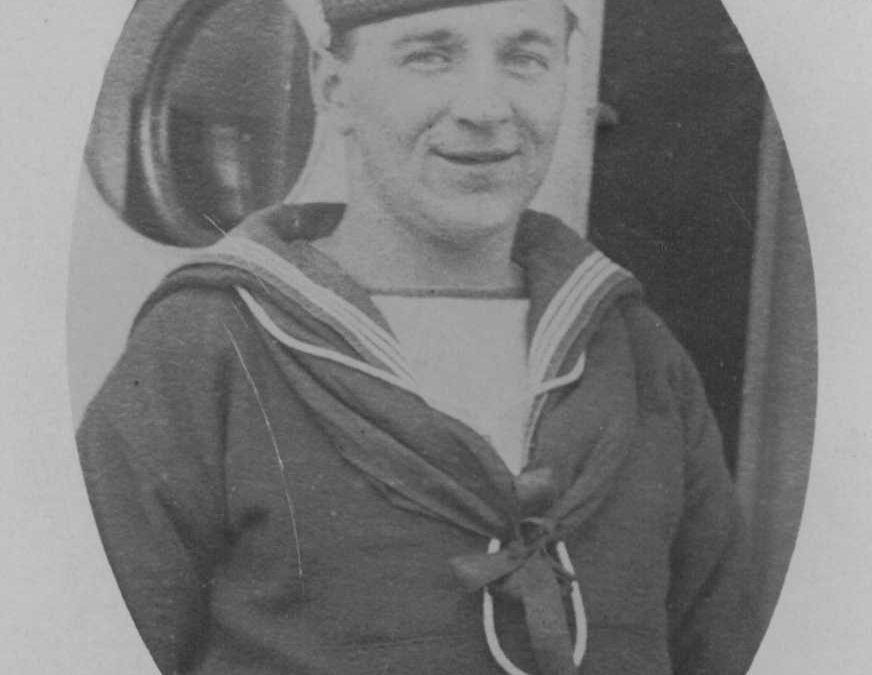
Today we commemorate the 100th Anniversary of the death of Stoker, 1st Class, Joseph Henry Stennett of Bilingborough, who was lost at sea on the 3rd January 1918, when the H.M. Submarine G8 went missing.
Joseph was born on the 12th August 1895 to William Stennett, a journeyman butcher, from Billingborough and his wife Alice Doughty from Kirton, Lincolnshire.
The couple were married in 1888 and made their home in Billingborough where in 1890 their first child, Alice Maud was born. They later moved to Horbling where Joseph was born in 1895 and then Urania Fanny was born in 1905. The young family also sadly lost two other children before 1911.
By 1911 Joseph was working as a baker’s assistant in Donnington and living with the Pattern family.
Joseph joined the Navy in July 1914 and signed up for a period of 12 years, this was one month before the war was declared. On the 21st July Joseph was posted to HMS Victory II, a shore station based at Crystal Palace and Sydenham, for initial training and remained here until the 27th December 1914 listed as a stoker. Following this initial training period he was posted to HMS Inconstant, as stoker 2nd class. HMS Inconstant was an Arethusa-class cruiser and was designed to lead destroyers into battle, launched on the 6th July 1914. HMS Inconstant joined the 1st Light Cruiser Squadron at Rosyth in February 1915. Joseph was promoted to stoker 1st class on the 2nd August 1915, staying with the ship until 7th December 1916. H.M.S. Inconstant and Joseph saw action during the Battle of Jutland.
On the 8th December 1916 Joseph was posted to HMS Dolphin a shore station near Gosport that was a submarine base and used as a training facility, he remained here only for a short period and on the 3rd January 1917 was posted to HMS Lucia.
H.M.S. Lucia was a german ship captured in September 1914 and then refitted as a submarine supply ship on the Clyde in 1916. During his period with the Lucia she was stationed on the Tees, at the South Bank, Middlesborough and the Lucia was working as a supply vessel for the 10th Submarine Flotilla. Joseph was posted onto H.M. Submarine G8, a G class submarine launched in 1917 for long range work with a crew of 31, she was attached to the 10th (Tees) Flotilla as a submarine hunter in the North Sea but Jospeh, for Naval accounting purposes was still attached to HMS Lucia.
Although working as part of the 10th Flotilla, G8 spent most of 1917 working out of Scapa Flow, her patrols were North of Shetland to Norway, Skagerrak, Kattegat and Horns Reef.
Jospeh Stennett left the Tees on G8, from the Lucia, on 27 December 1917, leaving with the submarine G12 and the destroyer HMS Medea, bound for Kattegat and then ordered to start her return to base on the 3rd of January, their mission was to hunt for two armed German steamboats.
G8 never returned from her patrol and was officially declared missing on the 14th January 1918. The cause of her demise remains unknown officially but it is believed she hit a mine, going down with all hands just off the coast of Denmark near Jutland.
The position of a wreck that was found in 2011 was on part of Route Blue, a narrow gap in the German defensive minefield that guard the entrance to the Baltic. This is believed to be the G8 and the dive team confirmed that the diesel engines were not running and the electric engine was on slow with the periscope raised indicating that she was hunting for her pray, below the surface when she hit a mine. Although the conning tower was raised the rest of the wreck has been untouched and left as a war grave.
Commonwealth War Graves Commission:
In memory of Stoker 1st Class Joseph Henry Stennett K/22930, H.M. S/M. “G8.”, Royal Navy who died on 3rd January 1918 Age 22.
Son of William and Alice Stennett, of Horbling, Billingborough, Lincs.
Remembered with honour, Portsmouth Naval Memorial
Joseph Stennett is also remembered on the War memorial in the Church in his native village of Horbling, Lincolnshire.
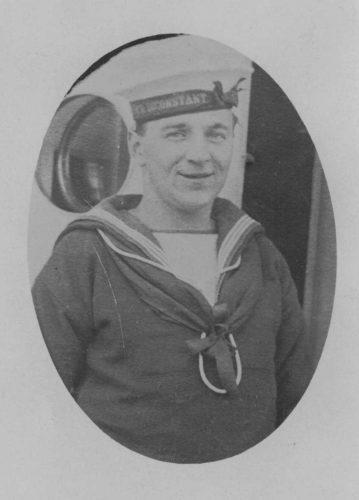
Photo courtesy Eric Gray
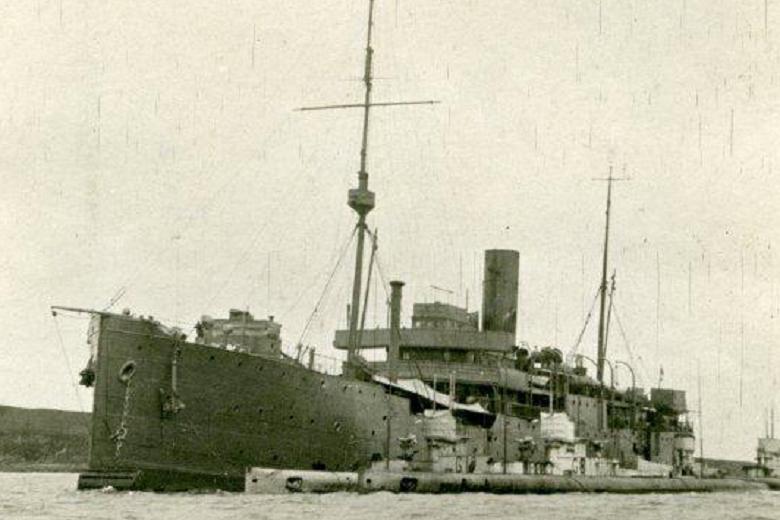
H.M.S. Lucia and H.M. Submarine G8 in the Tees.
by James | Dec 22, 2017 | Remembrance
Today we remember Joseph Arthur Carter of Bourne, who made the ultimate sacrifice for his country this day, 22nd December, 100 years ago.
Joseph (normally known as Arthur) was born in the spring of 1888 in Castle Bytham to John Carter, a brewery labourer and his wife Mary Wallhead.
By 1911 the family were living at 27 Hereward Street, Bourne and Arthur was working as a compositor for a printers.
Arthur enlisted to the army in Stamford on the 22nd February 1916 and was eventually mobilised on the 11th April 1916 and subsequently posted to the 9th Battalion for training. After 3 months Arthur was posted to the 1st Battalion on the 27th August 1916 and sent to France.
In May 1917 Arthur was admitted to hospital with an injury to the knee joint which was deemed not be be due to active service. He was posted a s fit one month later and rejoined his Battalion. He was granted leave between the 18th and the 30th November 1917 and then once again joined his Battalion in time to entrain at Maroeiul at 11pm for Peronne and then they marched to Cartigny arriving there at 11am on the 1st December. The battalion were held in readiness until the 6th December when they were moved to Heudecourt. On the 9th they went into the line around the railway embankment west of Villers Guisain, a village that was in enemy hands, to relieve the 15th battalion Durham Light Infantry. At this time there were not connected lines here just a series of posts. Over the next few days they formed working parties at night to attempt to link up the posts.
On the 12th after a couple of quiet days, the enemy shelled the advanced posts, killing one man and wounding 5 others. These were the first casualties of this tour.
On December 15th the battalion diary reported that the day was quiet until about 5.30pm when the battalions position was shelled heavily, without causing any casualties. Two hours later a barrage was put up by our machine guns and artillery.
Artillery activity was marked throughout the night, the enemy shelling the Battalion front and the railway embankment intermittently, our artillery retaliating spasmodically.
December 16th only had one entry in the Battalion Diary, A quiet day, nothing noteworthy taking place.
On the 17th things changed around 4am, the enemy raided the left front of the Battalion with a party of about 20 men. This post was held by a party of about 20 men of A company. The enemy made his way through a gap in our wire to the left of the post. The approach was made under cover of the extreme darkness and a snowstorm, and attacked the post from the flanks and the rear, throwing a number of hand grenades when close in. One of the grenades dropped in the post and wounded 6 men. A few of the enemy succeeded in forcing their way into the trench but were thrown out again immediately not however before they had captured two of our men whom they took back with them.
In the evening the Battalion was relieved by the 1st East Yorks Regiment, relief being completed by 6pm. Shortly after D Company had left battalion HQ a number of shells burst in their vicinity causing 6 casualties, otherwise the relief was carried out undisturbed. On relief the battalion marched to Longavesnes.
During this tour in the line the Battalion accomplished much good work. Existing posts and trenches were improved by being widened and deepened and making of firesteps, laying of trench boards and erection of shelters. New trenches were dug and the existing were strengthened and a number of dug outs were constructed behind the railway embankment. Severe weather prevailed throughout.
The casualties sustained by the battalions during this spell in the line were 4 killed, 3 missing, 27 wounded, a total of 34.
Arthur carter received a gun shot wound to the back, suposedly on the 16th December 1917, although certainly during this tour and later died of wounds on the 22nd December 1917 at a casualty clearing station around Tincourt.
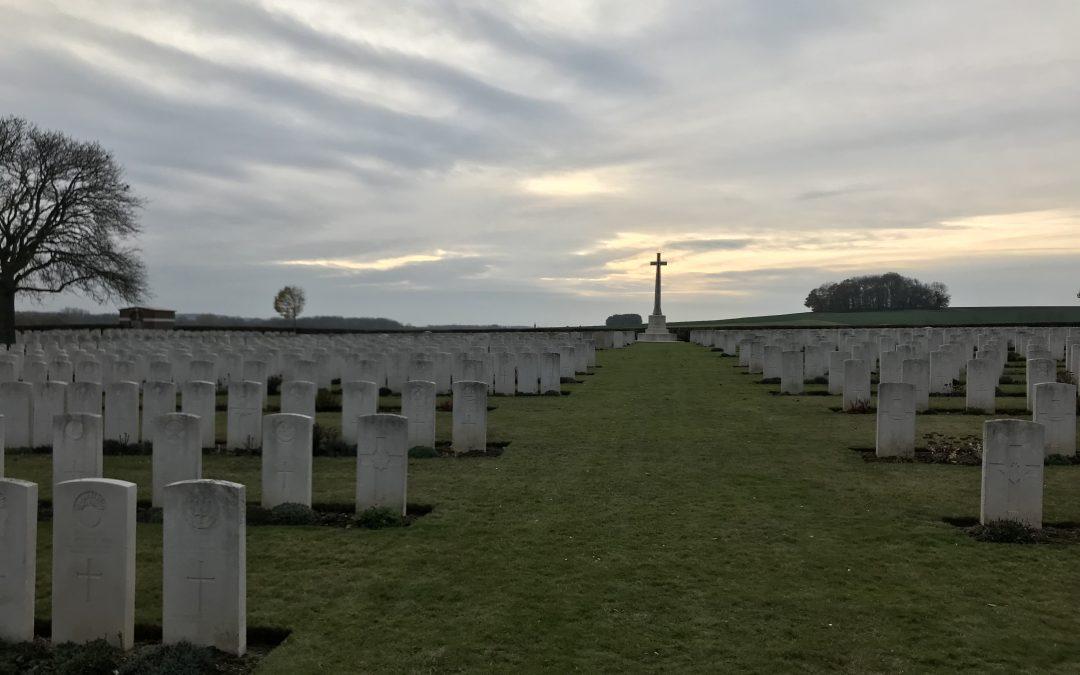
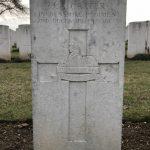
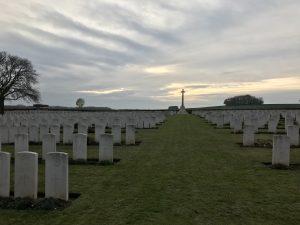
Private Joseph Arthur Carter 22883, 1st Bn., Lincolnshire Regiment who died on 22 December 1917 Age 30. Son of John and Mary Carter, of 27, Hereward St., Bourne, Lincs. Remembered with honour Tincourt New British Cemetery.


Recent Comments