Remembrance – George Sherwin

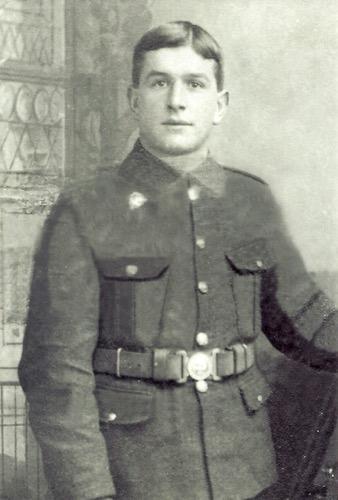
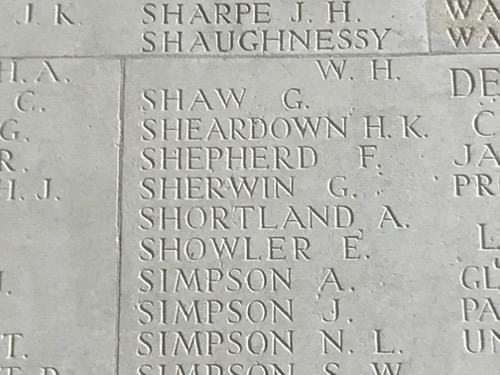
Today we remember Bourne man George Sherwin of the 2nd Battalion Lincolnshire Regiment who was killed on the 1st July 1916, the first day of the Battle of the Somme.

George was born in 1891 in Bourne to Luke Woodstock Sherwin, a General Dealer and his wife Mary Jane, nee Brand.

Luke Woodstock Sherwin was born in Bourne in 1855 and was a Brewer (Later a General Dealer), Mary Jane Brand was born in Bourne in. 1857 and the couple were married in the Stamford District in 1877.
They settled in Bourne where all of their 10 children were born.
• John Sherwin, 1878, Bourne
• Florence Sherwin, 1879, Bourne
• Sarah Jane Sherwin, 1881, Bourne
• Elizabeth Sherwin, 1883, Bourne
• Albert Sherwin, 1885, Bourne
• Gertrude Sherwin, 1886, Bourne
• Fanny Sherwin, 1888, Bourne
• Luke Sherwin, 1889, Bourne
• George Sherwin, 1891, Bourne
• Alice Sherwin, 1892, Bourne

By 1891 Luke had changed occupation to a General Dealer and they were living on West Street, Bourne with the first 8 of their children.
10 years later the 1901 Census shows us Luke living on West Street next door to his brother George, also a general Dealer. The family is now complete and as well as Luke working as a general dealer, eldest son John was working as a Shop worker. An occupation that Younger son Luke would later go on to have with his own shop on West Street.

In 1911 we find the Luke and Jane Sherwin still on West street now married for 33 years although sadly we learn that three of the ten children have now passed away. As well as George being a general dealer, son John has joined him in that occupation. Son Luke is working as a hair dresser (Picture of Luke’s shop has been added to the photographs on this post) and George is working as a maltster . This is not unusual for Bourne’s young men especially as the Maltings were on the opposite side of West Street to where the family were living. Youngest Daughter Alice is the only other child living at home on the census night 1911.

George Sherwin filled out his attestation form and enlisted in the Army at Bourne on the 30h August 1914. On his attestation he declares that he has had previous military service with F Company 4th Lincolns (Disbanded).
He is given the Regimental number 11059 and posted to the 7th Battalion Lincolnshire Regiment at the depot in Lincoln. After a coupe of days he is moved to Grantham and then on the 9th September posted to the 6th Battalion.

The 6th Lincolnshire was formed in the first week of the war and stationed themselves at Belton Park near Grantham, ready to receive recruits. By the end of the month they had formed 4 companies of new recruits from the men that answered Kitchener’s call. It was noted that the physical standard of troops for the 6th Battalion was high due to the high numbers of agricultural workers that joined the Battalion.

————————————-
Grantham Journal Saturday 5th October 1914
BOURNE
HEARTY SEND OFF FOR RECRUITS -On Monday morning a company of fifteen left Bourne Station to join the Lincoln Regiment of Lord Kitchener’s Army. The company met at the recruiting station in West Street, and we escorted to the station by the Bourne Brass Band and a large number of the residents of the town. The names were:- Arthur Maxon, Fred W Savage, John Thos Baldock, Geo Sherwin, George Carver, Frank Baldock (married), H Cleary, W Herbert Bloodworth, Percy J Vickers, Walter Parker (married), Ernest Robinson, Harry Darnes (Bourne), Jos Smith, Walter Archer and Percy Cave (Witham-on-the Hill), the latter three being the result of a meeting at Witham-on-the-Hill on Sunday evening, addressed by Lord Kesteven and Lieut K. R. G. Fenwick and presided over by Col C Birch-Reynardson.
————————————-

George trained with the 6th Battalion at Belton Camp until the 29th January 1915 when he received a posting to the 3rd Battalion in Grimsby. The third Battalion were a home service battalion and would be used to guard key infrastructure in the area such as docks and munitions factories. They were also used to train men who had joined the army as a career before they received their posting to either of the 1st or 2nd Battalions which were regular army battalions.

George would remain with the 3rd Battalion for about 6 weeks before receiving is orders to join the British Expeditionary Force in France and so George embarked for France on the 6th March 1915. Typically when arriving in France men would arrive at a base camp to be processed and then posted to their Battalion in the field. In George’s case he was posted to the 2nd Battalion on the 9th March 1915. It is assumed that he arrived with the Battalion around this time but as this could take many days we cannot be totally sure that he had joined them before their next action on the 10th March. The Battalion Diary makes no reference to receiving reinforcements at this time or any time in the months before or after.

In March the 2nd Battalion had just been moved from their previous sector into the area of Neuve-Chapelle in readiness for the planned attack on the German defences there. The plan was to take Neuve-Chapelle and then move on to Aubers Ridge.
The battalion Diary tells the story of what may have been George Sherwin’s first action of the war:-

10th March 1915 – Opposite Neuve-Chapelle
7.30am – Battalion remained in trenches during the night 9th-10th at 7.30 artillery bombardment started (about 300 guns). At 8.5 am guns lifted their sights and infantry attacked. The Colonel was with the assaulting companies.
The Battalion all rose simultaneously and rushed the first trench after cutting the barbed wire in an incredibly short time – losing about 20 men. The blocking parties then proceeded down the trenches clearing all before them with grenades –
Captain Peake did good work, he was soon afterwards shot in the head. The Battalion still moved on – the supports (A and B Companies) following up close in rear – some of A company supporting the firing line as soon as it got to the second German trench. Lt Col G B McAndrew was hills between the first and second German trench – his right leg was blown to pieces by one of our own shells – he died asking after his regiment, without any complaint of the pain he was suffering. The assault in companies then pressed on, being temporarily checked by a water obstacle at ’26’ (see map attached) – a plank was eventually discovered and the line took a position in front of this obstacle. They were then checked by the fire of their own guns and it was found necessary to retire 50 yards on account of this. It was at about this period that we were subjected to a severe fire from our left rear, which caused the greater part of our casualties. Lieut. Wylie was shot (mortally) at about this time. The line then retired again and took up a position behind the water obstacle where they entrenched themselves. The battalion was then sorted out into its proper sections – A and B Companies remind in the front trench while C and D companies were in rear in an old German trench which was being converted to face the other way. Later on in the day a and B companies were sent forward to help the Irish rifles who were previously passed through us. They help them in and trenching themselves in. During the night of the 10th-11th C and D companies were back in the fire trench behind the obstacle – A and B Companies in support German trench just in rear. The battalion was then commanded by Major J J Howley DSO. Captain E H Impey was adjutant, Captain E P Lloyd having been wounded in the hand.
During the small hours of the morning of the 11th, A and B cos had to move to be in close support of the Irish Rifles – at about 5 am we had orders to collect the battalion in some trenches near us on our left rear. To do this the headquarters of the battalion moved to a point ‘X’ just south of ’18’. At about 6 am a small H E Shell came through the parapet – making a direct hit on Major Howley – killing one of the other men and wounding two more. Major S Fitz G Cox then took command and the battalion was eventually collected in the old German trench just in rear. During the morning and operation order was received to the effect that the Irish Rifles and Rifle Brigade would attack at 10 am and that the Lincolnshire Regiment would support the Irish rifles – this order was afterwards postponed to 12:30 pm. At 10 am the battalion was subjected to a very heavy shelling which lasted till 12 o’clock. The shelling was very accurate, and they were big shells – so the moral of the regiment was very highly tried – especially after all it had already gone through. At 12:15 pm Major Gitz G Cox decided to anticipate an order which should been expected (our telephone wire had been blown away) and namely to move up to Neuve Chappelle into close support of the Irish Rifles. This was done. The battalion remained in Neuve Chappelle during the night of the 11th-12th.

12th March 1915 – Neuve Chapelle
On the morning of the 12th we moved back to our previous position into the old German trench. The battalion remained in their trenches all that day and night. It was between 12 and 1 am on the 13th that Captain C G V wellesley was killed – he had been ill and away from the regiment previous to this, and had only just rejoined 10 minutes before a shrapnel burst from the left – mortally wounded and him and about 10 others.

13th March 1915 – Neuve Chapelle
Next morning we went into loose support of the Irish Rifles returning again to these trenches during the afternoon (?). On the morning of the 13th we believe the Irish rifles in trenches North East and East of Neuve Chapelle. During the night nothing unusual because we strengthened our defence and filled in the trench, which was full of half buried Germans.

14th March 1915 – Neuve Chapelle
Enemy shelled Neuve Chappelle all day. During the night we were relieved by the Royal Berkshire and we intern relieves the door sits in adjoining trenches on our left.

15th March 1915 – Neuve Chapelle
Spent in consolidating our position – add a detached fort of 40 men a machine gun and officer about 40 yards to our front, which wanted strengthening.

16th March 1915 – Neuve Chapelle
Enemy shell headquarters trenches very severely – dropping 128 shelves within 50 minutes no damage done.

17th March 1915 – Neuve Chapelle
Released by Irish Rifles – total casualties during action of Neuve Chapelle –
7 officers killed. 8 officers wounded – 298 men killed and wounded.
Went into trenches on Tilloy Road.

18th March 1915 – Neuve Chapelle
Provided working parties for burying dead and carrying materials etc.

19th March 1915
Moved to billets at Epinette.

George Sherwin certainly had a big introduction to trench warfare in his first tour of the trenches and the planned attack. As can be seen from the description over one quarter (1 in 4 men) became casualties in the Battle of Neuve Chapelle, although it would take a second battle in May before both the objectives of taking Neuve Chapelle and Aubers Ridge would be realised.
The Battle of Aubers Ridge description for the 2nd Battalion, including George Sherwin, can be found on our posts regarding Charles Sharpe, Archer Cooke and Harry Briggs.

The Battalion remained in the same sector of the Western Front doing tours in and out of the trenches until in September 1915. On the 25th September they had their next major planned action with the assault on Bridoux.
Following this it was back to their normal tour routine until November when they started company training and over a period were moved back to la Belle Hotesse for Divisional training that was to go on throughout December 1915.

January was to see them back in the trenches near Fleurbaix in the same old sector they had left in November and back into the tour of trenches routine with usually 4 days in and the same out before repeating.
At the end of March the Battalion entrained for the Longveau and the Somme, then marching to Flesselles via Amiens.

In George’s Service Record there is a note that on 1st April 1916 he was awarded 7 days field punishment No.2 by his Commanding Officer for “making an improper remark to a Non-commissioned Officer”.

The Battalion eventually ended up near Albert, in Brigade reserve, on the 9th April, being brought back into the trenches on the 11th in support of the 2nd Berkshire at USNA Redoubt, before finally getting back into the fire trenches themselves near La Boiselle on the 13th April.
The usual trench routine they had previously been used to around Armentieres now resumed, only now it was Albert and the Somme rather than Sailly and Bois Grenier.

June, when not in the trenches, would see the Battalion start to undertake extra training or periods when they supplied working parties, one such party working on the railway extension at Dernacourt. This continued until the 24th June when the Battalion Diary notes ‘Bombardment Commences’, this of course being the Bombardment that was meant to destroy the enemy trenches in advance of the commencement of the planned attack (Battle of the Somme) that would follow the days of bombardment.

We take up George’s story and that of the Battalion via the Battalion Dairy on the 28th June after going back into trenches overnight.

28th June 1916 – In trenches
In trenches preparatory to assault – Operations postponed about 4pm – Move to billets at Millencourt. Bombardment continued – 1 killed, 2 wounded.

29th June 1916 – In Long Valley
Move to bivouacs in Long Valley “W” company to Bouzincourt defences – Bombardment continues.

30th June 1916 – To assembly trenches
Moved to assembly trenches – W company 8 platoons front line 1 platoon – Pendle Hill. X company 3 platoons front line 1 platoon – Longridge – Y company 3 platoons in front line 1 platoon Longridge. Z Company 2 platoons Pendle Hill 2 Platoons Longridge. Battalion Headquarters Waltney Tunnel.
Battalion in position about 2.30am July 1st.

1st July 1916 – In trenches opposite Ovillers
Everybody was in their position by 3:30 am and the wire along the home of our front reported cut by 2:30 am. 2/Lt Eld and a few men got wounded doing this and Lt Ross’ party had trouble owing to continual hostile machine-gun fire. Brigade line was checked at 5:30 am.
6.25am – the intensive bombardment commenced to which the enemy retaliated on our front line and assembly trenches with high explosive shrapnel.
7.25am – companies started to move forward from there are similar positions preparatory to the assault. The three assaulting companies getting their first two waves out into no mans land and the third and fourth waves are out at zero hour. These arrangements were carried out most excellently, no hitch occurring, but casualties were fairly heavy from machine-gun fire. The support company got into our frontline trench but suffered a lot of casualties from shellfire.
7.30am – as soon as the barrage lifted the whole assaulted. They were met with very severe rifle fire and in most cases add to advance in rushes and return the fire. This fire seem to come from the German second line and the machine-gun fire from the left. I’m reaching the German front line they found it strongly held and we met with showers of bombs, but after a very hard fight about 200 yards of German lines were taken about 7:50 am the extreme right failing to get in and also the extreme left where there appeared to be a gap of about 70 yards although units of platoons of the 70th brigade joined them. The support company by this time joined in. A few offices that were left gallantly lead the men over the German trench to attack the second line but owing to the rifle and machine-gun fire could not push on. Attempts were made to consolidate and make blocks but the trench was so badly knocked about that very little cover was obtainable. From the enfilade machine-gun fire and continual bombing attacks which were being made by the enemy the whole line, and one frontal attack from the second line which we repulsed.
9am – this isolated position became untenable, no supports being able to reach us owing to the intense rifle and machine-gun fire. I will left being driven back the reminder which by now only held about 100 yards had to withdraw. On reaching our own line all the men that could be collected were phoned up and tried to push on again but the heavy machine gun and rifle fire made the ground quite impassable.
1pm – orders were received from the Brigade to withdraw to Ribble and Melling streets and occupy the assembly dugouts there which was done.
12 midnight – we were relieved by this 6th West Kents and proceeded to Long valley.
Other Ranks, 26 killed, 303 wounded, 89 missing, 25 wounded and missing.

Private George Sherwin was originally posted as wounded and missing in this fateful day for the British Army. It would not be until 23rd April 1917 that he was “Accepted an official purposes as having died on or since 1st July 1916”

——————————————

Grantham Journal 19th May 1917
LOCAL CASUALTIES – Corporal Jos. Brown, son of Mr. and Mrs. John Brown, of Eastgate, Bourne, is in hospital at Hampton Court, suffering from wounds in his back and right hand. He is one of six sons, five of whom are in the Army. Private. G. Sherwin, son of Mr. and Mrs. Luke Sherwin, Bourne, who some months ago was officially notified as wounded and missing, is now reported dead. The official notification of Private Sherwin’s death was received by his parents last week. A memorial service for Private Sherwin and Private W Needham was held on Sunday, at the Abbey Church. Official notification has this week been received the Corporal E. Robinson, son of Mr. and Mrs. John Robinson, Wood View, Bourne, has been killed in action. Corporal Robinson was attached to the Lincolns.

Mr Luke Sherwin eventually received The British and War Medals for his son and the returned confirmation of delivery slip was sighed for by Luke Sherwin on Nov 10th 1921.

Brother John Sherwin also Served in WW1 with the Army Service Corps in the remounts section, enlisting in June 1916 one month before his brothers’ death, being mobilised in May 1917 and embarking for France in that September.

https://www.southlincolnshirewarmemorials.org.uk/…/george-…/

Family Photos Courtesy of Philip Sherwin
Remembrance – William Swift

Today we remember 2nd Lieutenant William Swift who was killed in the action of the 1st July 1916, first day of the Battle of the Somme, serving with the 8th Battalion, Lincolnshire Regiment. William is remembered on both the Morton and also Bourne war memorials.

William was born in Morton in the late spring of 1889 to George Swift, a grocer and draper, and his wife Mary Ann, nee Wright. George was born in. Morton on 23rd May 1862 and Mary Ann was born on 30th January 1866 in Brentford, Middlesex.

The couple were married on the 17th January 1887 in All Saints Church, Walworth, London., immediately moving back to Morton to start their family having five children in total.
  Laura Agneta Swift, 1887, Morton
  William Swift, 1889, Morton
  Bertha Swift, 1890, Morton
  Percy Swift, 1893, Morton
  Ella Mercia Swift, 1898, Morton

In 1891 the young family were living in Morton where Henry Swift had his own grocer’s shop close to the church. At this time George, Mary Ann, Laura Agnetta, William and Bertha were living at the shop and they were joined by George’s Elderly Mother Caroline.

In another seven years time the family would have been complete, with youngest Son Percy and Daughter Ella being born. The family are still living at the shop in 1901 where George is still running his small business.

William would eventually leave Morton School and attend Bourne Council School where later he was to become a Pupil Teacher. He Matriculated at London University before moving back to the Peterborough Area to start his career at St Peter’s teacher training College. On Census Night of 1911 William was boarding at St Peter’s School at he age of 21. 

William furthered his career when he Entered St Catherine’s College, Cambridge to obtain his degree. Here he joined the Officer Training Corps but his undergraduate period was eventually broken by entering the Army.

We are currently unable to access any service records for William Swift, many of the men of the Great War unfortunately had their service records destroyed by a warehouse fire in London during the Blitz. William being an officer has a different record set that are held at the National Archives in London WO 339/40260 but these have not been digitised and it is not possible to currently view these due to the closure of the Archives to the public during the current pandemic. We will research these records and add to William’s story when this is possible. Officers were given a long service number that stayed with them throughout their career, unlike the other ranks of men who were given a number by their regiment or battalion that was the next available and thus there was no coordination between different regiments and duplicate number across different regiments was possible. Unfortunately without this number and his papers held at the National Archives it is tricky to piece together Williams exact movements.

The following information has been collated from various available sources including newspaper articles and the Battalion Diaries and the “History of the Lincolnshire Regiment” by C R Simpson.

We are not sure when William enlisted in the Army but we do know that he trained with the 3rd Battalion Lincolnshire Regiment. The 3rd were a Home Service battalion and would traditionally be responsible to guarding essential infrastructure such as docks, munitions factories and other work necessary for the war effort. During the first phase of the war the Battalion would be responsible for training before the formation of the Army Training Reserve in 1916 once conscription was introduced.

Similarly we do not know exactly when William joined his Battalion, the 8th Lincolns.
The 8th Battalion Lincolnshire Regiment was formed in 1914 and after training camps in England eventually was sent to France in September 1915. The medals roll shows that William entered foreign service in France on 8th April 1916 at this point joining the Battalion that were already in the field.

During his training with the 3rd Battalion he gained his commission and in May 1915 was granted leave, coming home to Morton visiting is recently retired father before returning to Grimsby.

———————
Grantham Journal Saturday 15th May 1915
MORTON
CONTRATULATIONS to Lieut. William Swift, who has recently obtained his commission in the 9th Battalion Lincolnshire Regiment. Mr. Swift, who quite recently retired from business in Morton. Lieut Swift is a schoolmaster, and had been most successful in his profession at the time of entering the Army, being a student at Cambridge University and a member of the Officers’ Training Corps. This week, Mr Swift is home on leave for a few days, after which he departs to Grimsby to continue his training with the 3rd Battalion Lincolnshire Regiment. Mr Percy Swift, brother, has also joined the forces, his choice being the 5th Leicesters.
———————

Returning to Grimsby to continue his training, William was to marry May Butler in Grimsby district between September and December 1915. It is not known if, when he left for the front he following April, William was aware that May had fallen pregnant.

The medals roll shows that William entered service in France on 8th April 1916. This was the day that the Battalion marched to Buire, on the River Ancre, four miles south-west of Albert, whence it furnished large working parties.

On the 14th April the 8th battalion moved to support positions about Becordel-Becourt village where, till the 22nd, much work was done on the forward trenches. William eventually joined the Battalion in the field on the 19th April and was posted as a Platoon Commander.

The first Battalion relieved the 8th on the 22nd of May in the right sector opposite Fricourt. The 8th Battalion then moved to La Neuville, opposite Corbie, on the Ancre river.

The attack for the first battle of the Somme could be seen to have started on the 24th June when one thousand five hundred and thirteen artillery guns opened on the enemy trenches. Day after day the guns continued to pour thousands of shells into the enemy trenches until they resembled a rubbish heap; but below ground, the enemy troops sheltered in deep dugouts, were safe from even the enormous shells of our “heavies”. In no less than 40 places gas was discharged and every enemy observation balloon was destroyed. The enemy replied fitfully to the shelling as they only had two hundred and forty guns on the Somme front at this stage.

At the end of June, the 8th Battalion Lincolnshire Regiment was detailed to support the 8th Somersets in the attack on the German positions planned for the 1st of July (the first day of the first battle of the Somme) and on the 30th of June moved to assembly trenches near Becordel-Becourt village.
The plan for the 8th Battalion Lincolnshire was to be the second wave of the attack with the York and Lancasters on their right and to filter through the new line once the Middlesex and Somersets had taken the first objective. Then one company of the 8th Battalion Lincolnshires was to advance immediately with the Somersets to clear the enemy front line trenches and fall in behind the remainder of the battalion as it advanced.

Throughout the night the guns bombarded the enemy lines in front of the zero time of 7.30am on the 1st ofJuly

At 7.25am the leading platoons of the advanced battalions carried out their plan and attempted to crawl towards their objective.

The Guns lifted at 7.30am and the enemy left their deep dugouts and placed machine guns to meet the advance with destructive force tearing gaps in the advancing battalions. The Middlesex and Somersets lost fifty percent of their men in the advance yet survivors reached the enemy trenches.

The 8th battalion Lincolnshires attacked with B and C companies; supported by A company with D company in the rear as a carrying party with picks and shovels, trench stores, ammunition and bombs. The leading platoons lost half of their number but the survivors reached the enemy front line and after being checked by machine gun fire the bombers got to work and knocked out the defences.
The survivors joined by successive platoons swarmed over the battered front line and crossing Empress trench and Empress Support reached the Sunken Road. The numbers of officers and men that got thus far we small in numbers because an enemy barrage was falling on no mans land and the supporting platoons suffered heavily.

The battalions bombed their way down the enemy communications trenches, Dart Lane, Brandy Trench and finally Lozenge Alley was reached. En-route every dug-out was bombed and the trenches themselves were battered beyond recognition being just a mass of craters.

One stokes gun remained with the Lincolnshires and gave valuable assistance until the officer in charge and his team were knocked out. A Lewis gun team arrived and gave great assistance to the advance.

Only two parties of the 8th battalion reached Lozenge Alley numbering about one hundred men and started the act of consolidation. Between 4 and 5pm orders arrived from Divisional HQ to consolidate the positions they held with the Lincolnshires holding part of the system from Dart Alley to and including Lozenge Alley. Throughout the night the 8th Lincolnshire successfully repulsed a bombing attack from the direction of Fricourt.

The right flank of the Lincolnshire area was attacked from Fricourt up Lonely Trench. Men were posted at the junction of Lonely Trench and Lozenge Alley and the enemy only once got in thanks to their rifle grenades but were soon turned out at a loss to the Lincolnshires of some men of Lozenge Alley and at least 20 in Lonely Trench. Two enemy drums were captured here and sent to the depot at Lincoln.

When Darkness fell on the night of the 1st July, although initial success had not been maintained, progress had been made at many points. Although Fricourt had not been taken it was now pressed on three sides with the 21st division holding the north which included the 1st and 8th Battalions of the Lincolnshire Regiment.
During the night the 8th Battalion had worked hard consolidating their positions from Dart Alley to Lozenge Wood and were protected from a counter attack by an artillery barrage.

Seven Lincoln Battalions in total were involved in the advance on the first day of the Battle of the Somme, known as the Battle of Albert, and the description of actions above was just one of many similar accounts that can be applied to all Battalions involved in this advance. It must be remembered that this day was followed by another 12 before the Battle of Albert was over.

8th Lincolnshire – 5 officers killed, 30 other ranks killed, 8 officers and 170 other ranks wounded, 34 other ranks missing. In total 13 officers and 235 other ranks.

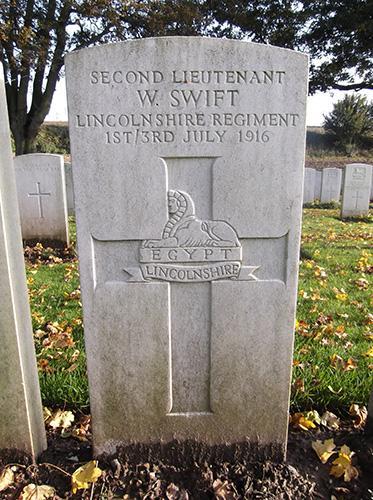
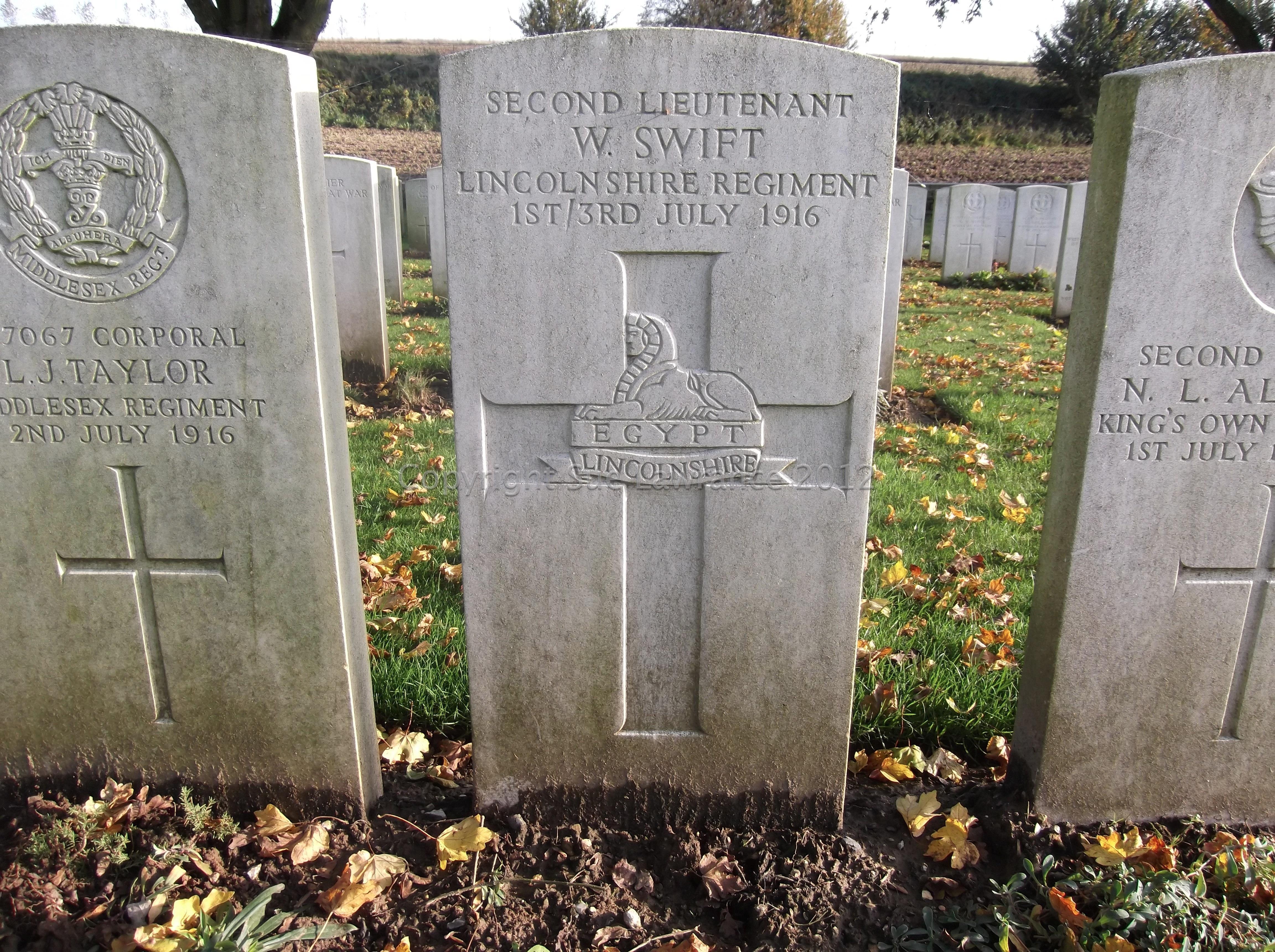
Second Lieutenant William Swift was killed on the 1st July 1916 during the advance on the first day of the Battle of the Somme and less than 3 months after arriving in France. The CWGC officially states that he died between the 1st and 3rd of July, but he is mentioned amongst the dead in the Battalion diary for the 1st of July.

On the very same day that William lost his life in battle, a letter he had written to his old headmaster Mr J Palmer in Morton was published in the Grantham Journal, the readers not knowing his fate during that day.
———————

LETTER FROM AN OLD MORTON BOY – The following extracts are taken from an interesting letter from Lieut. W. Swift, to Mr. J. W. Palmer:- “I have had a lot of moving about since coming here, a variety of billets, some good and extremely bad, and many curious situations, but we have to take the bad with the good and hope for butter times some day. I have slept in a wood, in an orchard, in a muddy trench, in a dirty bed in a French farmhouse, and occasionally have had the luxury of a decent feather bed in a respectable hotel. An extremely pleasing feature about this existence in the manner in which our splendid lads adapt themselves to their trying circumstances. Sometimes wet through, or covered with the mud from chalky trenches, and terribly hot with heavy roads on long marches. they still “carry on” with square chins. I feel quite proud to be amongst such a fine lot of felloes, both officers and men. You don’t realise what the British Army is like until you see it in this country. I have been in the trenches several times, once for a period of ten days. During this time we had several exciting hours, what with one thing and another. They shelled us with all kinds of stuff. sausages, canisters, and whizz-bangs, but our heavies always replied quickly with about three to the Huns’ one. The sausages you can see falling if your eyesight is good, but the whizz-bangs, as their name implies, come “some pace.” In one part of the line we could only get sufficient water up for drinking, so you can imagine how I gave my razor a rest, and the luxury of a bath after keeping clothes on so long. I often see Fisher Handford, and his officer tells me he is one of the best and cheeriest in his platoon. Certainly, Fisher is always smiling when I see him. I feel proud to think he is a Morton boy. You can tell his mother he is the picture of health. At present, I am billeted in a farmhouse. The French people. what few there are left round here, keep their gardens in beautiful order, and scrupulously clear. In this place, another officer and myself share a room, and we are absolutely overrun with rats. Last night, we made a couple of traps with our steel helmets. We propped them up with a sardine tin, and placed a tempting piece of cheese inside. We sincerely hoped for success, but our friend rat was too cute for us, eating the cheese without disturbing anything else. There is a decent artists from the music halls, who entertain us on returning from the line. It is a fine thing for keeping up the spirits and taking you mind from grenades &c. Boxing and football matches seem to catch on the best, but in these June days I often wish for a bit of cricket, though the ground, of course is unsuitable for that.”

———————
Grantham Journal Saturday 29th July 1916
WAR LETTER FROM BOURNE BOYS.
One of the old Council School boy, writing to Mr. J. J. Davies, says:- I have seen very close quarters many of the prisoners we have taken, and I am struck by the sullen, almost criminal type of face. One is not astonished at the cruelties of which we have heard. These hundreds of figures are clad in grey; dirty, miserable looking. I do not think any scenes of past history can rival the tragic and glorious episodes enacted here during the last three weeks. One sees the khaki-clad Briton going fearlessly, even brightly, into the fight, and one sees the wounded returning, who, whatever they suffer, are yet smiling and cheerful. What a splendid lesson. These scenes are beyond my powers of description. Your imagination must fill in the picture: who can fail to be profoundly impressed? It gives one food for thought. What a terrible lot the Germans will have to answer for. Still the “push” goes on. The opinion of all here is that the end, a glorious one for the Allies, is not many months distant. I am sorry to hear that Lieut. Swift has been killed: he has given life for others. No finer death can man die. Duty well done and death even on a battlefield has its glory.

———————

On the 2nd November 1916, William’s daughter Megan Fricourt Swift was born at the Bargate Nursing Home. Mrs May Swift, the Mother was at the time living at ‘Laurels, Old- Clee Road, Cleethorpes.’

Commonwealth War Graves Commission:
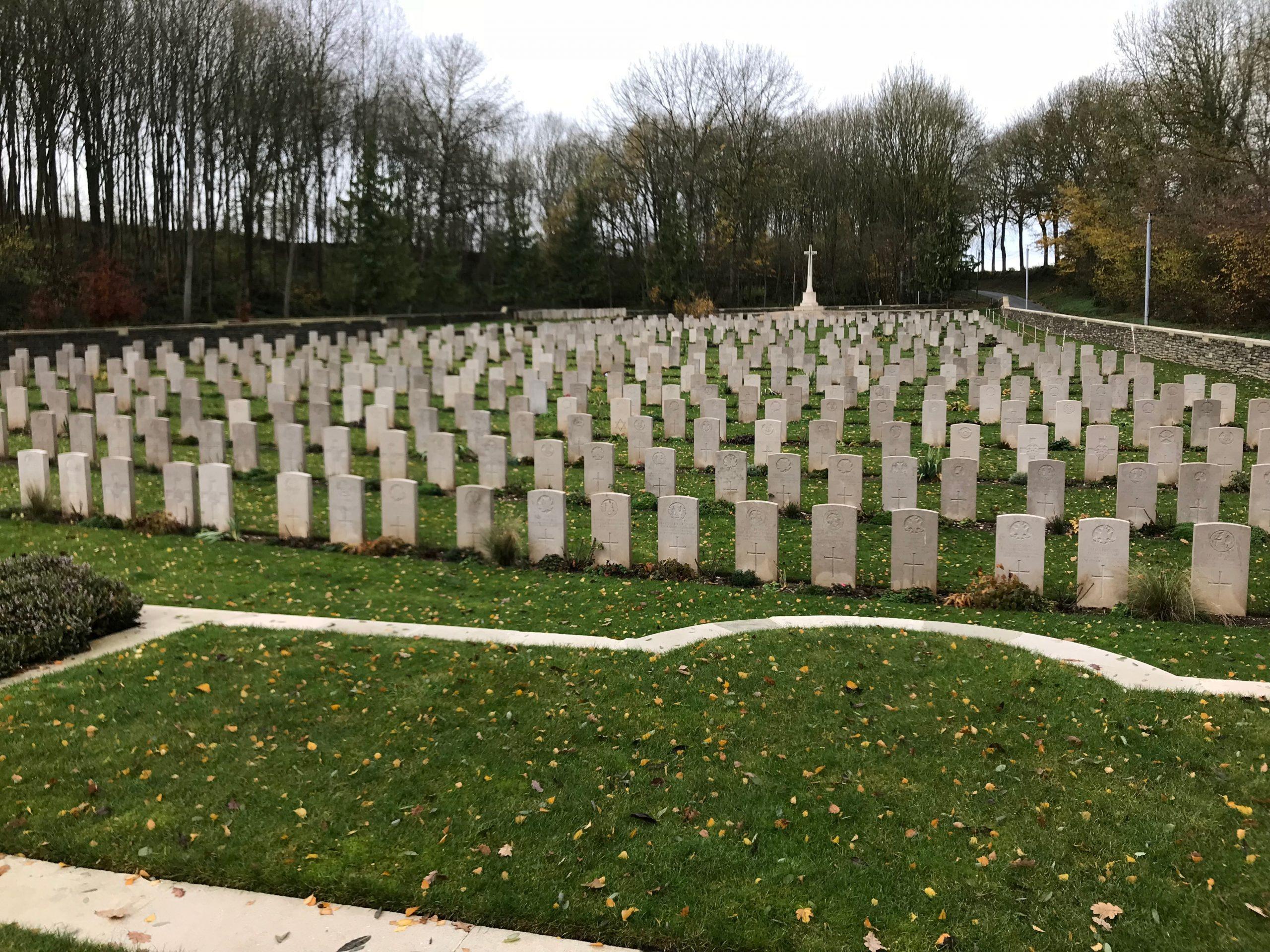
In memory of Second Lieutenant W Swift, 8th Bn., Lincolnshire Regiment who died on 1 July 1916. Remembered with honour, Gordon Dump Cemetery, Ovillers La Boisselle.

William is also remembered on the War Memorials in his home village of Morton, also on Bourne Memorial where he finished his education and started his teaching career. He is also remembered on the memorial tablet dedicated to St Peter’s Training College in Peterborough Cathedral, and the memorial in Bourne Baptist Chapel.

Remembrance – Wilfred Dent Wroe

Today we remember local Baston man Lieutenant Wilfred Dent Wroe who was killed in action on this day, 29th June 1916, whilst serving with the 10th Battalion Lincolnshire Regiment on the Somme.

Wilfred Wroe was born on the 31st March 1884 in Burnley Lancashire to Dent Wroe and his wife Florence, nee Barnes.
Dent Wroe was a school master who was born on 9th March 1859 in Colne Lancashire, his wife Florence Barnes was born on the 19th August 1858 in Burnley. The couple were married on the 28th December 1881 in Burnley St Matthews.
The couple went on to have three children all born whilst they were living in the Burnley Area:-
• Wilfred Dent Wroe, 1884, Burnley
• Mary Wroe, 1886, Burnley
• Annie Wroe, 1887, Burnley

In 1891 the couple were living at 6 Harriet Street in Habergham Eaves, Burnley.
At this time Dent Wroe was a schoolmaster, Florence a School mistress and both Wilfred aged 7 and Mary aged 5 were listed as scholars. The youngest daughter Annie aged three was the youngest member of the family and also living in the house was Isabella Wardle their 15 year old general domestic servant.

In another 10 years time Wilfred had already left home and was working as a Pupil Teacher at Rugby St Matthews school. Wilfred and another pupil teacher, William Wright, boarded in the home of Henry West, a groom, at 43 Oliver Street, Rugby.
Wilfred received his early training at Rugby St Matthews and on the 3rd March 1905 it was reported in the Northampton Mercury that had gained success in the King’s Scholarship, Third Class – Division 1.

Between 1906 and 1908 Wilfred attended Saltley Training College (St Peter’s College, Saltley, Birmingham) arriving as an uncertified teacher.
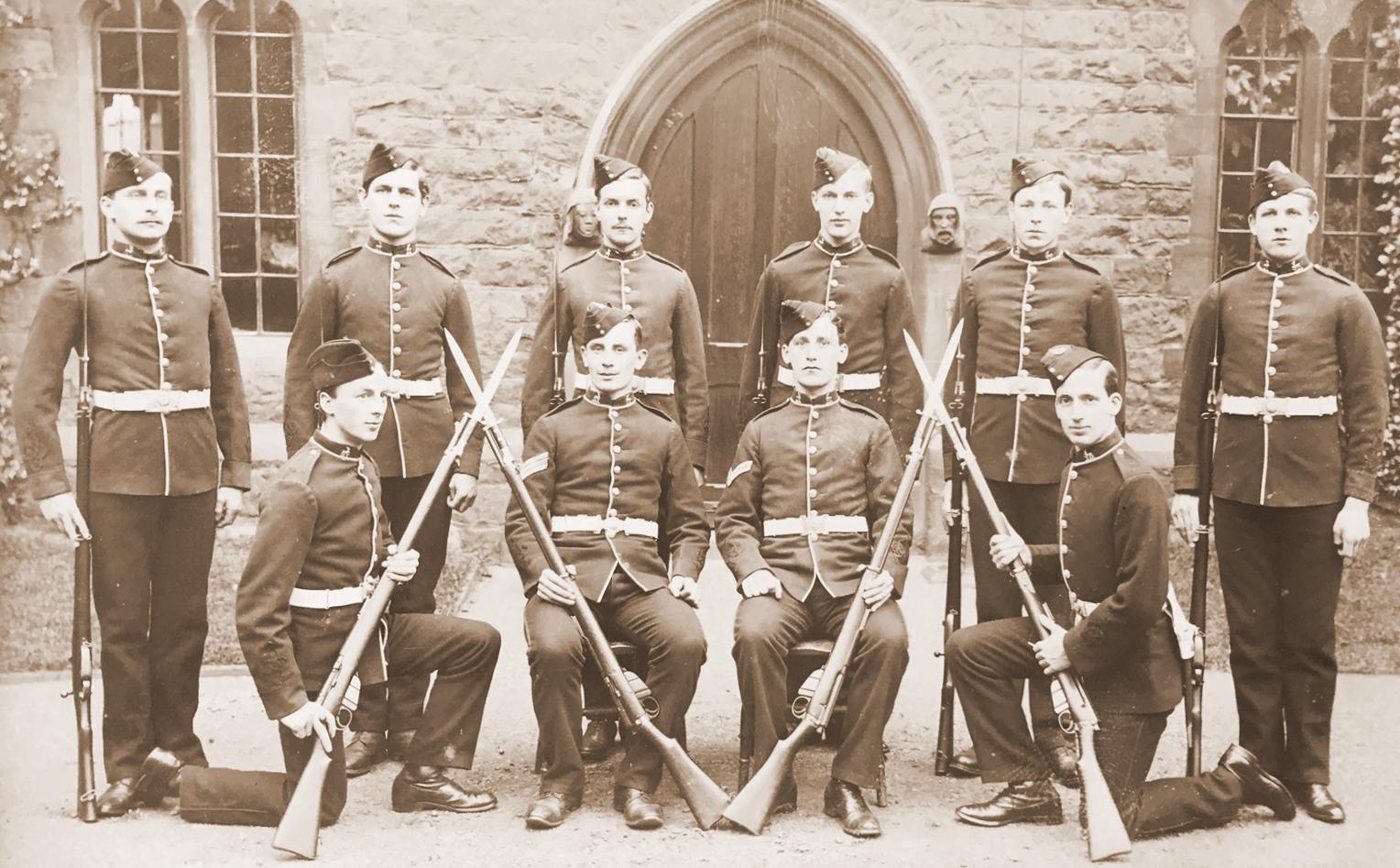
During his time at Saltley he joined the College Guards, and as a precursor to his later service, he was also promoted to Sergeant in the Royal Warwickshire Regiment..

(Photo attached, Wilfred front row right kneeling, Saltley College Guards 1907. Photo with permission of Paul Nixon, British Army Ancestors https://britisharmyancestors.co.uk/ )

After qualifying as a teacher Wilfred moved to Lincoln in August 1908 to join the staff at the North District National School in Lincoln. During his time in Lincoln he was well known as a member of the Carholme Golf Club and he was reported as an enthusiastic Golfer. It was also reported that as a teacher he had a promising career and in social life he had a quiet and genial personality that endeared him to all.

The next official record for Wilfred was the 1911 census. By now he was living at 36 York Ave Lincoln, and his occupation was given as an elementary school teacher working for the borough council. He was once again boarding, living with Mary Ann Moses a widow and her daughters Mary Moses (38) a Dressmaker and Ellen Frances Moses (36), both single.

Wilfred was to move home once again before the beginning of the war moving only 2 minutes walk away, into the next street at 22 Albert Crescent in Lincoln. This was even closer to the West Common and the Carholme Golf Club .

We have been unable to find the official service records for Wilfred. This is common for WW1 soldiers as 60% of all their records were destroyed in a fire in a London warehouse where they were being housed in the Blitz. The following information has been pieced together using other available sources such as medals rolls, newspaper reports and especially the war diaries of the 10th Battalion Lincolnshire Regiment and effectively tells the story of not only Wilfred’s war but also that of the ‘Grimsby Chums’ the 10th battalion of the Lincolnshire Regiment.

On the 21st September 1914, three teachers from the North District School, Lincoln, left to take up their duty. Wilfred was accompanied by Mr A Dowman and Mr H G Woods. The next day, 22nd September, the three chums enlisted in the 10th Service Battalion of the Lincolnshire Regiment, ‘The Grimsby Chums’.

The Battalion had been raised in Grimsby by the Mayor and started recruiting on the 9th September 1914. The battalion was billeted in Grimsby, the HQ being the Drill Hall and equipped by contracts made by the raiser with private firms payment being made by Northern Command either direct or by an Officer’s Impact account, the Battalion was finally taken over by the war office in July 1915.

Almost at once Wilfred received a commission as temporary 2nd Lieutenant, and then in August he was to be made Temporary Lieutenant.

Sheffield Daily Telegraph Wednesday 18th August 1915
Infantry Service Battalions
10th Battalion the Lincolnshire Regiment (Grimsby).
The undermentioned Temporary Second-Lieutenants to be Temporary Lieutenants: Harold L. Dent, Wilfred D. Wroe, Allan H. Smith, Ransome C. Green.

He later received his second star as 1st Lieutenant in December 1914.

The Battalion moved from Grimsby to Brocklesby Park and initially the Battalion was Brigaded on the 28th December 1914 to the 115th Infantry Brigade.

Their training continued at Brocklesby Park through the first half of 1915 being inspected by the 115th OC Brigadier General Bowles on the 19th February.

On the 23rd April they took part in a route concentration march from the South Humber Defences to Barnetby-Le-Beck were it was inspected by Brigadier General Nugent.
Training continued and the next month saw the Battalion entrained on the 19th May bound for Cleethorpes from where it Marched through Cleethorpes and Grimsby, halting to be addressed by the Mayor. The march occupied from 6pm to 8.30pm at which time the Battalion entrained at Grimsby and returned to Brocklesby.

In May 1915 the Battalion had its passing out parade and along with Lieutenant Wilfred Wroe officially took its place in the British Army.

Their next posting was to Studley Royal Camp in Ripon on the 17th June where it joined the 101st Infantry Brigade, part of the 34th Division. The 101st Brigade consisted of the 10th Lincs, 15th and 16th Royal Scots and the 11th Battalion Suffolk Regiment.
They were kept on the move for the next couple of Months as next was Musketry Firing Parts 1 and 2 and General Musketry course at Strenshall Camp, York where 76% of the Battalion qualified.
After being taken over by the War Office in July the training continued and on the 23rd of August the Commanding Officer of the Battalion, Lt-Col G.E. Heneage was sent for 5 days with the British Expeditionary Force. The 28th of August the Battalion was on the move again, moving to Peckham Down on Salisbury Plain, Lt-Col Heneage re-joining them the next day on return from France.

Their new camping ground having been in constant use for a long period was in bad condition and by no means sanitary, the tents were old and in bad condition. After 14 days of these conditions the Battalion struck camp and moved to higher ground after several officers and a considerable number of men were made unwell due to the insanitary conditions. From the 17th September they undertook Brigade training.
After one month at Peckham Down they were on the move again, this time the location of the new camp was Sutton Veny near Warminster and this time they were billeted into the Hutments of No 5 camp.
Their Divisional Training started on the 5th November, one year after Wilfred had joined the Battalion. The initial plan for Kitchener’s New Army was that it would be ready for war in the middle of 1916 but circumstances of the war dictated that this should be brought forward.
On the 10th November the Battalion was to undertake their Part III Musketry training using 30 old rifles that were issued to them, closely followed by Part IV training with 35 new rifles that had then been issued.

The 13th December was the first day of mobilisation for the Battalion and the communicated destination for their commencement into the war was going to be Egypt.
The next day the divisional training was an attack on “Enemy Trenches” by the 34th Division with general Paget and a mission of Japanese officers present. There was approval at then conduct of all ranks in the most adverse weather conditions and also the manner in which they carried out their work.

Around this time Wilfred ordered his sun helmet (Wolseley) and place his order with Harrods of London. The story of his Wolseley helmet can be found at http://www.militarysunhelmets.com/…/a-wolseley-of-the-10th-…

Chrisitmas day came and the only comment in the Battalion Diary was that it was 3rd day of mobilisation before embarkation. Boxing day brought the news that service in Egypt had been withdrawn, their sun helmets had been withdrawn and they were all issued with warmer clothing to the vast disappointment of all ranks. At this point Wilfred’s helmet became of no use to him as his new destination was to be France and the Western Front.

On the 9th January the Battalion was finally deployed and arrived in France, although it would be another month before they saw their first trenches near Erquinghem on the outskirts of Armentiers. On the 2nd February A+B Companies went into the trenches for 2 days for instruction, A company were attached to the 1st Battalion Sherwood Foresters and B Company the 1st Battalion East Lancashire regiment. B Company had the Battalion’s first man wounded during his tour. They changed over and C and D companies started their instruction being attached to the 1st Worcesters and 1st Northants respectively. This time it was C company that had one man wounded.

Lord Kitchener inspected the 101st Brigade at Steenbecque on the 11th February, the Battalion marching their from their billets in Morbecque.

The first Battalion deaths would come on their first official tour of the trenches, in the Bois Grenier sector, on the 29th February 1916 where the diary reports that 4 men were killed including 1 N.C.O and 5 men wounded.

The Battalion started March still at Bois Grenier their next tour being between the 5th and 10th March coming out of the trenches after 6 days and each day there had been snow, the trenches were reported to be “Very wet”. The weather changed over the next few days and with the Battalion in Divisional reserve they were now based at Jesus farm near Erquinghem awaiting their next tour that was to see them up to the 17th March.

On the 8th April the battalion started marching to Eperleques (ten miles north-west of St Omer) arriving there on the 12th. They rested and on the 14th started platoon training and between the 15th and 25th April they were trained in Platoon, Company and Battalion training schemes over their allotted area and also undertook further musketry training. For the rest of the month they carried out Divisional and further Company training over their allotted area, no doubt in advance of some big push that was being planned. The training continued in May when their Divisional Training ended.

Their next move was a march to St Omer where they entrained and proceeded by rail to Longeau, detraining and then marched to Rainneville the route taking them through Amiens on the 9th May.
For the next two weeks the diary does not mention their movements until they were marched to Dernancourt where Wilfred’s Company (C Coy) were placed at Becourt acting as Brigade reserve.

In June they were to move first to Bresle where the Diary reports that between the 4th and the 12th June they were carrying out a series of tactical services.

From here we pick up Wilfred’s story in the words of the Battalion Diary.

16th June 1916 – Bresle
The Battalion moved by route march to E.8.a near Albert and went under canvas.

23rd June 1916 – Albert
Relieved the 15th bn Royal Scots in the trenches right sector Divisional area. Battalion HQ at Chapes Spur.

26th June 1916 – Albert
Relieved by the Royal Scots and proceeded to Becourt Chateau and Wood.

28th June 1916 – Albert
Relieved the 15th Royal Scots in the right sector Divisional area of the trenches, heavy rain storms and the trenches were in. a bad condition being in many parts nearly knee deep in mud and water.

29th June 1916 – Albert
This was the fifth day of the artillery bombardment of the German trenches which commenced on the 24th. Lieut W.D. Wroe of C company was killed by shell fire on this day. He was the first officer of the Battalion to be killed since the battalion went on active service in January.

30th June 1916 – Albert
German retaliatory fire heavier on this day than any other since the commencement of our bombardment.

As we can see from the Diary Lt Wilfred Dent Wroe was killed by enemy shellfire in the line of duty on the 29th of June 1916 just two days before the ‘Big Push’ that was to be the first day of the Battle of the Somme. A day that would go down in history not only for the British Army, but also for the many “Pals Battalions’ that would, just like the Grimsby Chums, sustain severe losses on that day.

But for Wilfred Wroe, the story and mark on the war does not end there. 2nd Lt Roland Ingle, writing in his diary the night before the First day of the Somme. “I Passed the Cemetery, as I came back, and Looked at [Lt Wilfred Dent Wroe’s] grave. I am moving up by myself at 8.30, having a little time here to wash and have a meal. I had three letters tonight and the Observer, all posted on Sunday. This ends the Diary before the ‘Push’ as I must pack up.” This was the last entry in his diary as Roland Ingle died only 13 hours later and is also buried in Becourt Military Cemetery with Wilfred Wroe.

On the 6th July Wilfred’s name appears on the war office casualty list in the Times newspaper as being killed in action on the 29th June 1916.

Mr Woods, Wilfred’s fellow enlistee from North District School, was previously wounded and suffering from severe shell shock was medically discharged from the Army. Mr Woods returned to teach at the school at the beginning of July only days after his friend and fellow teacher Wilfred Wroe, was killed in action.

Commonwealth War Graves Commission:
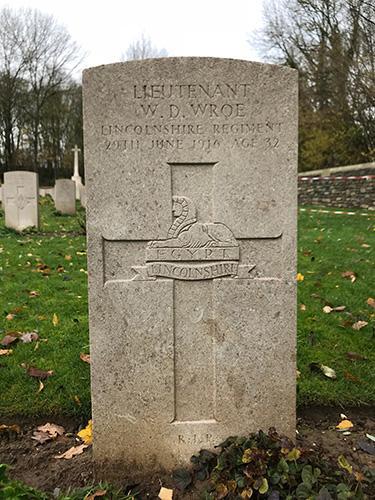
In memory of Lieutenant Wilfred Dent Wroe, 10th Bn., Lincolnshire Regiment who died on 29 June 1916 Age 32. Son of Dent and Florence Wroe, of Baston, Peterborough.
Remembered with honour, Becourt Military Cemetery, Becordel-Becourt.

Lieutenant Wilfred Wroe is also commemorated on:-
The War memorial in Baston Village where his father was a teacher;
The memorial in St James’ Church, James Street, Grimsby;
The memorial tablet commemorating the men of St Peter’s College in St Saviours Church Saltley, Birmingham.

Wilfred Wroe was well remembered after his death and appeared in many Newspaper Articles.

Lincolnshire Echo Tuesday 15th December 1914
TEACHER’S GONE AWAY
The following lines are penned with the idea that they came from a boy in the top class of an elementary school, whose teacher had joined Kitchener’s Army. The idea suggested itself to the writer on finding that three assistants had gone out of one Lincoln school, the North District, one of whom, Mr. Wroe, has just got his commission in the “Chums” Battalion and expects to leave for the front shortly. Mr Wroe was a teacher of as fine a set of boys as one would wish to meet.

Our teacher’s gone away,
He’ll soon be at the front-
To keep the foe at bay,
And help to bear the brunt.
He always loved to tell
Of men brave, pure and true;
And now I feel full well
He lived the life he drew.
He told us ‘fore he went
The reasons why we fight-
That England’s word was meant,
And God would prove us right.
Our need, he said, was great,
Still greater Belgium’s need,
That men should not wait,
But help with utmost speed.
So he was going away
With friends old, tried, and true,
And would we sometimes pray
That they’d their duty do?
Yes Duty; That’s the word
That seemed to thrill him through,
Whose call he clear had heard,
And to it he’ll prove true.
So teacher’s gone away,
He’ll soon be at the front-
To keep the foe at bay,
And help bear the brunt.
J.H.P

—————————————————————

Lincolnshire Echo Monday 3rd July 1916
LINCOLN TEACHER KILLED
LIEUT. WROE’S DEATH IN ACTION
The many Lincoln friends of Lieut. Wilfred Dent wroe will regret to learn that news has reached his mother from the War Office to the effect that he was killed in action on Thursday of last week, June 29.
Lieut. Wroe, who was 32 years of age, had been an assistant teacher at North District School, Lincoln, from August, 1908. He received his early training at Rugby St Matthew’s and after his pupil teachership and a year as uncertificated teacher went to Saltley Training College, where he had a most successful career, from 1906-8.
He enlisted in the “Chums” (10th Service) Battalion of the Lincolnshire Regiment on September 22nd, 1914, with two other members of staff of the North District School. Almost at once he received a commission as 2nd Lieutenant, and later obtained his second star, as 1st Lieutenant.
Of a most amiable and charming disposition, Lieut. Wroe was highly valued as a teacher, and at North District School especially his loss will be felt very keenly.

—————————————————————

Sheffield daily telegraph Tuesday 4th July 1916
Lincoln Lieutenant Killed.
Official notification was received in Lincoln, yesterday that Lieutenant Wilfred Dent Wroe, of the Lincolnshire Regiment, had been killed in action on June 29. Lieutenant Wroe, who was an assistant master of the Lincoln North District School, enlisted in the Chums 9Service) battalion of the Lincolnshire Regiment, on September 22, 1914. He was given a commission almost at once. He was 32 years of age.

—————————————————————

The Times Thursday 6th July 1916
ROLL OF HONOUR
111 CASUALTIES TO OFFICERS
23 REPORTED DEAD
Reported by the War Office under various dates:-
KILLED
WROE, Lieut. W. D., Lincolnshire Regiment

—————————————————————

Lincolnshire Echo Thursday 6th July 1916
LOCAL CASUALTIES
The following casualties are reported under various dates:-
KILLED LINCOLNSHIRE REGIMENT
Lieut. W. D. Wroe.

—————————————————————

Grantham Journal Saturday 8th July 1916
LINCOLNSHIRE OFFICER CASUALTIES
The names of the following officers of the Lincolnshire Regiment occur in this week’s casualty lists:-
Bertham Sec-Lieut. W. E., Denning Dec-Lieut. J. E. N. P., Parish Captain A. B. O., Churchhouse Sec-Lieut. M. (all wounded): Wroe, Lieut. W. D. (killed)

—————————————————————

Lincolnshire Echo Saturday 8th July 1916
LINCOLN SCHOOL TEACHER KILLED
Lieut. W. D. Wroe.
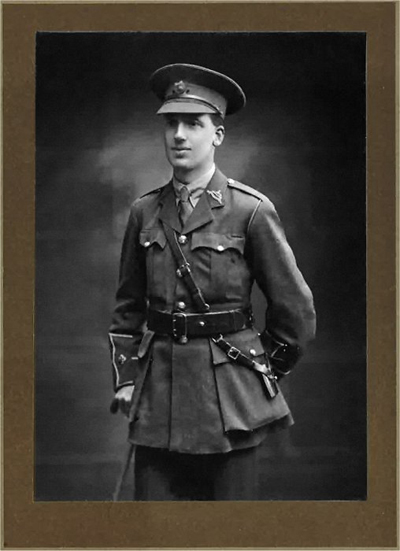
Our photograph is of Lieutenant Wilfred Dent Wroe, a well-known and highley respected Lincoln school teacher, news of whose death on the Western front, on June 29th, has been received in the city with profound regret.
Lieutenant Wroe had been an assistant teacher at the North District School since August 1908, and during that time many pupils passed through his hands, and some are actually serving with the colours. He commenced his scholastic career at St Matthew’s School, Rugby, and following a short period a pupil teacher and uncertificated teacher he entered Saltley training College, and was there two years – 1906-8, his course being a most successful one.
Decreased, who was 32 years of age, was well fitted for military matters. Whilst at Saltley he was promoted to the rank of sergeant of the Royal Warwickshire regiment, which he joined whilst at College. One of his commissioned officers was Captain (now Major) Trowell, of St martin’s Boys School, Lincoln.
In September, 1914, deceased, together with two other members of the staff of the North District School, enlisted in the ‘Chums” (10th Service) Battalion of the Lincolnshire Regiment. In a comparatively short time he was commissioned a second lieutenant and was subsequently promoted full lieutenant.
Lieut. Wroe was also well known as a member of the Carholme Golf Club, and he was an enthusiastic golfer. As a teacher he had a most promising future. In social life he displayed a quiet and genial personality which endeared him to all, and his lost will be keenly felt in Lincoln, especially at the North District School.
Mr. Woods, a teacher at North District School, who enlisted with Lieut. Wroe in 1914, has we regret to say, been compelled to relinquish his commission ‘through ill-health and again takes up his school duties on Monday.

—————————————————————

Lincolnshire Echo Monday 10th July 1916
BACK TO CIVIL DUTY
LINCOLN SCHOOL TEACHER’S WELCOME
ON the 21st September, 1914, three teachers at the North District School, Lincoln, left to take up duty for their country and go on military service. Unhappily, one of them, Lieut. Wroe, has made the supreme sacrifice, the sad news that he had been killed in action reaching the city a few days ago. This morning another of them, Mr. H. G. Woods, returned to his civil calling, the doctors having decreed that he was no longer fit for active service, and he was given a very hearty welcome by his fellow teachers, by a representative of the Education Committee, by one of the School Managers, by a church warden and also by the scholars. It was a interesting ceremony, which took place in the playground prior to the commencement of lessons. The lads were drawn up in their standards, and sang a hymn, after which the Rev. J. Kaye (Rector of St Paul’s) led the prayers. Then came a half hour which the lads will remember for many a long day, for it was one which the lessons of the war were explained to them, and they were able to express their own wish to give a cordial welcome to Mr. Woods on his return to the school.

—————————————————————

Lincolnshire Echo Wednesday 19th July 1916
SOLDIER TEACHERS
The Mayor made feeling reference to the death of Lieut. W. R. Wroe, killed in action, and moved that a letter be sent to his parents expressing the regret of the Education Committee at having lost so valuable a teacher. His Worship also alluded to the return to duties of Lieut. Woods, and moved that the Committee place on record their appreciation of his services to his country. To both of these resolutions the committee agreed.

—————————————————————

Boston Guardian Saturday 22nd July 1916
BOSTON LAD’S DUTY DONE
LINCOLN SOLDIER – TEACHER RESUMES CIVIL DUTIES
Lieut H G Woods
A pleasing and memorable event took place at Lincoln North District School last week, when the scholars and teachers extended a cordial welcome to Mr H. G. Woods an old Boston Grammar school boy, whose parents live at Mount Bridge, Skirbeck, on his return to the school to resume his teaching duties, after his discharge from the Army by the medical authorities.
Mr Woods joined the forces on September 21st 1914, together with two fellow teachers from North District School Mr A. Dowman and Mr W. D. Wroe and chose the 10th (Service) Battalion of the Lincolnshire Regiment. In a very short time Mr. woods and Mr. Wroe were given commissions, and they both went to France in January last year. Mr. Woods has been since invalided home wounded, and suffering from severe shell shock, and it will be remembered that only last week news reached Lincoln that Lieut. Wroe had been killed in action.

—————————————————————

We would like to take the opportunity to thank the following for the pictures that illustrate this remembrance.

Mr Paul Nixon, British Army Ancestors – Saltley College Guards Postcard 1907.
https://britisharmyancestors.co.uk/

Mr Toby Riley-Smith, Gt. Gt. Nephew of Wilfred Wroe – Photo of Wilfred in uniform taken at home in 1915.

Wilfred Wroe is also remembered on our own website
https://www.southlincolnshirewarmemorials.org.uk/…/william…/

Remembrance – James Burt

This month we remembered Bourne and 1st Battalion Lincolnshire Regiment man James Burt, who was killed in action on 16th June 1915 at the Battle of Bellewaarde.

James was born in the spring of 1892 to James Burt and his wife Elizabeth Ann Reeve. James Snr was born at Deeping St Nicholas in 1860 and Elizabeth in Weston near Spalding in 1863. The couple were married in 1891 and that marriage was registered in Spalding.

The couple settled in Fulney where they lived and where all their children were born between 1892 and 1900.
The children of James and Elizabeth were:-
• James Burt, 1892, Fulney
• William Burt, 1894, Fulney
• Elizabeth Ann Burt, 1895, Fulney
• George Burt, 1898, Fulney
• Arthur Burt, 1900, Fulney

In 1901 James was living with his parents in Nyles Bank, Fulney, Spalding. Father James was working on the farm as a farm foreman and the children, who’s ages were between 8 and 1, were all at home with Mother Elizabeth the eldest three classed as scholars. Ten years later and James Snr is still working as a farm labourer although by now James has left the home in Swindlers Drove and 2nd son William is working as a farm labourer.

James has moved out of the family home and moved to Waplode Marsh where he is working as a Horseman on a farm. He is now living with John Thrower, a farm labourer, his wife Anne and brother Bestie, also a Horseman. The family had both James Burt and a 15 year old Charles Staff, another horseman, lodging with them.

James enlisted into the Army at Bourne and Joined the 1st Battalion Lincolnshire Regiment, his regimental number of 15273 would indicate that he joined around January 1915.
After a three months of training he embarked to join his Battalion in the Field landing in France on the 4th May 1915. Unfortunately he would only serve with the Battalion for one month.

As with 60% of all service records, James’ did not survive intact after the London warehouse fire in the Blitz in 1940. The following information is pieced together from other remaining records and mainly with the reference of the Battalion Diary.

After landing in France on the 4th May 1915, James would have likely arrived in the base camp and then after a few days being posted to the Battalion. The Battalion Diary for the 4th May reports that Captain H. M. C. Orr arrived at Dickebusch with 50 other ranks reinforcements. At the time the Battalion were in the middle of a tour of the trenches, their sector being near Lankof Chateau and in the vicinity of Hill 60. It is very unlikely that this batch included James.

The next day, the morning of the 5th, rifle shots were heard from the direction of Hill 60 and this continued until 9.30am. Enemy’s artillery shelled roads and buildings near Lankof Chateau and two shells burst inside the Battalion’s dressing station. During the afternoon and evening asphyxiating gases were detected floating from the German trenches towards our lines. Our artillery kept up a steady fire throughout the day in the direction of Hill 60. At about 9pm heavy artillery and rifle fire was heard and this continued for about an hour and a half when the artillery fire died down. Later the artillery was again active and opened a very heavy fire on the German trenches, continuing until dawn.
Sprays containing Carbonali of Soda were issued to the Battalion for use in the fire trenches to combat the effects of the gases used by the Germans.
Weather fine.
Casualties, Other Ranks, 2 wounded.

The next batch of reinforcements arrived on the 9th May. “Reinforcements of 118 other ranks Joined at Dickebusch”. It is more likely that James arrived with these reinforcements as the previous batch arrived on the same day as he arrived in France and therefore it is unlikely that he would have moved up in that timeframe.

On the 10th May one of the notes in the diary states that “Reinforcements of 118 Other Ranks moved up and were billeted at Bedford House.

The diary for the next day, 11th May, reported that at about 2am we opened burst of rapid fire to which the enemy replied. The firing lasted for about an hour. Enemy’s artillery shelled wood near Bedford House without causing any damage. Later that day the Battalion’s part of the trench was subject to grenade fire and afterwards some shelling of the fire trench but this caused little damage but our artillery response fell accurately on the enemy’s trench causing much damage and effectively silenced them for the rest of the day. 2nd Lieut Jeudwine, 3rd Lincolns, slightly wounded along with 3 other ranks.

On the 14th May another reinforcement of 50 other ranks joined the Battalion at Dickebusch.

By now we must have established that James was with the Battalion as now it had been 10 days since his arrival in France and during that time the Battalion had received 218 reinforcements.

The Battalion Diary reports the following for what would have been James’ first days with the Battalion,

15th May 1915.
Heavy firing was heard from our left and continued until about 9am when all became very quiet especially on our front. At about 11am our heavy batteries shelled the German trenches in front of our position, this firing continued for about half an hour. Enemy’s artillery shelled the approaches to the firing line at irregular intervals during the night. After dusk a party of men of the Battalion went out in front of our fire trenches to remove some growing crops which we were obstructing our field of fire. This party successfully carried out their task and returned without casualty. A perty of miners of the battalion completed the construction of a tunnel under the bank of the Yser Canal. Work was continued on fire trenches and progress was also made in linking up two fire trenches held by the Battalion.
Casualties Other Ranks 1 died of wounds and 1 wounded.

16th May 1915
All quiet on our front. During the day heavy firing was heard from the direction Ypres Salient.
At about 2pm our batteries shelled the German trenches in front of our position, causing considerable damage to the enemy’s parapets. Late in the afternoon the enemy’s snipers became active + Lieut Cave-Orme was severely wounded. During the evening rifle grenades were usd by the enemy and some casualties were caused.
D Company relieved C Company in the fire trenches during the night. D Company occupied dug-outs on canal bank, A company moved back to Bedford House in support.
Casualties, Lieut R W Cave-Orme 1st Lincoln Regt Severely wounded
5 Other ranks wounded.

17th May 1915
A quiet day. During the night a rapid fire was opened on our trenches at 11.15pm, but soon died down
Casualties 1 died of wounds, 8 wounded.

The Battalion would remain in the trenches for another 10 days, eventually being relieved by the 2nd King’s Own Scottish Borderers and that night heading for Outerdom and billets. Here they stayed a couple of days before being moved back to huts at Vlamertinghe where they rested and also provided fatigue parties working on the support trenches.

On the 31st May they marched back to Outerdom and were destined to start June at Hooge in support at Zouave and Hooge Woods for their next tour. This tour only lasted until the 5th June and afterwards the Battalion was returned to the rest camps at Vlamertinghe.
As well as resting, this time the battalion were lectured in the use of smoke helmet respirators, Rifle exercises, bombing practice plus the more usual physical drill and route marches which continued until mid June.

15th June 1915
The battalion. Remained in bivouacs during the day.
The Battalion paraded at 4.15pm ready to march to the assembly trenches, Cambridge Road South End I.11d. The order of the march was D. C. HQ. A + B Companies. The machine gun detachment accompanied the left column of the Brigade:- (5th Fus, R Scots Fus + Liverpool Scottish). The Battalion and 4th Royal Fusiliers formed the right column. The right column marched off from road junction H13 central at 5.0pm, and proceeded by the road through H13. H14. H15. H23 to Krruisstraat crossed the canal at bridge 13 + thence through Ypres to the Lille Gate at 8.30pm continuing via railway hack to I.10.d.0.2 thence by Menin Road.
Casualties 4 other ranks wounded.
Fine summer weather.
16th June 1915.
The Battalion occupied the assembly trenches I.11.d at 1.15am. The 9th Brigade were to attack the Bellewarde Spur at early morning. The objective was to seize and hold the line I12.d.3.2 – Y18 – Y7. The 1st phase of the attack was begun by our artillery severely bombarding the hostile trenches and wire entanglements with high explosive shells. Short spaces were made in the bombardment at 3-10am, 3-40am and 4am.
Our front line was occupied by Royal Fusiliers, Roy Scots Fusiliers and 5th Fusiliers. The Lincolns and Liverpool Scottish in support. The Liverpool Scottish were on our left, the 1st Wilts (7th Brigade) on our right. When in the assembly trenches the Battalion was shelled by enemy and a few casualties accrued.
At 4-15am exactly our first line rushed forward and immediately seized the first line of hostile trenches from the East edge of wood Y16-Y15-NE corner of Railway Wood and took prisoners all of the enemy in the trenches that had not been killed.
The Roy Scots Fusiliers in conjunction with 5th Fusiliers seized the trenches between Y13 + Y15. at the same time.
The Battalion rushed forward in support of the Royal Fusiliers reinforcing their line. The line continued its advance, bombing parties forcing their way along the trench Y16-Y20 driving the enemy at a run into his second line trenches.
The attack was being covered on the right by rifle and machine gun fire from the Menin Road and from the South of it, and covered on the left by rifle and machine gun fire of the 6th Division from the railway.
The Battalion and Royal Fusiliers seized the trench Y20-Y21. The artillery bombardment on the first line of trenches had been most effective in rendering them untenable and in destroying the barbed wire entanglements. Many dead Germans were found in the trenches. The prisoners taken were forced to the rear.
The attack now assumed its second phase which was the seizing of the trench running from Bellewarde farm to house on the road 100yds South of Y17. Our artillery had already dealt with the trench which we seized at 4.30am with very few casualties to our side, the enemy being finally driven out with the bayonet.
The third phase of the attack followed immediately. A party of 50 NCOs and men led by Major Boxer succeeded in occupying the line Y17-Y18. It was however found impracticable to retain, owing to our own artillery not having ceased to shell this position. The artillery observers were prevented from seeing the flag carried seeing the flag carried by the infantry, denoting the progress of the advance, by mist and smoke from shells. Also communication was difficult owing to the signal wires being cut by the enemy fire.
The advance of the infantry had been extremely rapid and was carried out with great dash and fervour and they had accomplished their object too quickly for our artillery, which caused many casualties to our side.
The commanding officer – Major H E BOXER was himself wounded when he ordered the men to fall back on the line Y17-Y20.
Units in their eagerness had rushed forward, mixed together and were much disorganised in captured trenches.
The attack had been brilliantly carried out and many acts of gallantry were performed by all ranks of the Battalion, both during the attack itself and during the subsequent enemy bombardment.
At 6.0am the Battalion now under the command of Major D F Grant received orders to fall back on to the first line of captured trenches Y16-Y17 and Y16-Y15 to reorganise and hold the line at all costs, which was held accordingly.
The Germans heavily bombarded the captured trenches throughout the day, the bombardment becoming most violent at 4pm when it became evident that a counter attack was being launched. The counter attack was met by our own artillery and by heavy rifle and machine gun fire, the enemy being repulsed with great loss to him.
At 6pm the enemy bombarded the trenches and ground behind with Gas-shells and the men had to resort to the use of respirators.
At 9.30pm the Battalion was relieved by the 4th Gordons (8th Brigade) and marched back to bivouac I.8.b.4.5 arriving about 5am next day.
17th June 1915
The battalion having returned to bivouac rested during the day.
A roll call was taken at 12 noon.
The following casualties had been incurred during the previous day’s fighting.
Officers:
Major H E R Boxer – Wounded and missing
Captain J R G Magrath – Wounded
Captain R H Spooner – Wounded
Lieut A D Walker – Missing
2Lieut F C Green – Killed
2Lieut J H P Barrett – Wounded
2Lieut R O Pearson – Missing
Other Ranks:
Killed 22
Died of Wounds 3
Missing 76
Wounded 265
Whether from one of the three bayonet charges, our own artillery barrage or the later German bombardment of their old trenches, Private James Burt was presumed dead on the 16th June 1915 as part of the action described by the Battalion Diary.

Commonwealth War Graves Commission:
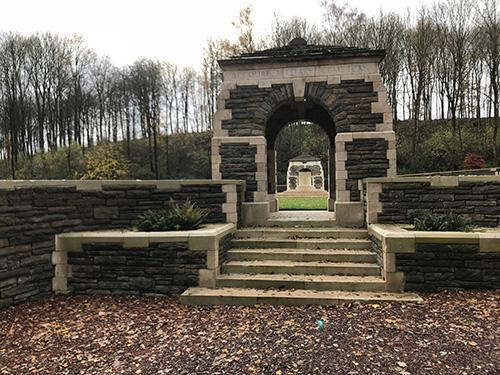
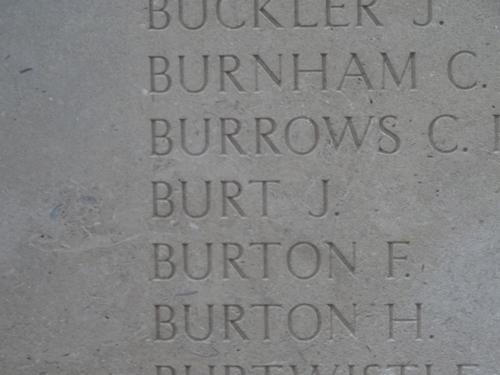
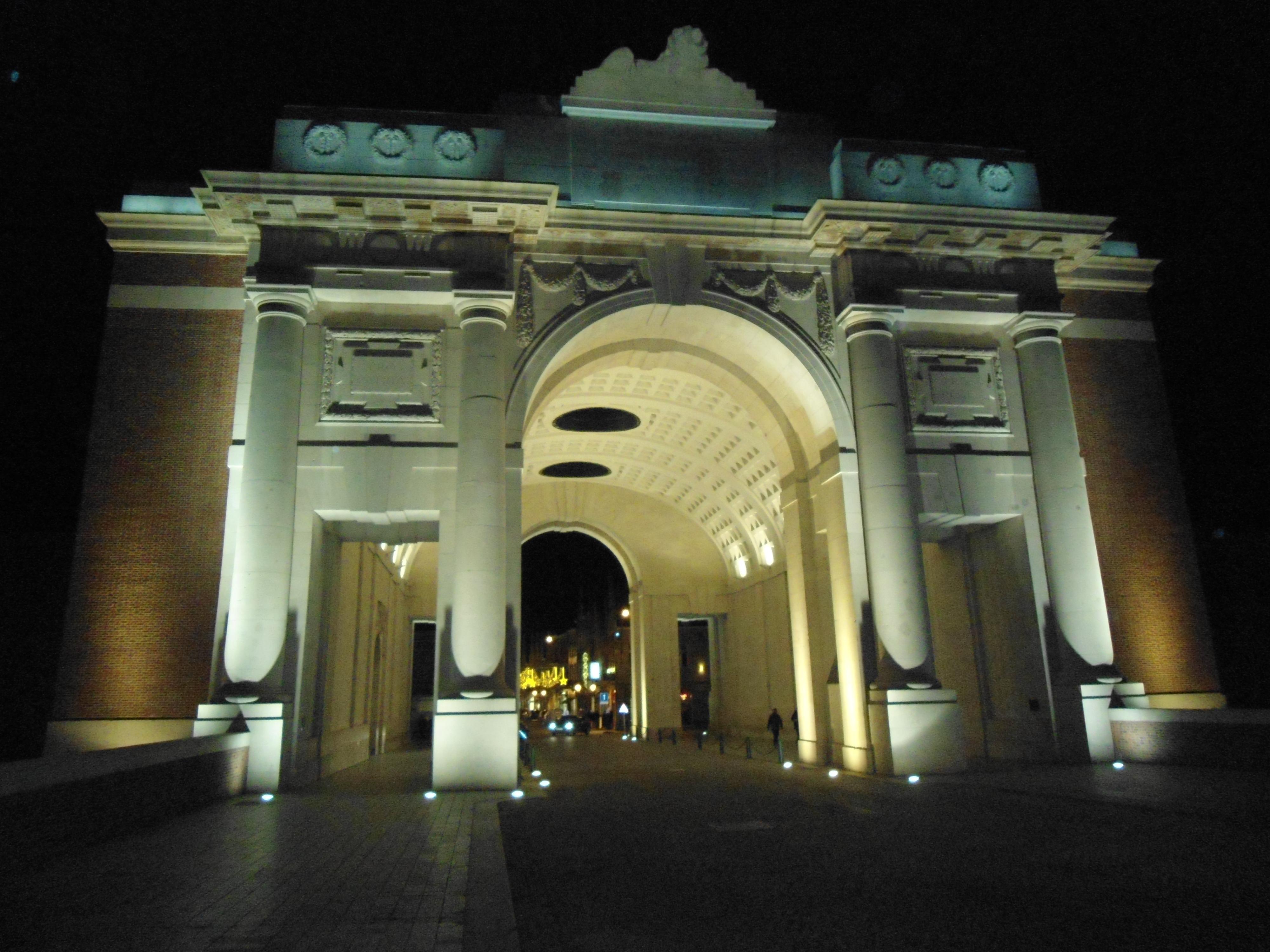
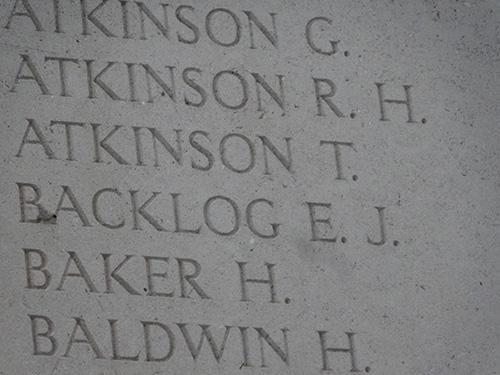
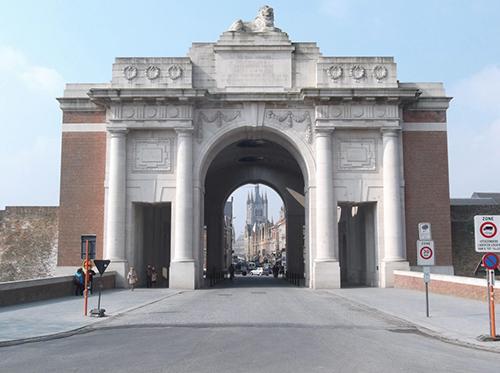
In memory of Private James Burt, 15273, 1st Bn., Lincolnshire Regiment who died on 16 June 1915. Remembered with honour, Ypres (Menin Gate) Memorial
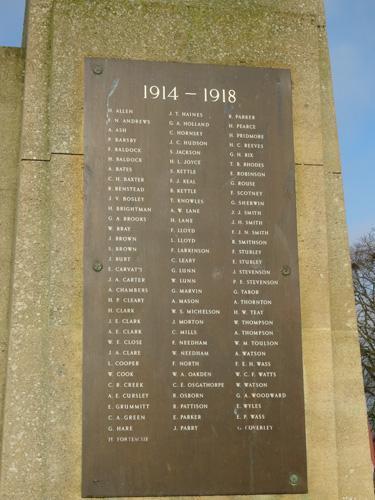
James is also commemorated on the war memorial in Bourne.

Remembrance – Edward James Backlog

Today remember Bourne and 1st Battalion Lincs Regiment man, Private Edward James Backlog 11495, who was killed in action on this day, the 16th June 1915 at the Battle of Bellewarde.

Edward was born in Thetford Norfolk in the late summer of 1878, one of twin sons born John. Edward and Sarah Ann Backlog.

John was a general labourer born in Thetford in 1848, where he met and married Sarah Ann Wing born who was born there in 1847. The couple were married in 1876 and set up home in Thetford along with Sarah’s daughter Mary.
As well as the twin boys the couple also went on to have a third son, all born whilst they were in Thetford.

• Mary Hudson Wing, 1868, Thetford (Half sister)
• John Ernest Backlog, 1878, Thetford (Twin)
• Edward Thomas Backlog, 1878, Thetford (Twin)
• William Thomas backlog, 1883, Thetford

In 1881 the three year old Edward was living with his parents and twin brother John Ernest, known as Ernest in Bury Road in Thetford. Also living in the household Edward’s half sister Mary Wing. Father John was working as a labourer at this time. Ten years later and the family are identified on the census at 30 Bury Road, most likely the same house, John working as a general labourer and the three boys now aged 12 and 7 attending school.

John Backlog died In 1895 leaving Sarah to bring up the family.

By 1901 the family had grown up, 22 year old Ernest was married and working as a Mason’s labourer, living in his own house at 32 Bury road next door to his Mother. Sarah, now widowed, was still living at no 30 with daughter Mary who worked in a pulp factory and youngest son William, now working as a labourer. At this time Edward can be found in Leyton, Essex as a visitor in the household of James Nunn. Even though he was listed as a visitor it was possible that he was here because of work as James Nunn was a local Stratford man who’s wife Harriet was from Thetford. Edward at this time was working as a boiler maker and James Nunn a boiler maker’s helper.

Edward attested to the Royal Engineers on 3rd May 1902 in Stratford for 12years, this consisted of 3 years of Army Service and a further 9 years on reserve. The record notes that at the age of 23 years and 11 months he was 5 feet 6 1/4 inches tall with fresh complexion, hazel eyes and brown hair. It also notes that he had a pierced heart tattooed on his right forearm and a flour in a pot with a leaf on his left forearm. Sapper Backlog was given the Regimental number of 11065.

It would look like Edward and the army were not good friends as he had only managed 93 days of service before he went absent without leave on the 4th August 1902 for 7 days. This was followed by three days in confinement awaiting disposal where he was then awarded hard labour. A little over two weeks later and again he went absent without leave from the 30th August until the 4th September. He was kept in the guard room from the 5th until the 18th of September awaiting court marshal on the 19th where he was sentenced to another l4 days hard labour taking him up to the 3rd October when he returned to duties.

The London Daily News on the 6th September reported:-
A Discontented Sapper
Edward James Backlog aged 24 a Sapper in the Royal Engineers stationed at Chatham was charged at the same court for the second time within a fortnight with being an absentee. The prisoner looked very dirty and untidy and by no means a credit to his corps. P.C. Norris said he arrested the prisoner who told him he didn’t like soldiering and was determined to get out of the army. Lance Corporal Dewhurst identified the prisoner as belonging to his company. The magistrate said: “what punishment did he get last time?” This witness said: “seven days imprisonment with hard labour”. The magistrate said: “He stated to the constable who arrested him that he was determined to get out of the army, you had better report that to your commanding officer” Witness said:
“Yes Sir”. The prisoner was then handed over to the escort who’s smart appearance contrasted strongly with his own bedraggled and unkempt condition.

Obviously he just didn’t want to be in the Army as only one month later he disappeared again from the 9th to the 14th of November. The same pattern was followed with 12 days in the Guard Room awaiting disposal and a court marshal on the 28th returned a punishment of 42 days taking him up to the 8th January.
At the end of the punishment period Edward was discharged at Chatham with all service forfeited for pension on account of him being “incorrigible and worthless”.

Sarah Ann was still living at 30 Bury Street in 1911, now sharing the house with her widowed sister Mary Ann Linge who was working as a mill hand in a pulp ware factory. Edward was now living back home with his mother, now 32 and working as a Boiler Maker, labouring in a traction engine works. The only other person in the house was a boarder, George Cousens a fitter’s labourer.

When war broke out Edward Backlog enlisted in Bourne, Lincolnshire into the 1st Battalion Lincolnshire Regiment in September 1914 being given the Regimental number 11945.
The regulars of the Battalion had already left their pre war base at Portsmouth on the 14th August for France and the Battle of Mons, fighting a rear-guard at Solesmes during the retreat from Mons and then Battles at Le Cateau, The Battle of the Aisne, at La Bassee, Messines and the First Battle of Ypres.

The 1st Battalion were in Hooge a village near Ypres in Belgium when Edward arrived in France on the 11th November 1914, following his initial training. The Battalion came out of the front line on the 20th arriving in the rear area near Westoutre on the 21st November. The Battalion Diary reports that in the evening they received reinforcements, which no doubt included Edward and the next 2 days were spent on refitting.

Edward’s first taste of the trenches came shortly afterwards when the Battalion relieved the Oxfordshire Light Infantry on the night of the 27th November in the front line near Kemmel. The next day was quiet in the trenches apart from occasional enemy sniping and the casualties for Edward’s first day at the front was 1 killed and 1 wounded other ranks.

At the end of the month that tour of the trenches was completed and whilst in billets on the 3rd December the entire Brigade were lined up alongside the main road through Westoutre for an inspection. His Majesty The King passed through on his tour of inspection and the men gave three hearty cheers as he passed them in an automobile accompanied by the commander in chief.
A letter was received afterwards in which his Majesty expressed great pleasure at the appearance of the troops.

A party of 50 NCOs and men under the command of Captain E Tatchell proceeded to Locre to perform the duties of a guard of honour where His Majesty presented medals for Distinguished Conduct to the NCOs and men of the brigade and Private Stroulger being the only representative owing to all the other NCOs and men who had been awarded the medal being killed or wounded. The Battalion paraded at 3.30pm to proceed to Locre where they were billeted in support of the units in the firing line.

It was not until the 6th of December when the daily stand to orders were changed and they marched to Kemmel to relieve the 1st Royal Scots Regiment in the trenches. The diary reports that –
“Owing to the recent heavy rains the trenches were in a very bad state and in some places were waist deep in mud and water. B,C + D companies formed the firing line and A company in support in a barn close to Battalion HQ. We obtained several bundles of fascines planks of wood and placed them in the trenches for the troops to stand on. The men were also provided with straw wisps to wrap around their legs + boots to keep themselves dry. These efforts proved of little consequence owing to the amount of water in the trenches. B Company who held the right of the position occupied by the Battalion were in such a bad state that after being in the trenches for 24 hours, the commanding officer found it absolutely necessary to relieve them with the company in support.
Officers A.S.S Wade and 2/Lieut A B L Parish joined the Battalion. Casualties. 1 Killed and 1 wounded.”

The battalion then being involved in what was to be Edward’s first involvement in a planned attack of the enemy trenches on their third day. The attack was deemed a success even though after reaching the enemy trench which by then resembled a small canal, the already fatigued men became subject to such rifle and machine gun fire that they were ordered to fall back to their own trenches, which they did in good order. The casualties for the attack were 4 killed, 19 wounded and 18 missing of the ranks and 3 officers wounded.
A and B companies were relieved and returned to the barn in support and it would be another day before the entire Battalion was relieved from their trenches and returned to Locre to billets before the division was relived.

The tours of the trenches continued with their next tour ending on the 24th December placing them back in Locre for Christmas Day.

The Battalion diary reported the following:

25th December 1914
Christmas Day and very seasonable, all ranks adapted themselves to the circumstances and celebrated Xmas in as an enjoyable way as the conditions permitted. Christmas Greetings were received from Field Marshall Sir John French, GCB, GCVO, KCMG, Commander in chief of the British Army in the field.
“In offering to the Army in France, my earnest and most heartfelt wishes for Xmas and the new year I am anxious once more to express the admiration I feel in the valour and endurance they have displayed throughout the campaign and to assure them that to have commanded such magnificent troops in the field will be the proudest remembrance of my Life”
All ranks of the Battalion received an Xmas card from the king and Queen and a present for all ranks from Princess Mary, consisting of a package containing Xmas Card and box containing tobacco and cigarettes which was greatly valued by all ranks of the Battalion. Greetings were also received from the Mayor and Citizens of Lincoln and many others interested in the welfare of the Regiment.

The Battalion went back into the trenches on New years eve. Eventually being transferred to the 28th Division and moving to Ypres in mid February to assist with operations on the Ypres canal. They stayed in the Ypres Salient and in April were involved in the attack on Hill 60 near Zillebeeke.

On the 23rd Edward’s Brother, Private Ernest John Backlog 17233 of the 3rd Battalion Norfolk Regiment died by Cerebro Spinal Fever contracted on active service, leaving a widow and five children. He was buried in Thetford Cemetery.

We jump forward to June 1915 and now the 1st Battalion Lincolnshire Regiment are based around Ypres, once again the battalion Diary tells the story of Edward Backlogs final days.

15th June 1915
The battalion. Remained in bivouacs during the day.
The Battalion paraded at 4.15pm ready to march to the assembly trenches, Cambridge Road South End I.11d. The order of the march was D. C. HQ. A + B Companies. The machine gun detachment accompanied the left column of the Brigade:- (5th Fus, R Scots Fus + Liverpool Scottish). The Battalion and 4th Royal Fusiliers formed the right column. The right column marched off from road junction H13 central at 5.0pm, and proceeded by the road through H13. H14. H15. H23 to Krruisstraat crossed the canal at bridge 13 + thence through Ypres to the Lille Gate at 8.30pm continuing via railway hack to I.10.d.0.2 thence by Menin Road.
Casualties 4 other ranks wounded.
Fine summer weather.

16th June 1915.
The Battalion occupied the assembly trenches I.11.d at 1.15am. The 9th Brigade were to attack the Bellewarde Spur at early morning. The objective was to seize and hold the line I12.d.3.2 – Y18 – Y7. The 1st phase of the attack was begun by our artillery severely bombarding the hostile trenches and wire entanglements with high explosive shells. Short spaces were made in the bombardment at 3-10am, 3-40am and 4am.

Our front line was occupied by Royal Fusiliers, Roy Scots Fusiliers and 5th Fusiliers. The Lincolns and Liverpool Scottish in support. The Liverpool Scottish were on our left, the 1st Wilts (7th Brigade) on our right. When in the assembly trenches the Battalion was shelled by enemy and a few casualties accrued.

At 4-15am exactly our first line rushed forward and immediately seized the first line of hostile trenches from the East edge of wood Y16-Y15-NE corner of Railway Wood and took prisoners all of the enemy in the trenches that had not been killed.

The Roy Scots Fusiliers in conjunction with 5th Fusiliers seized the trenches between Y13 + Y15. at the same time.

The Battalion rushed forward in support of the Royal Fusiliers reinforcing their line. The line continued its advance, bombing parties forcing their way along the trench Y16-Y20 driving the enemy at a run into his second line trenches.

The attack was being covered on the right by rifle and machine gun fire from the Menin Road and from the South of it, and covered on the left by rifle and machine gun fire of the 6th Division from the railway.

The Battalion and Royal Fusiliers seized the trench Y20-Y21. The artillery bombardment on the first line of trenches had been most effective in rendering them untenable and in destroying the barbed wire entanglements. Many dead Germans were found in the trenches. The prisoners taken were forced to the rear.

The attack now assumed its second phase which was the seizing of the trench running from Bellewarde farm to house on the road 100yds South of Y17. Our artillery had already dealt with the trench which we seized at 4.30am with very few casualties to our side, the enemy being finally driven out with the bayonet.

The third phase of the attack followed immediately. A party of 50 NCOs and men led by Major Boxer succeeded in occupying the line Y17-Y18. It was however found impracticable to retain, owing to our own artillery not having ceased to shell this position. The artillery observers were prevented from seeing the flag carried seeing the flag carried by the infantry, denoting the progress of the advance, by mist and smoke from shells. Also communication was difficult owing to the signal wires being cut by the enemy fire.

The advance of the infantry had been extremely rapid and was carried out with great dash and fervour and they had accomplished their object too quickly for our artillery, which caused many casualties to our side.

The commanding officer – Major H E BOXER was himself wounded when he ordered the men to fall back on the line Y17-Y20.
Units in their eagerness had rushed forward, mixed together and were much disorganised in captured trenches.

The attack had been brilliantly carried out and many acts of gallantry were performed by all ranks of the Battalion, both during the attack itself and during the subsequent enemy bombardment.

At 6.0am the Battalion now under the command of Major D F Grant received orders to fall back on to the first line of captured trenches Y16-Y17 and Y16-Y15 to reorganise and hold the line at all costs, which was held accordingly.

The Germans heavily bombarded the captured trenches throughout the day, the bombardment becoming most violent at 4pm when it became evident that a counter attack was being launched. The counter attack was met by our own artillery and by heavy rifle and machine gun fire, the enemy being repulsed with great loss to him.

At 6pm the enemy bombarded the trenches and ground behind with Gas-shells and the men had to resort to the use of respirators.

At 9.30pm the Battalion was relieved by the 4th Gordons (8th Brigade) and marched back to bivouac I.8.b.4.5 arriving about 5am next day.

17th June 1915
The battalion having returned to bivouac rested during the day.
A roll call was taken at 12 noon.
The following casualties had been incurred during the previous day’s fighting.

Officers:
Major H E R Boxer – Wounded and missing
Captain J R G Magrath – Wounded
Captain R H Spooner – Wounded
Lieut A D Walker – Missing
2Lieut F C Green – Killed
2Lieut J H P Barrett – Wounded
2Lieut R O Pearson – Missing

Other Ranks:
Killed 22
Died of Wounds 3
Missing 76
Wounded 265

Whether from one of the three bayonet charges, our own artillery barrage or the later German bombardment of their old trenches, Private Edward James Backlog was originally posted as missing presumed dead and then later officially regarded as died on the 16th June 1915 as part of the action described by the battalion Diary.

Commonwealth War Graves Commission:
In memory of Private Edward James Backlog, 11945, 1st Bn., Lincolnshire Regiment who died on 16 June 1915 Age 37. Son of John and Sarah Ann Backlog, of 30, Bury Rd., Thetford, Norfolk. Remembered with honour, Ypres (Menin Gate) Memorial

Edward is also remembered on the war memorials in Bourne Lincolnshire and also Thetford Norfolk.

https://www.southlincolnshirewarmemorials.org.uk/…/edward-…/