
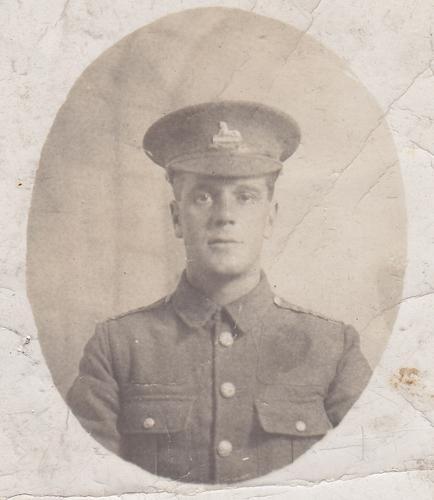
Biography of Lance Corporal Albert Codling (1608)
1st/4th Battalion Lincolnshire Regiment
Died 13th May 1915
Soldier
- Name: Albert Codling
- Date of birth: 1893
- Place of Birth: Lincoln, Lincolnshire, England
- Date of Birth Registration: January – March 1893
- Place of Birth Registration: Lincoln, Lincolnshire, England
Father
- Name: John Codling
- DOB: 1867
- Place of Birth: Lincoln, Lincolnshire, England
- Occupation: Railway Porter
Mother
- Name: Mary Elizabeth Cobb
- DOB: 1865
- Place Of Birth: Lincoln, Lincolnshire, England
- Marriage: 1892 Lincoln District
Siblings: (Name), (DOB), (POB)
- Albert Codling, 1893, Lincoln
- Gertrude Mary Codling, 1894, Lincoln
- Ernest Codling, 1896, Lincoln
- Frank Codling, 1899, Lincoln (Died 1901 Age 2)
- Elsie Codling, 1901, Lincoln (Died 1904 Age 2)
- Edith Codling, 1904, Lincoln (Died 1905 Age 0)
- John William Codling, 1906, LIncoln
- Doris May Codling, 1910, Lincoln
Census
- 1901: Albert is living with his parents at 37 Queen Street, Lincoln, Lincolnshire.
- 1911: Albert is living with his parents at 1 Noam Cottages, Gray Street, Lincoln, Lincolnshire. The census gives him an age of 18 and he is listed as a Cattle cake maker (cake mills).
Relatives in services
- Albert’s brother Ernest also fought and were killed in WW1 and can be found on our page dedicated to the Bourne Memorial.
Marriage
- No marriage for Albert has been found and because of his age we can assume that he never had the opportunity to marry.
Newspaper Mentions
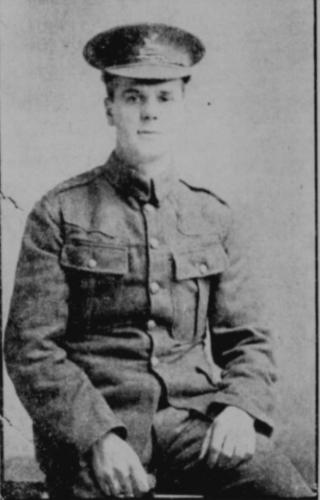
- The Lincoln Leader and County Advertiser – Saturday May 29th 1915
LINCOLN TERRITORIAL KILLED
Hit in the Communication Trench
UNDER NOTICE FOR PROMOTION
HELPED TO BURY LANCE-CORPORAL LEAMY
“SPLENDID IN EVERYTHING HE DID”
By the death Of Lance Corporal Albert Codling the 4th Lincoln territorials have lost yet another valued an promising non commissioned officer. ” I had him under notice for further promotion writes captain Tetley and it is a Distinct loss to his platoon that such an energetic and intelligent young soldier should have been fatally wounded so soon after his arrival in the trenches. Additional poignancy is added to the circumstances in view of the fact that the deceased Lance Corporal was a close comrade of the late Lance Corporal Leamy, who under like conditions lost his life a few weeks ago. Codling in fact was one of those who attended to the burial of Leamy and in a letter home he remarked at the time on the loss he and his comrades had sustained. It had been said by those in authority that the magnificent standard of efficiency attained by the British Army at present in France and Belgium is to a very large extent due to the unselfish and untiring efforts of the non-commissioned officers and Captain Tetley in his letters has more than once paid high tribute to the service of this important branch of our present army. - CAPTAIN TETLEY BREAKS THE NEWS
The 1st news of codling’s death was received by his parents early this week, when a letter was received from Captain Tetley to the following effect:-
“I am very grieved to have to tell you that your son Lance Corporal Codling was killed last Thursday night during an attempt by the Germans to blow up a mine that was in the trench that we were holding. The enemy was throwing trench mortar bombs and it was necessary to vacate the trench temporarily, in addition to these bombs there was a hail of shrapnel, and it was one of these bullets that hit him as he was going down a communications trench. I feel his loss very much, and he will be missed by everyone in his platoon and company. He was splendid in everything he did and I had him under notice for further promotion. His lost to you will be great, and all my sympathy and that of his comrades is with you and yours in your great bereavement. Take comfort from the fact that he died doing his duty and in the service of his country (Signed) F Eric Tetley.” - HIS HOPEFUL LETTERS
Deceased, who was only 22 years of age, wrote regularly from the trenches, but rarely mentioned the doings of either himself or his company. Shortly before his sad end he wrote in a letter to his mother: “Just a line to let you know that I am in the pink. We have just come out for arrest again. It is very cold here today, though it is nice and dry. I had two boxes of woodbines and one of gold flake from the boys at the Lindum and have plenty of fags now, but I can always find plenty of room for them… I did not expect there would be much fair this year, they are more particular about the lights in England than what they are here; In fact the people live right under shellfire. I expect they go down the seller when they begin to drop 2 near. It is alright hearing shells come screaming along so long as they keep whistling but a little bit before they burst they stop whistling, so we have a good idea whereabouts they’re going to drop. We know the report of their guns, an as they go off we know there is one coming. They are rotten shots. - HE DID HIS DUTY
Under date 23rd inst. Colour Sergeant Maplethorpe writes:- ” Dear Madam, – It is with deepest Sympathy that I enclose these few lines along with the money that was found on your son. It was handed to me by Captain Dean, who asked me to forward it to you. His few private things have been sent to the base and will be forwarded from there. I knew your son very well, and he was one of the old H company, of which I was colour Sergeant, and I am very sorry we lost him and so are all the company. But he did his duty and did it well to the end, and I hope that that will be a little consolation to you for his loss.” - AN OLD TERRITORIAL
Lance Corporal Codling was an old member of the territorial’s, he having joined the 4th battalion 2 years ago and having attended 2 camps previous to mobilisation. After leaving school at the age of 13 he was employed as dray man by the Midland Railway Company and was very well known and liked by all the employees at the station. He was a youth of pleasant demeanour, and all who came in contact with him quickly became attached to him. As a soldier he was ever popular alike with his superior officers and with the men under him. Along with the late Lance Corporal Lee me he was transferred to the front about 10 weeks ago, and together with him received his first stripe not many weeks later. As already stated codling was close by when Leamy was hit, and it was his extremely unpleasant task to assist in burying his comrade.
A second son of Mrs Codling is at present with the 2/4th Lincolns at Luton, and is anxious to get out to the scene of action and do his duty.
In a letter home at the time of his comrade’s death the Lance Corporal wrote: “I received Dad’s letter when we entered the trenches at 3:30, I was just against poor Leamy when he was hit. He was one of my pals, and he got promoted at the same time as I did. He was in the same section as I am. It was mustard that night, bullets were coming like rain around us and we were taking no notice of it when he got hit, poor chap. It unnerved us a bit. I feel sorry for his wife, he having only been married after mobilisation. He was only 21 that day. The corporal of the section and myself and some others saw that he got a decent burial”
© BNA
- Lincolnshire Echo Thursday 3rd June 1915
CASUALTIES AMONG LINCON TERRITORIALS.
The following are reported by Officer Commanding Battalion on May 17th:-
4th LINCOLNS.
KILLED IN ACTION.
Codling, 1608 Lce.-Corpl. H. (May 13th).
- London Daily Chronicle 14th June 1915
KILLED
4th LINCS (TF): Codling, 1608 H.
- Sheffield Daily Telegraph Monday 14th June 1915
KILLED
4th LINCOLNS (T.F.) Codling (1608) H.
- Yorkshire Post and Leeds Intelligencer Monday 14th June 1915
NON-COMMISSIONED OFFICERS AND MEN.
The Casualties amongst non-comissioned officers and men of the Expeditionary Force reported from the Base include the following. All are privates except where otherwise stated:-
UNDER DATE 27th MAY.
KILLED
Lincolnshire Regt., 4th Batt. (T.F.) Codling 1608 H.
- Brighton Gazette Wednesday 16th June 1915
KILLED
4th LINCOLNSHIRE REGIMENT.
CODLING, 1608, H.
- Grantham Journal Saturday 19th June 1915
LINCOLNSHIRE REGIMENT CASUALTIES
The following casualties among N.C.O’s and men of the Lincolnshire Regiment are reported from the Base under the dates given:-
May 27th – (4th Batt., T.F.) Killed – Codlng 1608 H.
Military Records
- None found
Soldier’s Died In The Great War
- These records show that Private Albert Codling, 1608, 4th Bn Lincolnshire Regiment was killed in action on 16th October 1915 in the Western European Theatre in France and Flanders.
- The death of this document is differnent to the date on his stone.
Pension Records
- Available
Effects Left To
- Father John
Medals
- The British Medal
The Victory Medal
The 15 Star
Memorials
- UK:
- Bourne, Bourne War Memorial in the Memorial Gardens
- Lincoln Memorial
- Commonwealth War Graves Commission:
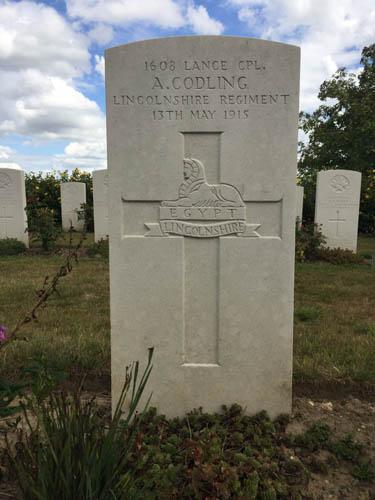
- In memory of Lance Corporal A Codling, 1608, 1st/4th Bn., Lincolnshire Regiment who died on 13 May 1915 Age
- Son of Mr. J. Codling, of 3, Wood View, Bourne, Lincs.
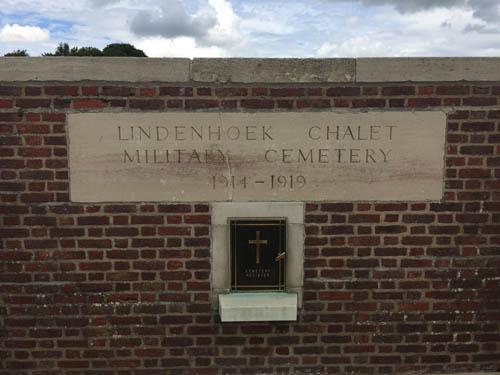
- Remembered with honour, Lindenhoek Chalet Military Cemetery
- Grave I. C. 14.
© Picture taken by South Lincolnshire War Memorials
© Picture taken by South Lincolnshire War Memorials
© Jonathan Smith
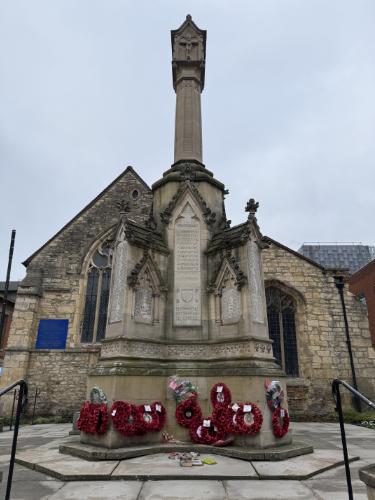
Lincoln Memorial
© Picture taken by South Lincolnshire War Memorials
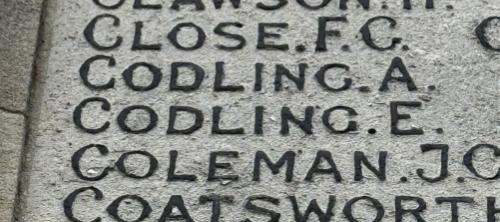
Lincoln Memorial
© Picture taken by South Lincolnshire War Memorials
Military Service Timeline
Unfortunately Albert’s full service records are not to be found, most likely destroyed during the warehouse fire in London in the Blitz that destroyed 60% of all WW1 service records. The following story tracks Albert’s life in the army from other available sources. We have also added some background information about the 4th Battalion that covers the period between his enlistment and the Battalion embarking for France.
The following information is taken from the History of The Lincolnshire Regiment by C R Simpson.
“At the outbreak of war the Lincolnshire Regiment was made up of 5 Battalions. The 1st and 2nd were the regular battalions, the 3rd Battalion was a militia battalion and the 4th and 5th Battalions were the territorial battalions.
The 4th Battalion was based at the Drill Hall in Lincoln whilst the 5th was based in the north of the county.
On the 25th of July, 1914, the 4th battalion (Lieut.-Colonel J.W. Jessop) and 5th Battalion (Lieut.-Colonel T.E. Sandall) were assembled at Bridlington for their usual annual
“Territorial Battalion” training, but on the 2nd of August, received orders to return to their Headquarters on the 3rd. By the afternoon of the 4th both battalions had returned to their respective Headquarters and been dismissed with orders to hold themselves in readiness to assemble at their Drill Halls on receipt of the hourly expected orders to mobilise. These came during the evening. The 5th, the first day of mobilisation, was one of great excitement and activity. At that early period only five Territorial battalions had signed the General Service obligation “ to serve overseas if required in time of national danger,” but on the declaration of war it was not long before the majority of Territorial units throughout the country volunteered for service overseas whenever they were required.
The first duties which fell to the lot of the Lincolnshire Territorials were to guard Grimsby Docks and Harbour, to protect the electric power station, wireless station at Weelsby and the construction of defences at the mouth of the Humber.
On the 10th of August, both battalions reported mobilisation complete and the following day they entrained for Belper, the War Station of the Lincolnshire and Leicestershire Brigade. For the next few days training consisted chiefly of route marching with full equipment. On the 15th, however, a move was made to Luton, which for several months was the home of the North Midland Division, the Lincolnshire being billeted in the town.
On the 15th of September, 1914, the Government called on the Territorials to volunteer for foreign service, and practically all battalions throughout the country answered the call, though for various reasons not all ranks could undertake overseas obligations: Units of which not less than sixty per cent. volunteered were designated “General Service”, and were ordered to recruit up to establishment and twenty-five per cent beyond it. As soon as units had obtained a sufficiently high percentage of volunteers for service overseas, a second unit of similar strength was formed : the latter were termed “ Second Line ” units; Later, “ Third Line ” units were formed. The original Territorial battalions then became known as the First Line units. Thus the original 4th and 5th Lincolnshire territorial Battalions became the 1/4th and 1/5th Battalions.”
The 1/4th and 1/5th Lincolnshire were eventually posted to the 138th (Lincoln and Leicester) Brigade, 46th (North Midlands) Division, and went to France with that formation in February 1915.
Part of the Battalion arrived in Havre on the 1st March, the other half embarking embarked on the Duchess of Argyll on the 2nd March. By the 3rd March the 2nd half of Battalion had arrived and billeted at Shed No6 at Pondicherry.
The Battalion formed again and after entraining at Harve in the evening arrived at Arneke at 2.30pm on the 4th March and marched 4 miles into Zuytpeene, about 10 miles from the Belgian border. They stayed here until the 9th March when they moved to Strazeele and then on to Sailly-sur-la-Lys.
On the 12th and 13th the Battalion were ordered to Stand To both days for a 2 hour notice of movement due to operational orders but nothing prevailed and they stayed in Sailly until the 16th. Upon leaving Sailly they were moved to Le Kirlem where they were trained in the attack and defence of trenches until the 26th both as brigade and also divisional training.
Finally after 26 days abroad the Battalion were moved to billets at the Brewery in Ploegsteert on the 27th march.
They were now attached to the Somerset Light Infantry for instruction in trench duties and 280 men of all ranks were employed during the day working for the Royal Engineers and another 80 men of ll ranks at night. One company in turn was placed in the trenches for 24 hours. This routine went on until the last day of the month with similar number of men assigned to digging by day (220), other duties by night (80) and with anywhere between one platoon and one company spending a day in the trenches.
It was Back to Le Kirlam for their four days away from the trenches and then on to Bailleul where officers joined the 5th Leicesters in the trenches. It would be another three days, 9th April, before the full Battalion was once again required for front line duty. Now based in Dranoutre they Battalion experienced their first full tour in the trenches and after 3 quiet days were subject to enemy shelling on the 13th April. The enemy shelled Frenchmens and Pond Farms and the Battalion reported their first casualties, Lieut Staniland and 3 privates killed and 6 wounded at Pond Farm. Later that night they were relieved by the 5th Leicesters and went back to billets 3/4 mile north of Dranoutre.
Their next tour started on the 18th when after a delay of one day, when they were ordered to stand to because of operations against hill 60, it was back to the same trenches with companies taking over Cookers, Cobb and packhorse Farms. This tour ended on the night of the 22nd but this time instead of returning to billets they were stood to at Lindenhoek waiting until he next day as 14 officers and 400 men of the Royal Irish Rifles were in their Billets. This last tour was deemed by the Battalion Adjutant as fairly quiet with only the loss of Lt W.B. Hirst despite being shelled by H.E. on their last day in the trench. They moved onto their billets the next day (24th April) and immediately C Company were on fatigue laying cable between Regentst and Picadillly. After only one day in the Billets the Battalion was back in the trenches until the month end. The Battalion Diary once again notes it as a quiet time with one visit in their trenches by the Officer Commanding North Midlands Division (46th Div).
For May and Albert’s last days we refer to the Battalion Diaries to tell the story.
May 1st 1915
Battalion in Huts at Locre. Interior Economy.
May 2nd 1915
In huts at Locre. A+D Companies on digging fatigue all night
May 3rd 1915
In huts at Locre. Interior Economy
May 4th 1915
Battalion relieved 5th Leicesters in evening. Relief completed 11:30pm
May 5th 1915
In the trenches. Bn HQ Cob Farm. Quiet Day
May 6th 1915
In the trenches. Quiet Day. Weather Hot
May 7th 1915
In the trenches. All night whole of front was wired completed 2:45am
May 8th 1915
In the trenches. Quiet day. Fire at R.E. Farm
Relieved by 5th Leicesters at midnight.
May 9th 1915
In huts at Locre. Lt Hall and Lt Fox reported from 2/4th Lincs Regt
Church Parade at 6pm
May 10th 1915
Left Locre at 7.45pm and relieved 5th Bn Sherwood Foresters at Lindenhoek at midnight. Bn HQ Lindenhoek Chalet.
Trenches occupied as follows F4 F6 – C Coy, F5-A Coy, G1,2+6 D Coy, S.P3-A Coy. In reserve-D Coy.
May 11th 1915
In the trenches. Quiet day.
May 12th 1915
In the trenches. Quiet day.
May 13th 1915
In the trenches. Enemy shelled our front line during afternoon + early evening. At 7pm they fired trench mortars (7) against G1+2 salient. They then directed machine gun fire at the breach made in the trench + shelled remainder of line. Under cover of this they sent across a party estimated at 20 men with bombs + explosive cylinders, 4 of which were afterwards found at the bottom of mine. The Battalion stood to all night + 5th Leicesters reinforced us with 1 Coy. 1 German (9th Bavarian Regiment) was left dead in G1. Nothing further took place.
The Battalion stayed in the trenches until the 16th when they were relieved by the 5th Leicesters.
On the 17th the Battalion diary notes that whilst they were in huts at Locre they observed a Zeppelin heading S.E at 5am and commented that it was most likely the one that dropped bombs on Ramsgate.
Sources
- WW1 Soldier’s Records (www.ancestry.co.uk)
- British Newspaper Archive.
- Fold 3
- Find My Past
- Genealogist
- Forces War Records
- British Army Service Numbers
- War Gratuity Calculator
- Commonwealth War Graves Commission
- National Archives – Battalion War Diaries
- General Registry Office
Last Updated – 19th February 2026